The spread of capitalism worldwide has made people wealthier than ever before. But capitalism’s future is far from assured. The global financial meltdown of 2008 nearly produced a great depression. Economies in Europe are still teetering. Income inequality, resource depletion, mass migrations from poor to rich countries, religious fundamentalism—these are just a few of the threats to continuing prosperity. How can capitalism be sustained? And who should spearhead the effort? Critics turn to government. In Capitalism at Risk, Harvard Business School professors Joseph Bower, Herman Leonard, and Lynn Paine argue that while governments must play a role, businesses should take the lead. For enterprising companies—whether large multinationals, established regional players, or small start-ups—the current threats to market capitalism present important opportunities. Capitalism at Risk draws on discussions with business leaders around the world to identify ten potential disruptors of the global market system. Presenting examples of companies already making a difference, the authors explain how business must serve both as innovator and activist—developing corporate strategies that effect change at the community, national, and international levels.Filled with rich insights, Capitalism at Risk presents a compelling and constructive vision for the future of market capitalism.
eBook - ePub
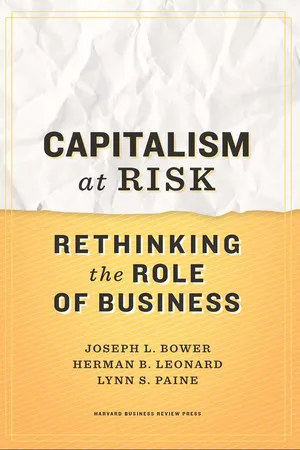
Capitalism at Risk
Rethinking the Role of Business
- 272 pages
- English
- ePUB (mobile friendly)
- Available on iOS & Android
eBook - ePub
About this book
Information
Part One
The Future of Market Capitalism
1
Introduction
AS FACULTY at Harvard Business School, we serve in an organization devoted to improving the leadership of business enterprise. Our school’s mission is “to develop leaders who make a positive difference in the world.” We do that with research that builds and communicates concepts useful to the managements of firms, by training the MBAs who go on to careers as business leaders, and by providing midcareer development programs for the top executives of companies.
In all this work, the faculty share a common, underlying set of beliefs that motivate our diverse approaches to our mission. Managers make their contribution to our society by guiding the organizations that provide goods and services to customers. For this contribution to be sustainable, the organizations must operate at a profit in the face of competition and a changing environment within the constraints of relevant laws and societal norms. Competitive markets—the invisible hand—insure that when firms behave this way, they are doing the best they can for society. That is the glory of the capitalist market system.
In that context, this book sets forth a radical proposition. We believe that the role of business needs to change. The capitalist market system has generated enormous wealth in recent decades, but if the system continues to operate more or less as it has been operating, then it is vulnerable to breaking down in serious ways. As we will discuss, plausible forecasts point to challenges on multiple fronts. To stanch these potentially disruptive forces and ensure that the system continues to function in an effective manner, we believe business must stop seeing itself as merely a self-regarding participant in a system that is largely “given”—or shaped and maintained by others—and start seeing itself as a leader in protecting and improving the system that gives it life.
We will argue that business must begin taking a more active role in assuring the market system’s ongoing health and sustainability. Much as we might wish to believe that the system will take care of itself through the magic of the invisible hand, we cannot in good conscience claim that narrow self-interest and competitive forces alone will ensure the system’s performance for society. But, unlike many writing in the aftermath of the financial crisis, we do not see government as the system’s savior, either. Good government is crucial, to be sure. But government, we will argue, needs the support and engagement of business to function effectively.
In the chapters that follow, we will share the research and reasoning behind our view and spell out the practical implications for companies and their leaders. We will offer concrete examples of what we have in mind when we call for business to take a leadership role in protecting and improving the system. We believe that today’s global enterprises—large and small, but especially large—are uniquely positioned to help address many of the most pressing challenges. Some of these challenges may lie beyond the current capabilities of most companies, but we are confident that with suitable leadership, they can acquire new knowledge and bring their talent and resources to bear on developing and implementing innovative solutions.
A Centennial Project
This book is the result of a project we launched as part of Harvard Business School’s centennial celebration. Initially, we viewed the approach of its hundredth birthday as a time to reflect on what the school had accomplished since its founding in 1908 as a training ground for managers of the railroads and other large industrial concerns that had arisen in the late nineteenth century. As envisioned by the university’s president and the prominent alumni who had urged the school’s creation, the school would prepare young men (young women were not mentioned) for a wholly new role in U.S. society—that of the professional manager. After a bumpy start and some trying periods, the school evolved as a source of training, research, and communication that eventually catalyzed the widespread growth of business schools across the United States and then, after World War II, around the globe.
Reflecting on the school’s past, we very quickly realized that in terms of the original vision, the school had far outstripped the imagination of its founders. By the fall of 2008, Harvard Business School had conferred the MBA degree on nearly fifty-six thousand aspirants, both male and female, including many who have gone on to head prominent companies in the United States and elsewhere around the world—as well as an array of government agencies, nonprofit organizations, and even countries. Whether or not management could be called a profession, knowledge had accumulated and pedagogy had progressed so that graduates came to their calling far better equipped to fill roles as general managers of companies and other organizations. One striking example lay in the contrast between the success rate of entrepreneurs with MBA training and those without. A study of ventures started by HBS MBAs found that they had a 50 percent chance of success, compared with the average of 10 percent.1 Moreover, although Harvard’s approach to teaching and research was unique in its commitment to case teaching and field research, many other business schools were developing capable graduates as well.
We concluded that an inquiry into what was on the minds of outstanding alumni would be more useful—and more interesting—than a self-congratulatory reflection on the past. As these leaders looked at the world around them and then ahead, what challenges did they see facing business that ought to provide the agenda for our school? In effect, if we were building a new school today, what areas would require attention? While that question is often asked by faculties when they are engaged in strategic planning, the answers they give typically reflect a subtle reframing of the question. They study what problems they should address, given the skill set of their faculty. We wanted to ask a different question: What did the best business leaders around the world think was important, and how did they view the health of the global market system? And since we were fortunate enough to be based at Harvard Business School, we had access to some of the very best business leaders and the resources to go talk to them. So we did.
We are longtime colleagues in the general management area at Harvard Business School, but we brought very different perspectives to this project. Joseph Bower and Herman “Dutch” Leonard are trained as economists; Lynn Paine’s formal training is in law and moral philosophy. Although we are all students of leadership, we have pursued this topic from different angles: Joe’s research has focused on corporate strategy and resource allocation; Dutch’s on business-government relations and corporate citizenship; and Lynn’s on ethics, culture, and corporate governance. In addition to teaching in the school’s educational programs, where we have interacted with thousands of MBA students and executives from all parts of the world, we have all worked as consultants to companies and served on corporate boards. Despite our diverse backgrounds, we all came to the project with a belief that as faculty members, we needed to lift our sights and take a dispassionate look at the future of the market capitalist system that has been the source of prosperity and wealth for so many during Harvard Business School’s first century.
In this spirit, we organized a series of forums in Europe, East Asia, Latin America, and the United States. We called on close business friends to recommend invitees, and in each region, we had a cohost who helped encourage participation. In the end, forty-six leaders took part in the meetings. Mostly CEOs (some had retired and taken other roles), the participants included Bertrand Collomb, longtime chairman of Lafarge; Sir David Scholey, CEO of S.G. Warburg and later vice chairman of UBS; Nancy Barry, CEO of Enterprise Solutions to Poverty; Victor Fung, chairman of Li & Fung; Ana Maria Diniz, president of Sykue Byoenergia; Jaime A. Zobel de Ayala, chairman of Ayala Corporation; Jorge Paulo Lemann, founder of Garantia and AmBev; Elaine Chao, U.S. Secretary of Labor; Carlos Cáceres, president of Instituto Libertad y Desarrollo, Chile; Jamie Dimon, chairman and CEO of JPMorgan Chase & Co.; and Jeff Immelt, chairman and CEO of General Electric. The full list of participants is provided in the appendix. Two other executives provided their views outside the forums proper.
The sample was certainly not random, and we did not even touch some important parts of the world, such as the countries of the former Soviet Union and Africa. What’s more, we were speaking with what some might call a biased sample, the winners in the past pattern of global progress. We did this, however, for a reason. We were asking a very specific question: If we stipulate that the system of market capitalism has been the source of remarkable economic growth, what problems might undermine that growth in the future? What aspects of the system at the level of firms, industries, nations, or multilateral institutions might cause serious difficulties? The people we were asking understood the system well and were viewing it from perspectives as varied as New York, Caracas, Turin, and Brunei. Each individual had decades of experience with global markets as well as considerable interaction with government leaders. They understood what they needed in order to function.
A Working Definition of Market Capitalism
Before describing the forums, we should perhaps say something about our definition of market capitalism, since it is the future of that system that we are examining. (We will take up this topic at length in chapter 4.) In general, we have in mind an economic system characterized by these key features:
- Private ownership of personal and enterprise assets
- Adequate provision of physical security for life and property
- The sanctity of private contracts
- A banking system that provides a sound currency
- Prices set by independent enterprise
- Free trade among nations
As will become clear in chapter 4, we also include important facilitating conditions such as:
- An educated population
- Good public health
- An effective legal system
- Effective and accountable government
Different countries have developed a variety of arrangements for providing these elements. The United States, for example, takes a highly decentralized approach, relying heavily on the fifty states to make laws and provide services to the populace. Moreover, the U.S. Constitution provides for a unique degree of individual liberty. This approach has led historically to the delegation of schooling to the states, but also to political suspicion of centralized economic intervention, for example, in resistance to the creation of a national bank. From Andrew Jackson’s presidency in the early nineteenth century to today, there has been fierce political resistance to both central direction and strict regulation of the banking system. At the same time, the United States has a long tradition of federal support for enterprise, going back more than two hundred years. “No taxation without representation” was as much a reaction to the British unwillingness to support American land speculators against the French in the Ohio territories and beyond as it was a reaction to taxes on tea.2
In contrast, France, Germany, and Japan all have strong central governments that are deeply involved not only in education and health but also in banking and industrial policy. Furthermore, ownership of enterprise is more complicated, given the importance of large complexes of enterprise with interlocking holdings. Through their various holdings and other relationships, companies such as Banque Nationale de Paris, Allianz, and Mitsubishi have had outsized influence in the management of their economies. How that influence is used, however, is considerably constrained by a communitarian ideology that many in the United States would find . . . well, foreign.
When we consider the so-called BRIC countries—Brazil, Russia, India, and China—the picture gets even more complicated. In these nations, state ownership of enterprise remains an active element of national economic strategy rather than a vestige of past arrangements. China has identified a group of national champions such as CNOOC, Ltd., and Haier; these companies look like independent enterprises but are partially owned by elements of the state and have the full backing of the state as long as their objectives align with those of the nation. Other companies, such as Baosteel, China National Building Materials, and China Mobile, are wholly owned by the state but have subsidiaries that are partly owned by the shareholding public. Brazil and India provide different versions of a mixed approach to ownership and regulation. Finally, Russian heavy industry is either privately owned by politically subservient oligarchs or, like Gazprom, state owned. Just as the United States controls where its high-tech firms sell their advanced technology products, Russia controls the terms on which Gazprom sells gas.
As these examples suggest, drawing sharp boundaries around what is—and is not—market capitalism in practice is not a straightforward exercise. Key elements are present to a greater or lesser degree in different countries, and some observers would argue that the rules of market capitalism are themselves in flux. Some countries are clearly outliers, embracing some features of the market system but rejecting others and at times behaving in ways that challenge the system. But even countries strongly committed to market capitalism will override market principles from time to time. National economic arrangements are inevitably embedded in a national political system that modifies those arrangements to reflect what its political leaders consider necessary for political stability. For example, George W. Bush’s administration—ideologically committed to free markets—imposed new barriers to trade with Canadian lumber producers and supported old barriers against Pakistani textiles in order to maintain political majorities in the United States, despite strong ideolog...
Table of contents
- Cover
- Title
- Copyright
- Preface and Acknowledgments
- Part One: The Future of Market Capitalism
- Part Two: How Business Can Lead
- Appendix: Participants in Regional Business Leader Forums
- Notes
- About the Authors
Trusted by 375,005 students
Access to over 1.5 million titles for a fair monthly price.
Study more efficiently using our study tools.
Frequently asked questions
Yes, you can cancel anytime from the Subscription tab in your account settings on the Perlego website. Your subscription will stay active until the end of your current billing period. Learn how to cancel your subscription
No, books cannot be downloaded as external files, such as PDFs, for use outside of Perlego. However, you can download books within the Perlego app for offline reading on mobile or tablet. Learn how to download books offline
Perlego offers two plans: Essential and Complete
- Essential is ideal for learners and professionals who enjoy exploring a wide range of subjects. Access the Essential Library with 800,000+ trusted titles and best-sellers across business, personal growth, and the humanities. Includes unlimited reading time and Standard Read Aloud voice.
- Complete: Perfect for advanced learners and researchers needing full, unrestricted access. Unlock 1.5M+ books across hundreds of subjects, including academic and specialized titles. The Complete Plan also includes advanced features like Premium Read Aloud and Research Assistant.
We are an online textbook subscription service, where you can get access to an entire online library for less than the price of a single book per month. With over 1.5 million books across 990+ topics, we’ve got you covered! Learn about our mission
Look out for the read-aloud symbol on your next book to see if you can listen to it. The read-aloud tool reads text aloud for you, highlighting the text as it is being read. You can pause it, speed it up and slow it down. Learn more about Read Aloud
Yes! You can use the Perlego app on both iOS and Android devices to read anytime, anywhere — even offline. Perfect for commutes or when you’re on the go.
Please note we cannot support devices running on iOS 13 and Android 7 or earlier. Learn more about using the app
Please note we cannot support devices running on iOS 13 and Android 7 or earlier. Learn more about using the app
Yes, you can access Capitalism at Risk by Joseph L. Bower, Herman B. Leonard, Lynn S. Paine in PDF and/or ePUB format, as well as other popular books in Business & Management. We have over 1.5 million books available in our catalogue for you to explore.