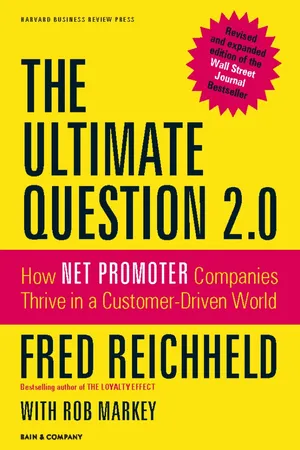
In the first edition of this landmark book, business loyalty guru Fred Reichheld revealed the question most critical to your company’s future: "Would you recommend us to a friend?” By asking customers this question, you identify detractors, who sully your firm’s reputation and readily switch to competitors, and promoters, who generate good profits and true, sustainable growth.You also generate a vital metric: your Net Promoter Score. Since the book was first published, Net Promoter has transformed companies, across industries and sectors, constituting a game-changing system and ethos that rivals Six Sigma in its power.In this thoroughly updated and expanded edition, Reichheld, with Bain colleague Rob Markey, explains how practitioners have built Net Promoter into a full-fledged management system that drives extraordinary financial and competitive results. With his trademark clarity, Reichheld:• Defines the fundamental concept of Net Promoter, explaining its connection to your company’s growth and sustained success
• Presents the closed-loop feedback process and demonstrates its power to energize employees and delight customers
• Shares new and compelling stories of companies that have transformed their performance by putting Net Promoter at the center of their businessPractical and insightful, The Ultimate Question 2.0 provides a blueprint for long-term growth and success.
eBook - ePub
The Ultimate Question 2.0 (Revised and Expanded Edition)
How Net Promoter Companies Thrive in a Customer-Driven World
- 224 pages
- English
- ePUB (mobile friendly)
- Available on iOS & Android
eBook - ePub
The Ultimate Question 2.0 (Revised and Expanded Edition)
How Net Promoter Companies Thrive in a Customer-Driven World
About this book
Information
Part One
The Fundamentals of the Net Promoter System
1
Bad Profits, Good Profits, and the Ultimate Question
Most companies these days are striving to focus more closely on their customers—to become more customer-centric. Little surprise here: we live and work in a Web-savvy world in which customers have near-perfect information. Only companies that put the customer at the very center of their operations can successfully compete in such a world.
Many companies also want to make themselves more mission driven than profit driven. Again, no surprise. Their leaders understand that they can’t win and keep customers without first winning and keeping the best possible employees. And most talented employees want to pursue a mission, a purpose that transcends profits for shareholders.
But despite all the effort companies have put into these twin tasks, focusing on customers and inspiring employees, the vast majority of firms haven’t made much progress. Their cultures remain staunchly profit-centric, ruled by financial budgets and accounting metrics. Managers must make their numbers; business-unit heads, their sales and profit goals. Chief financial officers must report quarterly earnings to Wall Street. Leaders know the catechism of customer centricity, and most can recite it by heart. Question: why do we want loyal customers? Answer: because loyal customers come back more often, buy additional products and services, refer their friends, provide valuable feedback, cost less to serve, and are less price sensitive. But what leaders track, discuss, and manage each day are the financial indicators.
This is a major disconnect. Our accounting systems—both financial and management accounting—don’t have anything to say about feelings of loyalty, enthusiasm, repeat purchases, referrals, and all the other emotions and behaviors that determine the economics of individual customers. Executives and employees know how to meet their immediate financial goals, and they know they will be held accountable for doing so. But customer loyalty and the company’s mission, as objectives, are soft, slippery, seemingly impossible to quantify. In the rush of daily decisions and priorities, of budget pressures and sales quotas and cost accounting, the gravitational pull toward short-term profits is powerful. And so companies, despite the best of intentions, drift into a vortex. They begin making decisions that alienate customers and employees. They spend too much time focusing on the wrong things. They allow themselves to be seduced by the easy lure of what can only be called bad profits.
Consider some examples.
Bad Profits
The year was 1992. Computer users were growing more numerous by the day, and the online services business was booming. A brash young company known as America Online, or AOL, seemed poised for takeoff. Thanks to an initial public offering of stock, AOL had more than $60 million in its coffers.
AOL wanted to spend that money on growth—and the path to growth, its executives decided, was to invest in customer acquisition. So over the next several years, the company carpet-bombed the United States with free software diskettes that allowed computer users to try out the service. It tucked the diskettes into the pages of magazines. It packaged them with the snacks served to airline passengers. It inserted them in cereal boxes and displayed them at the checkout stands of grocery stores. Most of the diskettes wound up in trash containers and then in landfills, and AOL’s marketing campaign became a kind of national joke. Still, enough people signed up that the company could declare its strategy a success. Membership grew from 350,000 in early 1993 to about 4 million by the end of 1995.
Unfortunately, AOL’s management team at the time wasn’t spending commensurate amounts on improving the company’s service capacity. Soon the flood of new users was straining the company’s operating network. AOL earned a new nickname, “America On Hold.” A full-day blackout in the summer of 1996—the longest in a series of service interruptions around this time, as it turned out—made headlines across the country and frustrated millions of members. AOL’s monthly customer churn rate rose to 6 percent, an annual rate of 72 percent. Searching for a way to boost current earnings, AOL began to inundate customers with irritating pop-up ads and sales pitches. Though the company’s membership continued to grow, more and more customers grew frustrated and disillusioned with what AOL was offering.
In January 2000, AOL merged with Time Warner, in a stunning deal that initially valued AOL at more than $190 billion. But it wasn’t long before AOL began to stumble. Broadband was spreading rapidly, and AOL lost many customers to broadband service providers. It even lost some to dial-up competitors MSN and Earthlink. AOL shifted its strategy to become a free content provider, more like Yahoo! and Google, with much of its support provided by advertisers. But it continued to annoy its customers. People who wanted to complain or terminate their contracts, for instance, struggled to find the carefully hidden 800 number. If they did succeed in finding it and actually reached an operator, they got a sales pitch to extend their contract instead of the service they were seeking. “Long ago,” wrote Randall Stross in the New York Times in late 2005, “the company’s culture became accustomed to concentrating energy on trapping customers who wished to leave.”1 In 2006, a disgruntled customer recorded a call with AOL in which he attempted to quit the service and was stonewalled at every turn. The recording went viral on the Internet, and once again AOL was a national joke.
In late 2009, Time Warner finally gave up on the AOL brand, spinning it off to shareholders at a valuation of $3.2 billion—a destruction of roughly $187 billion in shareholder value in just nine years.
Too many companies these days are like AOL back then. They want to make the most of their innovations. They want to build a great brand with world-class loyalty. But they can’t tell the difference between good profits and bad. As a result, they let themselves get hooked on bad profits.
The consequences are disastrous. Bad profits choke off a company’s best opportunities for true growth, the kind of growth that is both profitable and sustainable. They blacken its reputation. The pursuit of bad profits alienates customers and demoralizes employees.
Bad profits also make a business vulnerable to competitors. Companies that are not addicted—yes, there are many—can and do zoom right past the bad-profits junkies. If you ever wondered how Enterprise Rent-A-Car was able to overcome big, well-entrenched companies to become number one in its industry, how Southwest Airlines and JetBlue Airways so easily steal market share from the old-line carriers, or how Vanguard soared to the top of the mutual fund industry, that’s your answer. These companies manage to balance the need for profits with the overarching vision of providing great results for customers and an inspiring mission for employees. They have figured out how to avoid bad profits, and their revenues and reputations have flourished.
The cost of bad profits extends well beyond a company’s boundaries. Bad profits provide a distorted picture of business performance. The distortion misleads investors, yielding poor resource decisions that hurt our economy. Bad profits also tarnish the position of business in society. That tarnished reputation undermines consumer trust and provokes calls for stricter rules and tighter regulations. So long as companies pursue bad profits, all the noisy calls for better business ethics are pretty much meaningless.
By now you’re probably wondering how in heaven’s name profit, that holy grail of the business enterprise, can ever be bad. Short of outright fraud, isn’t one dollar of earnings as good as another? Certainly, accountants can’t tell the difference between good and bad profits. All those dollars look the same on an income statement.
While bad profits don’t show up on the books, they are easy to recognize. They’re profits earned at the expense of customer relationships.
Whenever a customer feels misled, mistreated, ignored, or coerced, profits from that customer are bad. Bad profits come from unfair or misleading pricing. Bad profits arise when companies shortchange customers the way AOL did, by delivering a lousy experience. Bad profits are about extracting value from customers, not creating value. When sales reps push overpriced or inappropriate products onto trusting customers, the reps are generating bad profits. When complex pricing schemes dupe customers into paying more than necessary to meet their needs, those pricing schemes are contributing to bad profits.
You don’t have to look far for examples. Financial services firms, for instance, like to throw around terms like fiduciary and trust in their advertising campaigns, but how many firms deserve these monikers? Mutual funds bury their often exorbitant administrative fees in the fine print, so that customers won’t know what they’re paying. Brokerage firms slant their research to support investment-banking clients, thus bilking their stock-buying clients. Retail banks charge astonishing fees for late payments or bounced checks. The resentment toward financial institutions after the 2008 economic meltdown was so pronounced that it spawned legislation to protect consumers from predatory practices.
Or take health care. No wonder the market doesn’t work and governments have had to step in. Most U.S. hospitals won’t reveal the deals they have cut with insurance companies, so consumers can’t know the real price of any particular procedure. If the regulations established by the 2010 reform law should be postponed or overturned—their fate is uncertain at this writing—most insurers will continue to do their best to exclude people who might actually need coverage; and whatever the outcome, if you do have coverage, they’re sure to drown both you and your doctor in a deluge of complicated paperwork. Many pharmaceutical companies pay doctors to push their drugs, while carefully quashing studies suggesting that a potentially lucrative new drug may be ineffective or dangerous. And many health maintenance organizations promise to provide cradle-to-grave coverage, yet balk at paying for many procedures their own physicians recommend.
Travelers face their own set of inhospitable tactics. They must pay most airlines $100 to change a ticket and as much as $100 for an extra piece of checked baggage. If they are so foolish as to use a hotel phone, they may find they have run up charges larger than the room rate. If they return most rental cars with less than a full tank, they will be charged more than triple the market price for the fill-up. Of course, they also have the option of buying a full tank at the beginning of the rental and then trying to manage their mileage so precisely that only fumes remain—they get no credit for unused gas.
At times, customers must conclude that businesspeople lie awake nights thinking up new ways to hustle them. Most airlines change their prices frequently—often by hundreds of dollars—so nobody can know what the “real” fare is. Banks develop algorithms that process the largest checks first each day, so that depositors will be hit with more insufficient-funds penalties. Many mobile-phone operators have created pricing plans that cleverly trap customers into wasting prepaid minutes or incurring outrageous overages. In 2010, one Boston-area family hit the headlines because it had received a monthly bill for $18,000 from its wireless provider—all because the family’s college-age son had unwittingly downloaded a stream of data to his phone after the introductory rate had expired. If only the father had been encouraged to sign up for the $150 unlimited data plan, he could have avoided three years of haggling over that bill.
Ironically, the best customers often get the worst deals. If you are a patient, loyal user of your telephone or cable company, your mobile-phone provider, and your Internet service company, chances are good that you are paying more than disloyal switchers who signed up more recently. In fact, you’re probably paying more than you need to, regardless of when you signed up, just because you didn’t know about some special package the company offers. Customers who discover an extra charge of $20, say, for using text messaging might find that unlimited text messaging is available for $5 per month—if only they had asked for it in advance.
How Bad Profits Undermine Growth
Bad profits work much of their damage through the detractors they create. Detractors are customers who feel badly treated by a company—so badly that they cut back on their purchases, switch to the competition if they can, and warn others to stay away from the company they feel has done them wrong.
Detractors don’t show up on any organization’s balance sheet, but they cost a company far more than most of the liabilities that traditional accounting methods so carefully tally. Customers who feel ignored or mistreated find ways to get even. They drive up service costs by reporting numerous problems. They demoralize frontline employees with their complaints and demands. They gripe to friends, relatives, colleagues, acquaintances—anyone who will listen, sometimes including journalists, regulators, and legislators. Detractors tarnish a firm’s reputation and diminish its ability to recruit the best employees and customers. Today, negative word of mouth goes out over a global PA system. In the past, the accepted maxim was that every unhappy customer told ten friends. Now an unhappy customer can tell ten thousand “friends” through the Internet.
Detractors strangle a company’s growth. If many of your customers are bad-mouthing you, how are you going to get more? If many of your customers feel mistreated, how can you persuade them to buy more from you? In 2002, surveys showed that a whopping 42 percent of AOL customers were detractors. No wonder the company was on a downward spiral. Right now, churn rates in many industries—cellular phones, credit cards, auto insurance, and cable TV—have deteriorated to the point where a company may lose half of its new customers in less than three years. People have to fly whichever airline takes them where they want to go, but many airlines have created so much ill will that customers are itching for alternatives. For a while, US Airways dominated many routes into and out of Baltimore-Washington International Airport (BWI). By 1993, its market share at BWI had reached 41 percent. With this market power, the airline was able to charge high fares while delivering mediocre service. Customer resentment grew, but there were few options: if you wanted a nonstop flight, you often had to take what US Airways offered. Then Southwest Airlines entered the market with lower fares, superior service, and none of those irritating bad-profit tactics. Travelers flocked to the new carrier, and even when US Airways dropped prices to match Southwest, the customer exodus continued. By 2010, Southwest had corralled a 53 percent share of the market at BWI, while US Airways’ share had diminished to only 6 percent.
True growth is hard to find these days. How hard? A recent study by Bain & Company found that only 9 percent of the world’s major firms achieved real, sustainable profit and revenue growth of even 5.5 percent a year over the ten-year period from 1999 to 2009.2 It seems like no coincidence that so many companies are having trouble growing and so many companies are addicted to bad profits. To change metaphors, business leaders have become master mechanics in siphoning out current earnings, but they fumble for the right wrench when it comes to gearing up for growth.
Granted, companies can always buy growth, just as AOL did. They can encourage the hard sell and pay fat commissions to the salespeople who master it. They can discount heavily, offering temporary rebates, sales, or “free” financing. They can launch heavy advertising and promotional campaigns. And of course, they can make acquisitions. All such techniques may boost revenues, but only for a while. It’s also true that many factors usually contribute to a troubled company’s downfall: AOL was hurt, for instance, by the increasing popularity of broadband as well as by its seeming disregard of the customer experience. But technologies and strategies are always changing, and companies that listen to their accountants more closely than to their customers are likely to find it hard to make a transition to a new business model.
Consider the experience of Blockbuster. Once a thriving, successful company, it had a leading market share in the video rental business. As video rentals gave way to online rentals and video on demand, it might have morphed into an equally successful company in an adjacent market—as a competitor to Netflix, for instance, or even as an owner of movie theaters. But Blockbuster was addicted to bad profits and thus had more than its share of detractors. Rent a movie for a long weekend for only $5.99! But if you return it even an hour late, the fee is doubled. And if you forget to return it for a week, you might owe more than $40. In our town, the Blockbuster store had no serious competition, so customers had to put up with this nasty practice. But they often took out their frustration on the store’s clerks, which made it harder to attract good employees. Soon the store was understaffed and the checkout lines long. The aisles were cluttered with DVDs that were never properly sorted. More and more customers were accused of failing to return videos. More and more accounts were turned over to collection agencies.
If Blockbuster had built a loyal customer base, it would have had a strong set of strategic options. But it chose to fund its growth with bad profits. What may have seemed like smart pricing tactics ended up alienating customers and employees and set the stage for the company’s rapid decline: Blockbuster’s share of the movie rental business dropped quickly, its losses mounted, and its market value plummeted. Despite management changes, it was never able to recover, and in 2010 it had to file for bankruptcy.
Shifting technology and resulting new business models don’t have to sound the death knell for companies, as Netflix illustrates. Netflix went out of its way to avoid bad profits. It developed innovative ways to make its Web site more customer friendly. It eschewed late fees and “gotcha” pricing tactics, and it invested heavily in creating great customer service. If customers lost a DVD, they faced no threats from collection agencies; they simply had to explain the circumstances. Netflix trusted them unless and until an unreasonable number of recurrences demon...
Table of contents
- Cover
- Title Page
- Copyright
- Dedication
- Contents
- Preface
- Introduction: From Score to System
- Part One: The Fundamentals of the Net Promoter System
- Part Two: Getting Results
- Appendix: Advice for the Journey
- Notes
- Acknowledgments
- About the Authors
Trusted by 375,005 students
Access to over 1.5 million titles for a fair monthly price.
Study more efficiently using our study tools.
Frequently asked questions
Yes, you can cancel anytime from the Subscription tab in your account settings on the Perlego website. Your subscription will stay active until the end of your current billing period. Learn how to cancel your subscription
No, books cannot be downloaded as external files, such as PDFs, for use outside of Perlego. However, you can download books within the Perlego app for offline reading on mobile or tablet. Learn how to download books offline
Perlego offers two plans: Essential and Complete
- Essential is ideal for learners and professionals who enjoy exploring a wide range of subjects. Access the Essential Library with 800,000+ trusted titles and best-sellers across business, personal growth, and the humanities. Includes unlimited reading time and Standard Read Aloud voice.
- Complete: Perfect for advanced learners and researchers needing full, unrestricted access. Unlock 1.5M+ books across hundreds of subjects, including academic and specialized titles. The Complete Plan also includes advanced features like Premium Read Aloud and Research Assistant.
We are an online textbook subscription service, where you can get access to an entire online library for less than the price of a single book per month. With over 1.5 million books across 990+ topics, we’ve got you covered! Learn about our mission
Look out for the read-aloud symbol on your next book to see if you can listen to it. The read-aloud tool reads text aloud for you, highlighting the text as it is being read. You can pause it, speed it up and slow it down. Learn more about Read Aloud
Yes! You can use the Perlego app on both iOS and Android devices to read anytime, anywhere — even offline. Perfect for commutes or when you’re on the go.
Please note we cannot support devices running on iOS 13 and Android 7 or earlier. Learn more about using the app
Please note we cannot support devices running on iOS 13 and Android 7 or earlier. Learn more about using the app
Yes, you can access The Ultimate Question 2.0 (Revised and Expanded Edition) by Fred Reichheld, Rob Markey in PDF and/or ePUB format, as well as other popular books in Business & Management. We have over 1.5 million books available in our catalogue for you to explore.