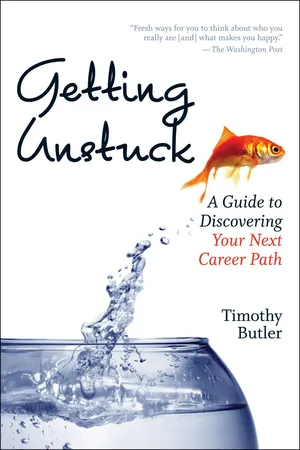
You will experience psychological impasse many times in your life. During these times, you have the sensation that you’re stuck or paralyzed. You’re convinced that something must change, whether in your work or personal life. Though this feeling is normal, you need to move beyond it. Failure to "get unstuck” can put your career and personal life—as well as the healthy functioning of your team or organization—at risk.In Getting Unstuck, business psychologist and researcher Timothy Butler offers strategies for moving beyond a career or personal-life impasse—by recognizing the state of impasse, awakening your imagination, recognizing patterns of meaning in your life, and taking action for change.Drawing on a wealth of stories about individuals who have successfully transitioned out of impasses, Getting Unstuck provides a practical, authoritative road map for moving past your immediate impasse—and defining a meaningful path forward.
- 240 pages
- English
- ePUB (mobile friendly)
- Available on iOS & Android
eBook - ePub
About this book
Information
Topic
Personal DevelopmentSubtopic
Business DevelopmentPART I
Impasse
Faced with a crisis at work or in our personal life, we try to push our way forward using our old views and methods. Soon we realize this is not working and find ourselves at a dead end. Energy and inspiration begin to evaporate; our conviction seems less certain. We begin to hear the stinging voice of our inner critic and old doubts about our ability and our direction return. We seem to be both sinking and moving backward. These feelings at first may bring alarm, but we must come to recognize them as signals that an important process is beginning. Being at impasse is a developmental necessity. It can lead to a new way of understanding and a new type of information. We have arrived at an important frontier.
ONE
Facing Crisis
IT WAS AN AFTERNOON in late spring, a few weeks before her graduation from the Sloan School of Management at MIT, and Marcy Kaufman was feeling unsettled.1 Sitting in my office, she leaned forward in her chair, her short blonde hair framing an alert expression and a direct gaze. I knew this alertness well, and how it could change in a moment from pensive reflection to a mischievous smile. But today her look was more serious; she wanted to know if she could continue counseling with me after graduation.
Marcy was no stranger to big changes or unsettling times. Bright, athletic, and full of energy, she had a history of taking things straight on. She grew up in Los Angeles, the only girl in a family of sports-oriented boys. Her brothers admired her tomboy toughness and let her into their rough-and-tumble crowd. When high school became boring, she arranged to graduate early, at sixteen, and spend six months traveling alone on a bus tour of Africa. At eighteen she enrolled at California Institute of Technology and majored in computer science. She excelled on all fronts. At five feet ten inches tall, she was a standout on the basketball team. She was also a star student and maintained a wide circle of friends. In business graduate school, she enjoyed her classes, her summer internship, and her time with her classmates.
Now twenty-seven, she had arrived at a place that, at least for the moment, seemed far less certain. She had a boyfriend, Henry, but it was not clear just where that stop-and-go relationship was headed. He was working in New England and so, for the time being, she planned to stay in the greater Boston area. But doing what? Marcy had come to MIT because leadership seemed to be her destiny, but, as for many of her fellow students, the best path toward that destiny was not clear. The job market was good, but as Marcy went from interview to interview she was not sure what she was trying to accomplish. Was she looking for the best job or the least bad job that would allow her to stay with Henry? She was no longer a software engineer, but what then was she?
My clients, unique as they are, all come to me for the same reason: they are stuck. They are uncertain about what to do to move closer to a more fulfilling work or life situation. Marcy was at such an impasse. She had “come to the end of her thinking,” and found herself at an uncomfortable crossroads. She felt torn between following her classmates in pursuing high-paying jobs in prestigious firms and her desire to make the relationship with Henry work. Beneath this tension was another source of stress that was even more unsettling, in that it was far more vague and harder to describe. It was more a feeling in the pit of her stomach than a problem that she could formulate and bring to a counselor.
What I as a career counselor and psychotherapist could see, but Marcy could not, is that as we live our lives, things don’t happen in a straight line, a little bit at a time, day by day. Growth as a person does not occur in a predictable and sequential fashion. Many times a path comes to an abrupt halt, only to continue again at a different place, at a different level. Our lives unfold more like that of the caterpillar and butterfly than we are perhaps ready to acknowledge. An impasse like Marcy’s was the first step in changing her very idea about what she really wanted and about how happiness might come into her world.
To understand this, it can be helpful to think of the worlds we inhabited as seven-year-olds and as seventeen-year-olds. Our lives in our second decade are not continuations of our childhood in a bigger body, but are different altogether. The transition to adolescence brought with it a crisis; the seven-year-old’s way of finding happiness in the world simply no longer worked. With struggle, we were able to forge a whole new perspective and a whole new agenda. The lines of our childhood worlds were broken, and new lines began at a very different place on the page. And this sense of disjunction and radical change happens again and again. When we talk about a childhood and adolescence and adulthood, or about Picasso in his Rose Period and then in his Blue Period, or about the early recordings of Miles Davis and then his last, in a real sense we are talking about almost different characters in each case. The change has been that radical and the life being experienced is that different.
In recent decades, developmental psychologists have created highly useful theoretical models of these necessary disjunctures in human development.2 Our concern here, however, is not theoretical. What does it mean to be, like Marcy, at the very point of the break? How do we find a new line of travel? If we simply try our old ways of understanding, it becomes painfully clear that the crisis is deepening.
The Black Sun
Both Greek and Celtic mythology include a mysterious image known as the “Black Sun,” which can be visualized as tremendous energy radiating from a dense and dark center. (Celtic myths sometimes place it in the center of the earth.) And it stands in contrast to the metaphoric qualities we commonly associate with the sun: The brightness of day gives life its warmth. Good things must be close by when we rise to a sunny morning.
But the idea behind the ancient Black Sun image is that energy and life radiate from darkness as well. Some kinds of energy that we need for growth and for a complete life come only from the experience of darkness. This Black Sun is a hidden resource, a font of energy that is available if we recognize it for what it is and know how to turn toward it and accept it. Being dark, its energy is hidden. We cannot explain it in the same way we can explain things in the light of the more familiar sun. The wisdom and energy it brings are less obvious, less rational.
Myths illuminate subtle aspects of the human condition and human development. The Black Sun tells us that there is value in slowing down and being patient when things seem dark and unclear. Do not run from such experiences, it says. Turn toward the difficult time. By just focusing on it and sticking with it we will discover power that radiates from it as surely as warming light radiates from the daytime sun.
The Black Sun is an apt metaphor for the deep concentration and inward focus that precedes the actual act of writing the poem, founding the company, forming the sculpture, or jumping into a radically different role at work. In all of these cases, we do not operate “in the light” or “from the light”; instead, we are going where we have not been before and are trusting an intuition that seems to rise from the depths of our selves. The successful artist and the successful businessperson alike learn how to stay with this process of being stuck in the darkness; in fact, they stick with it until a new momentum emerges from the very experience of being stuck, of being in the dark.
The problem, of course, is that we are afraid of the dark. We want to move in the sunshine, walk along familiar streets, and have experiences that are sure to give us pleasure. We want to feel that most of life can be planned and that we have a reasonable chance of avoiding pain. The idea of staying with things just as they are, without a plan, of suspending our model of how things work, puts us at a frontier of unknowing, which is to say at a place that is “dark” to our previous conception of things, to our plan for ourselves and our notion of how everything works. We avoid this dim frontier, and so we stay stuck.
Being in the dark, at an impasse, is not clinical depression. (It is important to know the difference, though; appendix B describes how to differentiate the two.) Sometimes we can’t help seeing impasse as failure, rather than as a necessary crisis in the service of larger creative movement. There is a danger of internalizing the experience of impasse as evidence of personal deficiency, as a statement about our self-worth. This can be painful. We may need the help of a friend, coach, or counselor to reflect the reality of the situation back to us and remind us that this is tough time and not a statement about who we are in the core of our being.
Impasse
When Marcy started to see me regularly after her graduation, she was not depressed in the clinical sense of the term. Her world, however, did seem flat rather than round and full. She sensed something was missing, and this feeling was all the more pronounced because she had always experienced life rushing forward, and had always known great confidence and youthful vitality.
Marcy had accepted a job in sales, an unusual choice for Sloan graduates, who more often choose positions in professional services firms or corporations that call on the strategic skills taught in the MBA curriculum. Marcy was ambivalent about her choice. She was working for a relatively small company that provided professional employees, mostly information technology specialists, on a temporary basis. She was going on the road regionally to analyze the computer programming and computer support employment needs of potential clients. She was the only woman on the sales force, but this in itself was neither new nor daunting. In fact, Marcy enjoyed the “one of the guys” camaraderie; it reminded her of times with her undergraduate buddies at their fraternity and of hanging out with her brothers before that. No, the problem was that she just wasn’t very excited generally and could not see how this work would take her toward the management roles she had envisioned when she applied to MIT.
The most creative people I know have learned, over time, to feel more at home during these times of impasse. Not that they like the experience of feeling slowed down or stuck; like all of us they enjoy the thrill of being in motion on a new project or venture. But they no longer expend energy in avoiding the experience of impasse and, most important, they no longer fear this experience. They have cultivated a capability to experience darker and heavier times as part of a larger cycle of creativity and change. They no longer identify with impasse; they are able to say, “This condition, this feeling state is “something I am going through,” rather than “something I am.”
But most of us, like Marcy, have not learned how to turn toward the Black Sun and realize the energy that is latent in times of crisis and impasse. We leave that to the poet, painter, or songwriter. (See Deep Dive: The Feeling of Impasse.)
My sessions with Marcy, alternating between career questions and uncertainties she had about her relationship with Henry, began to turn her toward the uncertainties of her Black Sun period of change. Between talk of career and relationship, as she let herself drop down into the experience of impasse, Marcy shared something else: her father was dying of cancer. I was more interested in this than she. She would grow quiet when we turned to this topic. It was not as if she were actively avoiding talking about her father, it was just that she did not have words for it. She was not in denial; she was just stuck. Her father, a computer scientist himself, was clearly an impor...
Table of contents
- Cover
- Copyright
- Dedication
- Acknowledgments
- Introduction
- Part I: Impasse
- Part II: Vision
- Part III: Getting Unstuck
- Appendix A: Continuing the Journey
- Appendix B: A Note on Impasse and Depression
- Appendix C: Scoring the One Hundred Jobs Exercise
- Notes
- About the Author
Trusted by 375,005 students
Access to over 1.5 million titles for a fair monthly price.
Study more efficiently using our study tools.
Frequently asked questions
Yes, you can cancel anytime from the Subscription tab in your account settings on the Perlego website. Your subscription will stay active until the end of your current billing period. Learn how to cancel your subscription
No, books cannot be downloaded as external files, such as PDFs, for use outside of Perlego. However, you can download books within the Perlego app for offline reading on mobile or tablet. Learn how to download books offline
We are an online textbook subscription service, where you can get access to an entire online library for less than the price of a single book per month. With over 1.5 million books across 990+ topics, we’ve got you covered! Learn about our mission
Look out for the read-aloud symbol on your next book to see if you can listen to it. The read-aloud tool reads text aloud for you, highlighting the text as it is being read. You can pause it, speed it up and slow it down. Learn more about Read Aloud
Yes! You can use the Perlego app on both iOS and Android devices to read anytime, anywhere — even offline. Perfect for commutes or when you’re on the go.
Please note we cannot support devices running on iOS 13 and Android 7 or earlier. Learn more about using the app
Please note we cannot support devices running on iOS 13 and Android 7 or earlier. Learn more about using the app
Yes, you can access Getting Unstuck by Timothy Butler in PDF and/or ePUB format, as well as other popular books in Personal Development & Business Development. We have over 1.5 million books available in our catalogue for you to explore.