More than a decade ago, Robert S. Kaplan and David P. Norton introduced the Balanced Scorecard, a revolutionary performance measurement system that allowed organizations to quantify intangible assets such as people, information, and customer relationships. Then, in The Strategy-Focused Organization, Kaplan and Norton showed how organizations achieved breakthrough performance with a management system that put the Balanced Scorecard into action.Now, using their ongoing research with hundreds of Balanced Scorecard adopters across the globe, the authors have created a powerful new tool--the "strategy map"--that enables companies to describe the links between intangible assets and value creation with a clarity and precision never before possible. Kaplan and Norton argue that the most critical aspect of strategy--implementing it in a way that ensures sustained value creation--depends on managing four key internal processes: operations, customer relationships, innovation, and regulatory and social processes. The authors show how companies can use strategy maps to link those processes to desired outcomes; evaluate, measure, and improve the processes most critical to success; and target investments in human, informational, and organizational capital. Providing a visual "aha!" for executives everywhere who can't figure out why their strategy isn't working, Strategy Maps is a blueprint any organization can follow to align processes, people, and information technology for superior performance.
eBook - ePub
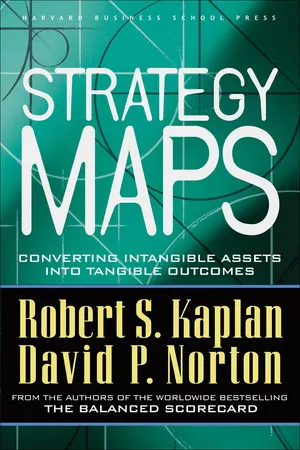
Strategy Maps
Converting Intangible Assets into Tangible Outcomes
- 480 pages
- English
- ePUB (mobile friendly)
- Available on iOS & Android
eBook - ePub
About this book
Information
P A R T O N E
Overview
C H A P T E R O N E
INTRODUCTION
Even though we manage everyone’s competencies, we had been biased toward the high-skill jobs. The identification of strategic job families brought something to the forefront that we wouldn’t have seen otherwise…. It showed us an entry-level job that was just as important. The benefits of focusing on this job will be huge.
Paul Smith, director of human resources at Gray-Syracuse, was commenting on a new training program that would rapidly upgrade its thirty assemblypersons on a broad set of new competencies. Gray-Syracuse is a world-class producer of precision casting parts for highly engineered products used in aircraft engines, power generation equipment, and missiles. Senior management, after developing a Balanced Scorecard (BSC) and strategy map for its new strategy, had learned that the front end of the production process was a major opportunity to reduce rework and improve quality. The entry-level operators of this process, mold assemblypersons, had the greatest impact on reducing rework and decreasing the lead time from product idea to customer delivery. The company focused its limited training dollars on these critical few employees and cut the time to achieve strategic objectives in half.
The Gray-Syracuse example shows how companies can now focus their human capital investments and, more generally, their investments in all intangible assets to create distinctive and sustainable value. All organizations today create sustainable value from leveraging their intangible assets—human capital; databases and information systems; responsive, high-quality processes; customer relationships and brands; innovation capabilities; and culture. The trend away from a product-driven economy, based on tangible assets, to a knowledge and service economy, based on intangible assets, has been occurring for decades. Even after the bursting of the NASDAQ and dot-com bubbles, intangible assets—those not measured by a company’s financial system—account for more than 75 percent of a company’s value (see Figure 1-1). The average company’s tangible assets—the net book value of assets less liabilities—represent less than 25 percent of market value.
What’s true of companies is even truer for countries. Some countries, such as Venezuela and Saudi Arabia, have high physical resource endowments but have made poor investments in their people and systems. As a consequence, they produce far less output per person, and experience much slower growth rates, than countries such as Singapore and Taiwan that have few natural resources but invest heavily in human and information capital and effective internal systems.1 At both the macroeconomic and microeconomic levels, intangible assets drive long-term value creation.
STRATEGY
An organization’s strategy describes how it intends to create value for its shareholders, customers, and citizens. If an organization’s intangible assets represent more than 75 percent of its value, then its strategy formulation and execution need to explicitly address the mobilization and alignment of intangible assets, the subject of this book.
Figure 1-1 The Increasing Importance of Intangible Assets

We, and our colleagues, have worked with more than 300 organizations over the past dozen years, helping them to develop and implement Balanced Scorecards. We have learned that the Balanced Scorecard is a powerful management tool. A measurement system gets everyone’s attention. For maximum impact, therefore, the measurement system should focus on the entity’s strategy—how it expects to create future, sustainable value. In designing Balanced Scorecards, therefore, an organization must measure the critical few parameters that represent its strategy for long-term value creation.
In our practice, however, we observed that no two organizations thought about strategy in the same way. Some described strategy by their financial plans for revenue and profit growth, others by their products or services, others by targeted customers, others from a quality and process orientation, and still others from a human resources or learning perspective. These views were one-dimensional. This narrowness was further amplified by the background of the individuals on the executive team. CFOs viewed strategy from a financial perspective; sales and marketing executives took a customer perspective; operations people looked at quality, cycle time, and other process perspectives; human resources professionals focused on investments in people; and CIOs on information technology. Few had a holistic view of their organization.
We found little help on a holistic framework from the prevailing wisdom of management thought leaders. Strategic doctrines existed around shareholder value,2 customer management,3 process management,4 quality,5 core capabilities,6 innovation,7 human resources,8 information technology,9 organizational design,10 and learning.11 While each provides deep insights, none provides a comprehensive and integrated view for describing a strategy. Even Michael Porter’s approach, based on positioning for competitive advantage, does not provide a general representation of strategy.12 Executives who have successfully executed strategy—Lou Gerstner at IBM, Jack Welch at GE, Richard Teerlink at Harley-Davidson, and Larry Bossidy at GE, Allied Signal, and Honeywell—provide a wealth of experiential insights, but not a consistent way to represent strategy.13 A generally accepted way to describe strategy did not exist.
Consider the consequences. Without a comprehensive description of strategy, executives cannot easily communicate the strategy among themselves or to their employees. Without a shared understanding of the strategy, executives cannot create alignment around it. And, without alignment, executives cannot implement their new strategies for the changed environment of global competition, deregulation, customer sovereignty, advanced technology, and competitive advantage derived from intangible assets, principally human and information capital.
In The Strategy-Focused Organization, we noted a study of failed strategies, which concluded, “in the majority of cases—we estimate 70 percent—the real problem isn’t [bad strategy]… it’s bad execution.”14 A more recent study by Bain & Company examined the performance of large companies (defined as companies earning revenues in excess of $500 million) in seven developed countries—the United States, Australia, the United Kingdom, France, Germany, Italy, and Japan—during the best ten years ever in economic history, 1988 to 1998. Only one out of eight of these companies enjoyed at least a 5.5 percent real cumulative annual growth rate in earnings while also earning shareholder returns above their cost of capital. More than two-thirds of these companies had strategic plans with targets calling for real growth in excess of 9 percent. Fewer than 10 percent of these companies achieved this target.15 Clearly, most companies don’t succeed in implementing their strategies. In contrast to this bleak record, organizations that made the Balanced Scorecard the cornerstone of their management systems, as we described in The Strategy-Focused Organization, beat these odds. They implemented new strategies effectively and rapidly. They used the Balanced Scorecard to describe their strategies and then linked their management systems to the Balanced Scorecard and, hence, to their strategies. They demonstrated a fundamental principle underlying the Balanced Scorecard: “If you can measure it, you can manage it.”
Describing Your Strategy
In order to build a measurement system that describes the strategy, we need a general model of strategy. Carl von Clausewitz, the great military strategist of the nineteenth century, stressed the importance of a framework to organize thinking about strategy.
The first task of any theory is to clarify terms and concepts that are confused…. Only after agreement has been reached regarding terms and concepts can we hope to consider the issues easily and clearly and expect to share the same viewpoint with the reader.16
The Balanced Scorecard offers just such a framework for describing strategies for creating value. The BSC framework (see Figure 1-2) has several important elements.
- Financial performance, a lag indicator, provides the ultimate definition of an organization’s success. Strategy describes how an organization intends to create sustainable growth in shareholder value.
- Success with targeted customers provides a principal component for improved financial performance. In addition to measuring the lagging outcome indicators of customer success, such as satisfaction, retention, and growth, the customer perspective defines the value proposition for targeted customer segments. Choosing the customer value proposition is the central element of strategy.
- Internal processes create and deliver the value proposition for customers. The performance of internal processes is a leading indicator of subsequent improvements in customer and financial outcomes.
- Intangible assets are the ultimate source of sustainable value creation. Learning and growth objectives describe how the people, technology, and organization climate combine to support the strategy. Improvements in learning and growth measures are lead indicators for internal process, customer, and financial performance.
- Objectives in the four perspectives link together in a chain of cause-and-effect relationships. Enhancing and aligning intangible assets leads to improved process performance, which, in turn, drives success for customers and shareholders.
The framework for value creation in public-sector and nonprofit organizations (see the right side of Figure 1-2) is similar to the private-sector framework described above, but with several important distinctions. First, the ultimate definition of success for public and nonprofit organizations is their performance in achieving their mission. Private-sector organizations, regardless of industry sector, can use a homogeneous financial perspective: Increase shareholder value. Public-sector and nonprofit organizations, however, span a broad and diverse set of missions and hence must define their social impact, their high-level objective, differently. Examples of missions include: “Improve the prospects of children growing up today in low-income communities” (Teach for America); “Ensure the long-term future of opera” (Boston Lyric Opera); and “Safe Homes, Safe Communities” (Royal Canadian Mounted Police).
Figure 1-2 Strategy Maps: The Simple Model of Value Creation

The mission for these organizations, as in the private-sector model, is achieved through meeting the needs of targeted customers (or constituents or stakeholders, as some of these organizations describe the people who benefit from their services). The organizations create success through internal process performance that is supported by their intangible assets (learning and growth). The fiduciary perspective, while not dominant, refle...
Table of contents
- Cover
- Copyright
- Dedicaton
- Preface
- PART ONE: OVERVIEW
- PART TWO: VALUE-CREATING PROCESSES
- PART THREE: INTANGIBLE ASSETS
- PART FOUR: BUILDING STRATEGIES AND STRATEGY MAPS
- PART FIVE: THE CASE FILES
- About the Authors
Trusted by 375,005 students
Access to over 1.5 million titles for a fair monthly price.
Study more efficiently using our study tools.
Frequently asked questions
Yes, you can cancel anytime from the Subscription tab in your account settings on the Perlego website. Your subscription will stay active until the end of your current billing period. Learn how to cancel your subscription
No, books cannot be downloaded as external files, such as PDFs, for use outside of Perlego. However, you can download books within the Perlego app for offline reading on mobile or tablet. Learn how to download books offline
Perlego offers two plans: Essential and Complete
- Essential is ideal for learners and professionals who enjoy exploring a wide range of subjects. Access the Essential Library with 800,000+ trusted titles and best-sellers across business, personal growth, and the humanities. Includes unlimited reading time and Standard Read Aloud voice.
- Complete: Perfect for advanced learners and researchers needing full, unrestricted access. Unlock 1.5M+ books across hundreds of subjects, including academic and specialized titles. The Complete Plan also includes advanced features like Premium Read Aloud and Research Assistant.
We are an online textbook subscription service, where you can get access to an entire online library for less than the price of a single book per month. With over 1.5 million books across 990+ topics, we’ve got you covered! Learn about our mission
Look out for the read-aloud symbol on your next book to see if you can listen to it. The read-aloud tool reads text aloud for you, highlighting the text as it is being read. You can pause it, speed it up and slow it down. Learn more about Read Aloud
Yes! You can use the Perlego app on both iOS and Android devices to read anytime, anywhere — even offline. Perfect for commutes or when you’re on the go.
Please note we cannot support devices running on iOS 13 and Android 7 or earlier. Learn more about using the app
Please note we cannot support devices running on iOS 13 and Android 7 or earlier. Learn more about using the app
Yes, you can access Strategy Maps by Robert S. Kaplan, David P. Norton in PDF and/or ePUB format, as well as other popular books in Business & Forecasting. We have over 1.5 million books available in our catalogue for you to explore.