How is Saddam Hussein like Tony Blair? Or Kenneth Lay like Lou Gerstner? Answer: They are, or were, leaders. Many would argue that tyrants, corrupt CEOs, and other abusers of power and authority are not leaders at all--at least not as the word is currently used. But, according to Barbara Kellerman, this assumption is dangerously naive. A provocative departure from conventional thinking, Bad Leadership compels us to see leadership in its entirety. Kellerman argues that the dark side of leadership--from rigidity and callousness to corruption and cruelty--is not an aberration. Rather, bad leadership is as ubiquitous as it is insidious--and so must be more carefully examined and better understood. Drawing on high-profile, contemporary examples--from Mary Meeker to David Koresh, Bill Clinton to Radovan Karadzic, Al Dunlap to Leona Helmsley--Kellerman explores seven primary types of bad leadership and dissects why and how leaders cross the line from good to bad. The book also illuminates the critical role of followers, revealing how they collaborate with, and sometimes even cause, bad leadership. Daring and counterintuitive, Bad Leadership makes clear that we need to face the dark side to become better leaders and followers ourselves. Barbara Kellerman is research director of the Center for Public Leadership and a lecturer in public policy at the Kennedy School of Government, Harvard University.
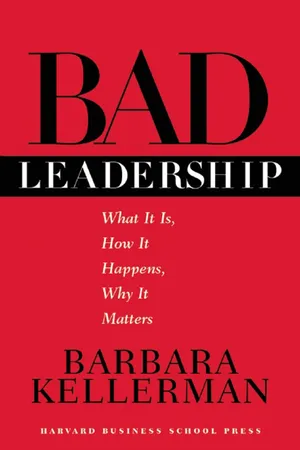
- 304 pages
- English
- ePUB (mobile friendly)
- Available on iOS & Android
eBook - ePub
About this book
Information
PART ONE
THE BAD Side
But I’d shut my eyes in the sentry box,
So I didn’t see nothin’ wrong.
So I didn’t see nothin’ wrong.
—Rudyard Kipling
CHAPTER ONE
Claiming the Bad Side
WHEN HE WAS INSTALLED as president of Harvard University in October 2001, Lawrence Summers delivered a speech in which he declared that “in this new century, nothing will matter more than the education of future leaders and the development of new ideas.”1 In this single sentence the new head of Harvard made at least two important assumptions: that people can be educated in ways that relate to being leaders, and in ways that relate to being good leaders.
This kind of positive thinking explains why leadership education has become a big business. The “leadership industry”—so tagged because in recent years it has grown so big so fast—is dedicated to the proposition that leadership is a subject that should be studied and a skill that should be taught. To meet the burgeoning demand for leadership education and training, a cadre of experts has emerged. These leadership scholars, teachers, consultants, trainers, and coaches work on the optimistic assumption that to develop leaders is to develop a valuable human resource.
The academic work that supports the leadership industry generally shares this positive bias. The titles of many of the best and most popular leadership books of the past twenty years send messages that make the point. Targeted primarily at those in the corporate sector, they include Thomas J. Peters and Robert H. Waterman’s In Search of Excellence: Lessons from America’s Best-Run Companies;2 Rosabeth Moss Kanter’s The Change Masters: Innovation & Entrepreneurship in the American Corporation ;3 Warren Bennis and Burt Nanus’s Leaders: The Strategies for Taking Charge;4 John Kotter’s A Force for Change: How Leadership Differs from Management;5 Noel Tichy’s The Leadership Engine: How Winning Companies Build Leaders at Every Level; 6 and Jay Conger and Beth Benjamin’s Building Leaders: How Successful Companies Develop the Next Generation.7 Each of these books assumes that people can learn to be leaders and that to be a leader is to be a person of competence and character.
Good cheer of this kind is in even greater evidence among those who write for the general public. Authors such as Steven Covey, Kenneth Blanchard, and Spencer Johnson continue to sell tens of millions of books that suggest that you too can learn how to be a (good) leader, and in no time flat.8
By now such optimism has come to pervade not only American schools of business but also American schools of government. On the reasonable assumption that if leadership education makes sense for graduate students entering the private sector, it also makes sense for those entering the public and nonprofit sectors, schools of government now offer courses on how to manage and how to lead. Moreover, even though bad political leadership is as ubiquitous as bad business leadership, the prevailing view of leadership is rather relentlessly positive. As John Gardner wrote in the first of a series of highly influential leadership essays, “In our culture popular understanding of the term [leadership] distinguishes it from coercion—and places higher on the scale of leadership those forms involving lesser degrees of coercion.”9
In this book I argue that there’s something odd about the idea that somehow leadership can be distinguished from coercion, as if leadership and power were unrelated. In the real world, in everyday life, we come into constant contact not only with good leaders and good followers doing good things but also with bad leaders and bad followers doing bad things. In fact, anyone not dwelling in a cave is regularly exposed, if only through the media, to people who exercise power, use authority, and exert influence in ways that are not good. Still, even after all the evidence is in—after the recent corporate scandals, after the recent revelations of wrongdoing by leaders of the Roman Catholic Church, and before, during, and after political leadership all over the world that is so abhorrent it makes us ill—the idea that some leaders and some followers are bad, and that they might have something in common with good leaders and followers, has not fully penetrated the conversation or the curriculum.
The positive slant is recent. Historically, political theorists have been far more interested in the question of how to control the proclivities of bad leaders than in the question of how to promote the virtues of good ones. Influenced by religious traditions that focused on good and evil, and often personally scarred by war and disorder, the best political thinkers have had rather a jaundiced view of human nature.
Machiavelli provides perhaps the best example. He did not wrestle with the idea of bad—as in coercive—leadership. He simply presumed it. He took it for granted that people do harm as well as good, and so his advice to princes, to leaders, was to be ruthless. Consider this morsel about how leaders should, if need be, keep followers in line: “Cruelties can be called well used (if it is permissible to speak well of evil) that are done at a stroke, out of the necessity to secure oneself, and then are not persisted in but are turned to as much utility for the subjects as one can. Those cruelties are badly used which, though few in the beginning, rather grow with time.”10
As the Gardner quotation makes plain, today leaders who use coercion are generally judged to be bad. But to Machiavelli, the only kind of bad leader is the weak leader. Machiavelli was a pragmatist above all, familiar with the ways of the world and with a keen eye for the human condition. And so, to him, the judicious use of cruelty was an important arrow in the leader’s quiver.
Although it seems counterintuitive, America’s founders thought like Machiavelli, at least insofar as they also believed that people required restraint. They were products of the European Enlightenment, but as they saw it, their main task was to form a government that was for and by the people but that would simultaneously set limits on the body politic and on those who would lead it.
To be sure, the emphasis was different. Whereas Machiavelli was concerned primarily with the question of how to contain followers, the framers of the U.S. Constitution were concerned primarily with the question of how to contain leaders. Alexander Hamilton, for example, was, in comparison with his peers, a proponent of a strong executive. But even he considered it ideologically important as well as politically expedient to focus not on the possibilities of presidential power but on its limits.
In The Federalist Papers, Hamilton acknowledged America’s “aversion to monarchy”—to leaders who inherit great power. He dedicated an entire essay to distinguishing between the proposed president, on the one hand, and the distant, detested British monarchy, on the other, an essay that made one main point: The U.S. Constitution would absolutely preclude the possibility that bad leadership could become entrenched. The very idea of checks and balances grew out of the framers’ presumption that unless there was a balance of power, power was certain to be abused. Put another way, the American political system is the product of revolutionaries familiar with, and therefore wary of, bad leadership.
But as sociologist Talcott Parsons observed, on matters that relate to the importance of power and authority in human affairs, American social thought has tended toward utopianism.11 For whatever reasons, most students of politics shy away from the subject of bad leadership and especially from really bad leaders, such as Stalin and Pol Pot. In other words, no matter how great and obvious its impact on the course of human affairs, “tyranny as such is simply not an issue or a recognized term of analysis.”12
The question is, why do we tend toward utopianism on matters relating to the importance of power and authority in human affairs?13 Why do we avoid the subject of tyranny in our leadership curricula, thereby presuming that tyrannical leadership is less relevant to the course of human affairs than democratic leadership? Why does the leadership industry generally assume that a bad leader such as Saddam Hussein has nearly nothing in common with a good leader such as Tony Blair, or that the Nazis were one species and the Americans another? Is Bernard Ebbers really so very different from Louis Gerstner Jr.? How did leadership come to be synonymous with good leadership?14 Why are we afraid to acknowledge, much less admit to, the dark side?
These are the questions to which I now turn.
The Light Side
We want to read books about good leaders such as John Adams, Jack Welch, and Nelson Mandela. We don’t want to read books about bad leaders such as Warren Harding, David Koresh, and Robert Mugabe.
This preference is natural. We go through life accentuating the positive and eliminating the negative in order to be as healthy and happy as possible. As Daniel Goleman put it, “[O]ur emotional and physical well-being is based in part on artful denial and illusion.” In other words, for us to cultivate an “unfounded sense of optimism” serves a purpose. It is in our self-interest.15
In the leadership industry, this disposition has now moved from the level of the individual to the level of the collective. Those of us engaged in leadership work seem almost to collude to avoid the elephant in the room—bad leadership.16 We resist even considering the possibility that the dynamic between Franklin Delano Roosevelt and his most ardent followers had anything in common with the dynamic between Adolph Hitler and his most ardent followers; or that John Biggs, the admired former CEO of TIAA/CREF, has skills and capacities similar in some ways to those of Richard Scrushy, the disgraced former CEO of HealthSouth.
As we have seen, the human predisposition to denial and optimism does not stop everyone from assuming the role of the hard-nosed pragmatist. Machiavelli and Hamilton understood that the human animal cannot be relied on to be good, and they prescribed accordingly. So what happened in the recent past to explain why the leadership industry and the general public have become positively disposed?
Reason 1: The Use of Language
In 1978 James MacGregor Burns, a Pulitzer Prize–winning historian and political scientist of impeccable repute, published Leadership, a book now widely regarded as seminal. The time was right. Even in higher education, there was growing support for the idea that “great men” mattered; and in the wake of Vietnam and Watergate and the assassinations of John Kennedy, Robert Kennedy, and Martin Luther King, Jr., Americans were increasingly persuaded that there was a “crisis of leadership.”
Because the book itself was impressive, because for decades there had been nearly no good work on leadership per se, and because Leadership was published just as questions about governance in America became urgent, Burns’s work had considerable impact. In fact, his two types of leadership—transactional and transformational—became part of the leadership lingo among those interested in both political and corporate leadership.
Thus the way in which Burns chose to define the words leader and leadership mattered. “Leadership over human beings is exercised when persons with certain motives and purposes mobilize . . . resources so as to arouse, engage, and satisfy the motives of followers,” he wrote. “This is done in order to realize goals mutually held by leaders and followers.” Burns was unwilling to call those who “obliterate” followers “leaders.” Instead he labeled them “power wielders.” “Power wielders,” Burns argued, “may treat people as things. Leaders may not.”17
The fact that Burns’s book came out just when the leadership industry was beginning to grow also explains his strong impact on how people understood the word leadership. Even now it is Burns’s particular definition of leadership—a definition that excludes leaders who, even though they may exercise power, authority, or influence, fail to “arouse, engage, and satisfy the motives of followers”—that dominates the field. Warren Bennis, one of the gurus of corporate leadership, has taken a semantic stance similar to B...
Table of contents
- Title Page
- Copyright Page
- Dedication
- Epigraph
- Table of Contents
- Acknowledgments
- INTRODUCTION - Webs OF Significance
- PART ONE - THE BAD Side
- PART TWO - Leading Badly
- PART THREE - From Bad to Better
- Notes
- Index
- About the Author
Trusted by 375,005 students
Access to over 1.5 million titles for a fair monthly price.
Study more efficiently using our study tools.
Frequently asked questions
Yes, you can cancel anytime from the Subscription tab in your account settings on the Perlego website. Your subscription will stay active until the end of your current billing period. Learn how to cancel your subscription
No, books cannot be downloaded as external files, such as PDFs, for use outside of Perlego. However, you can download books within the Perlego app for offline reading on mobile or tablet. Learn how to download books offline
Perlego offers two plans: Essential and Complete
- Essential is ideal for learners and professionals who enjoy exploring a wide range of subjects. Access the Essential Library with 800,000+ trusted titles and best-sellers across business, personal growth, and the humanities. Includes unlimited reading time and Standard Read Aloud voice.
- Complete: Perfect for advanced learners and researchers needing full, unrestricted access. Unlock 1.5M+ books across hundreds of subjects, including academic and specialized titles. The Complete Plan also includes advanced features like Premium Read Aloud and Research Assistant.
We are an online textbook subscription service, where you can get access to an entire online library for less than the price of a single book per month. With over 1.5 million books across 990+ topics, we’ve got you covered! Learn about our mission
Look out for the read-aloud symbol on your next book to see if you can listen to it. The read-aloud tool reads text aloud for you, highlighting the text as it is being read. You can pause it, speed it up and slow it down. Learn more about Read Aloud
Yes! You can use the Perlego app on both iOS and Android devices to read anytime, anywhere — even offline. Perfect for commutes or when you’re on the go.
Please note we cannot support devices running on iOS 13 and Android 7 or earlier. Learn more about using the app
Please note we cannot support devices running on iOS 13 and Android 7 or earlier. Learn more about using the app
Yes, you can access Bad Leadership by Barbara Kellerman in PDF and/or ePUB format, as well as other popular books in Business & Leadership. We have over 1.5 million books available in our catalogue for you to explore.