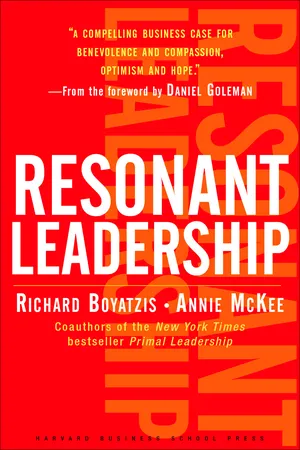
The blockbuster best seller Primal Leadership introduced us to "resonant" leaders--individuals who manage their own and others' emotions in ways that drive success. Leaders everywhere recognized the validity of resonant leadership, but struggled with how to achieve and sustain resonance amid the relentless demands of work and life. Now, Richard Boyatzis and Annie McKee provide an indispensable guide to overcoming the vicious cycle of stress, sacrifice, and dissonance that afflicts many leaders. Drawing from extensive multidisciplinary research and real-life stories, Resonant Leadership offers a field-tested framework for creating the resonance that fuels great leadership. Rather than constantly sacrificing themselves to workplace demands, leaders can manage the cycle using specific techniques to combat stress, avoid burnout, and renew themselves physically, mentally, and emotionally. The book reveals that the path to resonance is through mindfulness, hope, and compassion and shows how intentionally employing these qualities creates effective and enduring leadership. Great leaders are resonant leaders. Resonant Leadership offers the inspiration--and tools--to spark and sustain resonance in ourselves and in those we lead.
eBook - ePub
Resonant Leadership
Renewing Yourself and Connecting with Others Through Mindfulness, Hope and CompassionCompassion
- 304 pages
- English
- ePUB (mobile friendly)
- Available on iOS & Android
eBook - ePub
Resonant Leadership
Renewing Yourself and Connecting with Others Through Mindfulness, Hope and CompassionCompassion
About this book
Information
N O T E S
Chapter One
1.Emotional intelligence, resonance, and results: See Daniel Goleman, Richard Boyatzis, and Annie McKee, Primal Leadership: Realizing the Power of Emotional Intelligence (Boston: Harvard Business School Press, 2002).
2. Ibid.
Chapter Two
1. “Eduardo”: Although a real person, we have used a pseudonym to protect the person from the embarrassing aspects of his story. Throughout the book, we will use a first name, in quotes the first time we mention him or her, to denote when a pseudonym is used.
2. Emotional reality: See Daniel Goleman, Richard Boyatzis, and Annie McKee, Primal Leadership: Realizing the Power of Emotional Intelligence (Boston: Harvard Business School Press, 2002). The concept has been expanded by Annie McKee and Fran Johnston in “The Impact and Opportunity of Emotion in Organizational Development” in The NTL Handbook of Organizational Development and Change (San Francisco: John Wiley & Sons/Pfeiffer, 2005).
3. Colleen Barrett and Southwest Airlines: Author conversation with Colleen Barrett, 2004. Much of the information about Colleen Barrett was gathered through author interviews and correspondence, 2004–2005.
4. Emotional intelligence and results: With Daniel Goleman, we have presented numerous studies of the impact of EI and results in Primal Leadership. See also Benjamin Schneider and David Bowen, Winning the Service Game (Boston: Harvard Business School Press, 1995).
5. “The Most Powerful Women in Business,” Fortune, October 13, 2003: 103–108.
6. Limbic contagion: Explained by Thomas Lewis, Fari Amini, and Richard Lannon in A General Theory of Love (New York: Random House, 2000). People do catch emotions from one another, and they catch them in particular from people they pay a lot of attention to, like leaders. For more on this, see Richard Petty, Leandre Fabriger, and Duane Wegener, “Emotional Factors in Attitudes and Persuasion,” in Handbook of Affective Sciences, ed. Richard J. Davidson, Klaus R. Sherer, and H. Hill Goldsmith (New York: Oxford University Press, 2003), 752–772.
7. Contagion of emotions: See Elaine Hatfield, John Cacioppo, and Richard Rapson, Emotional Contagion (New York: Cambridge University Press, 1994); also see Paul Ekman, Joseph J. Campos, Richard J. Davidson, and Frans DeWaals, Emotions Inside Out, Annals of the New York Academy of Sciences, vol. 1000 (New York: New York Academy of Sciences, 2003); and Lyndall Strazdins, “Emotional Work and Emotional Contagion,” in Emotions in the Workplace: Research, Theory and Practice, ed. Neal Ashkanasy, Wilfred Zerbe, and Charmine Hartel (Westport, CT: Quorum Books, 2000), 232–250.
8. Facial expression of emotion: See Paul Ekman, Emotions Revealed: Recognizing Faces and Feelings to Improve Communication and Emotional Life (New York: Henry Holt, 2004).
9. Emotions and communication: See Alfons O. Hamm, Harald T. Schupp, and Almut I. Weike, “Motivational Organization of Emotions: Autonomic Changes, Cortical Responses, and Reflex Modulation,” in Davidson, Scherer, and Goldsmith, Handbook of Affective Sciences, 187–211.
10. Watching the leader’s emotions: Ekman, Emotions Revealed (2004); for more on this see Daniel Goleman, Destructive Emotions: How Can We Overcome Them? A Scientific Dialogue with the Dalai Lama (New York: Bantam Books, 2003).
11. Catching the message even when it is nonverbal: See Thomas Lewis, Fari Amini, and Richard Lannon and their book A General Theory of Love (2000); Paul Ekman, “Should We Call It Expression or Communication?” in Innovation in Social Science Research 10, (1997): 333-344; and John Gottman, Robert Levenson, and Erica Woodin, “Facial Expression During Marital Conflict,” in Journal of Family Communication 1, (2001): 37–57.
12. Reading the leader’s mood: Anthony T. Pescosolido, “The Leader’s Emotional Impact in Work Groups” (PhD diss., Case Western Reserve University, 2000).
13. Blood pressure rising when working for supervisors with negative styles: Nadia Wager, George Fieldman, and Trevor Hussey, “The Effect on Ambulatory Blood Pressure of Working Under Favorably and Unfavorably Perceived Supervisors,” Occupational Environmental Medicine 60 (2003): 468–474.
14. Southwest’s customer service relationships: Angela Vargo, Public Relations Specialist, Measurement and Evaluation, Southwest Airlines, was very helpful and insightful in our work with Southwest.
15. The link between emotions, attitudes, and behavior: For an overview on many studies linking emotions, attitude, and behavior, see Joseph P. Forgas, “Affective Influences on Attitudes and Judgments” in Davidson, Scherer, and Goldsmith, Handbook of Affective Sciences, 563–573.
16. Insulting offers and emotional response: Alan Sanfey, James Rilling, Jessica Aronson, Leigh Nystrom, and Jonathon Cohen, “The Neural Basis of Economic Decision-making in the Ultimatum Game,” Science 300, no. 5626 (2003): 1755–1758.
17. Destructive emotions: Goleman, Destructive Emotions. In this book, renowned scientists and monks, including His Holiness the Dalai Lama, discussed the definition of destructive emotions. According to B. Alan Wallace, “Destructive emotions are those emotions that are harmful to oneself or others” (p. 53). Owen Flanagan posits that a western view of destructive states of mind includes “… low self-esteem, overconfidence, harboring negative emotions (e.g., anger, fear, jealousy and envy), lack of compassion, and an inability to have close interpersonal relations” (p. 67). Matthieu Ricard notes that from the Buddhist perspective, “ … a destructive emotion—which is also referred to as an ‘obscuring’ or ‘afflictive’ mental factor—is something that prevents the mind from ascertaining reality as it is” (p. 75); he goes on to say that “Such emotional states impair one’s judgment, the ability to make a correct assessment of things. … Thus, obscuring emotions impair one’s freedom by chaining thoughts in a way that compels us to think, speak, and act in a biased way” (pp. 75–76).
18. Emotional intelligence and leadership competencies: The study of leadership competencies has a long and distinguished history, arguably beginning with David McClelland’s early work (see David C. McClelland, “Testing for Competence Rather Than Intelligence,” American Psychologist 28 (1973): 14–31). This work has been carried further by Richard Boyatzis, Lyle Spencer, Cary Cherniss, Daniel Goleman, and Annie McKee, as well as many other academic researchers and practitioners. See Richard Boyatzis, The Competent Manager: A Model for Effective Performance (New York: John Wiley & Sons, 1982); Lyle Spencer Jr. and Signe Spencer, Competence at Work: Models for Superior Performance (New York: John Wiley & Sons, 1993); and Cary Cherniss and Mitchel Adler, Promoting Emotional Intelligence in Organizations: Make Training in Emotional Intelligence Effective (Washington, DC: American Society of Training and Development, 2000). The foundational research has been extended considerably over the past ten years, and our work and the work of countless colleagues indicates that a set of competencies related to emotional intelligence are distinguishing factors in great leadership. See Daniel Goleman, Working with Emotional Intelligence, (New York: Bantam, 1998) for an early review of the theory and research and Goleman, Boyatzis, and McKee, Primal Leadership, for extension of the theory and more recent research.
19. Emotional intelligence, leadership style, and resonance: See Daniel Goleman, “What Makes a Leader?” Harvard Business Review (November–December 1998): 92–102; and Goleman, Boyatzis, and McKee, Primal Leadership. Also see Daniel Goleman, Richard Boyatzis, and Annie McKee, “Primal Leadership: The Hidden Driver of Great Performance,” Harvard Business Review (December 2001): 42–51. For a discussion of clustering of these abilities or competencies, see Richard Boyatzis, Daniel Goleman, and Kenneth Rhee, “Clustering Competence in Emotional Intelligence: Insights from the Emotional Competence Inventory (ECI),” in Handbook of Emotional Intelligence, ed. Reuven Bar-On and James D. A. Parker (San Francisco: Jossey-Bass, 2000), 343–362.
20. Pattern recognition: This cognitive competency is, like competencies related to emotional intelligence, a defining factor in differentiating outstanding leaders from their more average peers. See Boyatzis, The Competent Manager; Spencer and Spencer, Competence at Work; Peter Senge, The Fifth Discipline (New York: Currency Doubleday, 1994); Richard Boyatzis, “Using Tipping Points of Emotional Intelligence and Cognitive Competencies to Predict Financial Performance of Leaders,” Psicothemia (in press). See also Dominic Massaro, “A Pattern Recognition Account of Decision-making,” in Memory & Cognition 22, (1994): 616–627
21. The link between emotion, cognition, and action: See Daniel Goleman, Emotional Intelligence (New York: Bantam, 1995), Goleman, Boyatzis, and McKee, Primal Leadership.
Chapter Three
1. Leadership requires the use of power: John Kotter, Power in Management: How to Understand, Acquire, and Use It (New York: AMACOM Press, 1979); John Kotter, The General Managers (New York: Free Press, 1982); David McClelland, Power: The Inner Experience (New York: Irvington Press, 1975); Gary A. Yukl, Leadership in Organizations, 5th edition (Upper Saddle River, NJ: Prentice Hall, 2001) and Gary A. Yukl and David Van Fleet, “Theory and Research on Leadership in Organizations,” in Handbook of Industrial and Organizational Psychology, 2nd edition, vol. 3, ed. Marvin D. Dunnette and Leaetta M. Hough (Palo Alto, CA: Consulting Psychologists Press, 1990): 147–197. The early research on power stress was conducted by motivational psychologist David McClelland and his colleagues; see David McClelland, Human Motivation (Glenview, IL: Scott, Foresman & Co., 1985).
2. Defensive routines: Chris Argyris, Strategy, Change & Defensive Routines (Boston: Pitman Publishing, 1985).
3. Power stress: Alan F. Fontana, Roberta L. Rosenberg, Jonathan L. Marcus, and Robert D. Kerns, “Type A Behavior Pattern, Inhibited Power Motivation, and Activity Inhibition,” Journal of Personality and Social Psychology 52 (1987): 177–183; John B. Jemmott III, “Psychosocial Stress, Social Motives and Disease Susceptibility,” (PhD diss., Harvard University, 1982); David McClelland, Human Motivation (1985); David McClelland, Erik Floor, Richard Davidson, and Clifford Saron, “Stressed Power Motivation, Sympathetic Activation, Immune Function, and Illness,” Journal of Human Stress 6, no. 2 (1980): 11–19; David McClelland and John B. Jemmott III, “Power Motivation, Stress, and Physical Illness,” Journal of Human Stress 6, no. 4, no. 2 (1980): 6–15; David McClelland and Carol Kirshnit, “Effects of Motivational Arousal on Immune Function,” (unpublished manuscript, Harvard University, 1982); and David McClelland, S. Locke, R. Williams, and M. Hurst, “Power Motivation, Distress and Immune Function,” (unpublished manuscript, Harvard University, 1982); Richard Boyatzis, Melvin Smith, and Nancy Blaize, “Sustaining Leade...
Table of contents
- Cover
- Copyright
- Foreword
- Dedication
- Acknowledgments
- ONE: Great Leaders Move Us
- TWO: The Leader's Challenge
- THREE: Dissonance Is the Default
- FOUR: Waking Up to Resonance and Renewal
- FIVE: Intentional Change
- SIX: Mindfulness
- SEVEN: Hope
- EIGHT: Compassion
- NINE: "Be the Change You Wish to See in the World"
- Appendix A
- Appendix B
- NOTES
- About The Authors
Trusted by 375,005 students
Access to over 1.5 million titles for a fair monthly price.
Study more efficiently using our study tools.
Frequently asked questions
Yes, you can cancel anytime from the Subscription tab in your account settings on the Perlego website. Your subscription will stay active until the end of your current billing period. Learn how to cancel your subscription
No, books cannot be downloaded as external files, such as PDFs, for use outside of Perlego. However, you can download books within the Perlego app for offline reading on mobile or tablet. Learn how to download books offline
Perlego offers two plans: Essential and Complete
- Essential is ideal for learners and professionals who enjoy exploring a wide range of subjects. Access the Essential Library with 800,000+ trusted titles and best-sellers across business, personal growth, and the humanities. Includes unlimited reading time and Standard Read Aloud voice.
- Complete: Perfect for advanced learners and researchers needing full, unrestricted access. Unlock 1.5M+ books across hundreds of subjects, including academic and specialized titles. The Complete Plan also includes advanced features like Premium Read Aloud and Research Assistant.
We are an online textbook subscription service, where you can get access to an entire online library for less than the price of a single book per month. With over 1.5 million books across 990+ topics, we’ve got you covered! Learn about our mission
Look out for the read-aloud symbol on your next book to see if you can listen to it. The read-aloud tool reads text aloud for you, highlighting the text as it is being read. You can pause it, speed it up and slow it down. Learn more about Read Aloud
Yes! You can use the Perlego app on both iOS and Android devices to read anytime, anywhere — even offline. Perfect for commutes or when you’re on the go.
Please note we cannot support devices running on iOS 13 and Android 7 or earlier. Learn more about using the app
Please note we cannot support devices running on iOS 13 and Android 7 or earlier. Learn more about using the app
Yes, you can access Resonant Leadership by Richard Boyatzis, Annie McKee in PDF and/or ePUB format, as well as other popular books in Business & Leadership. We have over 1.5 million books available in our catalogue for you to explore.