The key to bridging your global innovation gap In today’s global economy, it would be short-sighted to rely solely on local resources for new-product innovations. Instead, knowledge and activity critical to innovation most likely lie outside your company’s home territories—sometimes far outside. And this distance makes it harder than ever to obtain and integrate these resources, eating away at your competitive edge.How to tackle this challenge? In Managing Global Innovation, INSEAD’s Yves L. Doz and Keeley Wilson show you how to build and leverage a global innovation network. Drawing on extensive research and real-life company examples, they walk you through a set of practical frameworks for acquiring and integrating innovation-critical knowledge from multiple sources. You’ll learn to optimize your innovation footprint, improve communication and receptivity, and enhance collaboration in order to succeed on a global scale.Based on in-depth research within more than three dozen corporations—including Citibank, Essilor, GE, GlaxoSmithKline, HP Labs, HP Singapore, Nokia, Novartis, Shiseido, Siemens, Snecma, Synopsys, and Xerox—this book bridges theory and practice. Managing Global Innovation gives you the tools to harness critical expertise from around the globe—and channel it into your innovation programs.
eBook - ePub
Managing Global Innovation
Frameworks for Integrating Capabilities around the World
- 256 pages
- English
- ePUB (mobile friendly)
- Available on iOS & Android
eBook - ePub
Managing Global Innovation
Frameworks for Integrating Capabilities around the World
About this book
Information
Topic
CommerceSubtopic
Stratégie commerciale[ PART I ]
MANAGING GLOBAL INNOVATION
The Challenge
[ CHAPTER ONE ]
The Innovation Challenge
Every so often, businesses face a seismic shift in the way they operate. One of those shifts is currently underway in how and where firms innovate. Take a product many people use every day, eyeglasses. People with bad eyesight once had to wear glasses with heavy, thick lenses. Not anymore, thanks to the ability of lens makers like Essilor to access and integrate innovations from around the world.
One of us, who has poor eyesight, recently bought a new pair of glasses in France. After choosing a frame and giving his prescription to a local optician, he was told to return at the end of the week to collect the new glasses. Little did he know the journey his lenses would take: the prescription was first sent to a local division of lens maker Essilor for screening to establish the complexity of the lenses. This was then engineered in Germany by the Carl Zeiss Company (a partner of Essilor), which then sent specifications to PPG in the United States (another Essilor partner) to make the blanks from high-transparency polymer materials. From there, the blanks traveled across the Pacific to a Nikon plant in Japan (yet another partner), which put twenty-three coatings, each a few microns thin, on the blanks, including antiglare filters, photochromatic adjustments (so that the lenses darken in sunlight), and an antiscratch finish. The lenses then traveled back to France to be fitted and aligned to the frame, ready to be collected at the end of the week.
Essilor is one of the world’s foremost corrective lens producers, a position it achieved by bringing together from around the world the leading innovators in their respective capability domains: PPG is a world leader in developing and making high-transparency light polymers; Nikon, with its long-standing leadership in high-quality camera lenses, excels at polishing and coating lenses; and Carl Zeiss is renowned for specifying the optical properties of corrective lenses. By integrating its partners’ unique competencies in a global product-creation and manufacturing process, Essilor has built a strong innovation-based advantage.
Although our example’s logic may seem obvious, it is a far cry from the way companies traditionally carry out innovation (for a detailed description of how the nature of innovation has changed, see appendix 1). Even before the recession beginning in 2008 forced many companies to reassess the effectiveness and durability of their innovation strategies, the need for changes to compete successfully in a rapidly altering world had become increasingly apparent. Whereas, in the past, it was sufficient for firms to innovate in their home market and disseminate those innovations across other markets, now innovations need to draw on dispersed and differentiated competencies, capabilities, markets, and customer insights from around the world. As with sales and manufacturing, innovation must become global.
The need for this change had become increasingly obvious during the decade leading up to 2012, yet few companies seem to have embraced it. The results of our joint survey with Booz & Company of 186 companies from 19 countries and 17 different sectors highlighted that, although the European companies were the most dispersed group, only 20 percent of their foreign innovation sites were outside the region. Less than half of the U.S. firms’ innovation sites were outside the United States, while the companies from Northeast Asia had slightly more than half their innovation sites located in other parts of the world. Only 12 percent of sites in India and China were involved in value-creating innovation, while less than a third of foreign-based innovation sites as a whole made a contribution to core innovation activities. Few companies undertook global innovation projects involving multiple sites in their networks. This chapter focuses on explaining why firms are finding it so difficult to make the transition from local to global innovation.
Why Companies Can’t Innovate Globally
Firms that have previously been successful innovators by creating one or two major innovation hubs in their home country and lead market aren’t necessarily able to transpose that success to a globally integrated innovation regime. They have based their approach on an inherent logic of knowledge complexity and dispersion trade-off that assumes the only way to access and utilize complex knowledge for innovation is through colocation, and conversely, that a more dispersed approach to innovation is only suitable for and capable of accessing and integrating explicit knowledge.
The significant limitations of this conventional wisdom are potentially worrying for any company with an ambition to innovate globally: complex knowledge is critical for creating competitive advantage because it is context-dependent and can only be understood by familiarity with its context, making it difficult for competitors to replicate. A good way of thinking about the nature of complex knowledge in a more tangible way is to look at how chefs train. Most aspiring chefs need to acquire a deep understanding of the world’s great cuisines, the philosophies that underpin them, and the techniques required to recreate them. Chefs can’t achieve this by reading a range of cookbooks, because all the context and nuance critical to understanding a cuisine is lost in the codified lists of instructions. Instead, chefs undertake years of apprenticeships in leading restaurants around the world. Only by experiencing the environment and local conditions in which great dishes are devised and created can chefs truly master various cuisines and later transpose elements of them into their own creations.
Explicit knowledge, on the other hand, travels easily. In the seventeenth century, scientists all over Europe were able to disseminate new knowledge by publishing their research and observations. Now, explicit knowledge for innovation is typified by software development and testing in which teams in Asia, Europe, and North America work on the same project twenty-four hours a day. Figure 1-1 captures this knowledge complexity and dispersion trade-off, illustrating why colocated innovation is more feasible than a dispersed global approach when complex knowledge is involved. The problem and challenge is that innovations increasingly rely on inputs of multiple, dispersed, complex knowledge ranging from location-specific skills to local customer insights.
FIGURE 1-1
The knowledge complexity and dispersion trade-off
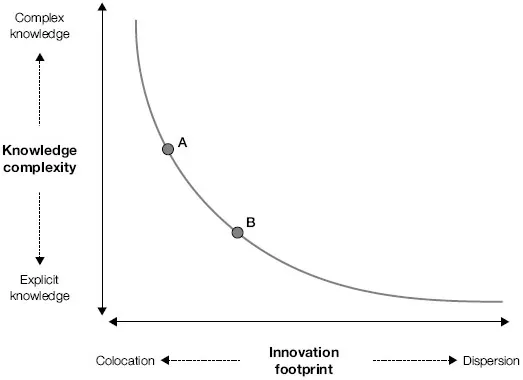
In the figure, the x axis represents the footprint of sites involved in innovation, from colocated innovation at a few sites on the left, to a greater number of globally dispersed sites on the right. Meanwhile, the y axis represents the nature of the knowledge required for innovation, from explicit, codified knowledge to context-dependent, complex knowledge. Currently, most companies are limited to innovation opportunities along the concave curve: because complex knowledge is locally rooted, companies dependent on this for innovation are forced into colocation, around the point marked A on the curve.
Over the past decade, many companies that have traditionally relied on a strong home-base innovation capability have faced pressure to access knowledge that is more dispersed, which has led them to simplify that knowledge. Take Infosys as an example. In the 1990s, as Infosys attempted to serve global customers with the advanced services and system integration and facility management skills it had developed, it implemented a global delivery model. In essence, it structured, codified, and standardized its knowledge so it could incorporate more sites into serving clients and facilitate the global integration of its activities. In other words, it moved from point A to point B on the curve.
But what if, instead of having to choose a position along the curve with all its limitations, it were possible to transcend the knowledge complexity and dispersion trade-off, or change the curve from concave to convex? What would it take to be able to access and integrate highly dispersed complex knowledge to deliver global innovations?
Building a global innovation capability that relies on complex knowledge will be difficult, though not impossible. As figure 1-2 depicts, flipping the curve to transcend the knowledge complexity and dispersion trade-off calls for new understanding, strategies, processes, and tools across three critical vectors: the innovation footprint, communication and receptivity, and collaboration.
To change the shape of the curve and overcome the complex knowledge and dispersion trade-off, the first step is to optimize the innovation footprint. This means being selective in both the choice and number of locations in which a company performs innovation. An optimal footprint is as compact as possible while still providing access to all the sources of knowledge needed to contribute to an innovation. Part II of this book introduces the frameworks, tools, and processes that enable companies to build an optimal footprint.
The next step is to improve communication and receptivity. Few companies have the tools, processes, and mechanisms to support the internal knowledge sharing and integration essential for a dispersed innovation network. Company cultures tend to lean toward original creation and knowledge hoarding, while few human resources policies encourage and reward the international experience paramount to global innovation. This deficit of integration capabilities paints a worrisome picture in which innovation networks comprise a group of autonomous or semiautonomous centers with neither the incentives nor ability to function as an integrated whole. In part III, we address the management and organization challenges companies need to overcome to improve communication and cooperation between dispersed sites.
FIGURE 1-2
Managing global innovation
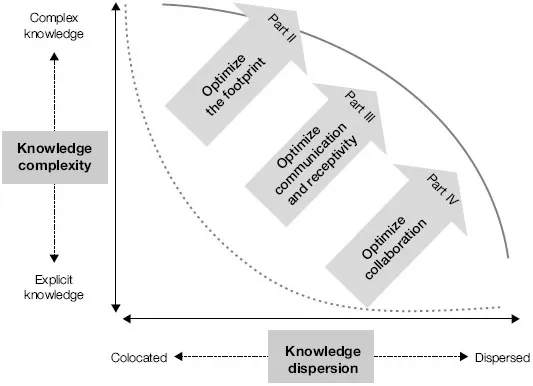
Finally, effective global innovation depends on companies that collaborate both internally and externally. Unfortunately, collaboration falls outside most companies’ comfort zones. In part IV, we introduce the frameworks and processes essential for successful global innovation projects and collaborative innovation with external players.
In the preface, we mentioned Sam Palmisano’s observation that a new corporate model is needed to optimize innovation. Some companies are already beginning to transcend the knowledge complexity and dispersion curve. They are building a new type of globally integrated firm that looks very different from the usual organizational models. For example, Tata Communications’ footprint is designed to access the best knowledge around the world (see sidebar 1-1). It has a dispersed top team, reflecting the need to be close to critical sources of knowledge. It is able to leverage this knowledge by having organizational structures, processes, and a culture that support and reward communication and collaboration.
In some ways, Tata Communications, along with other emerging market global players, had a significant advantage over its old-world competitors. It didn’t have a huge legacy structure and processes to overturn and overcome but was able to build a globally integrated model from the ground up. The jour...
Table of contents
- Cover Page
- Title Page
- Contents
- Foreword
- Preface
- Acknowledgments
- Part I. Managing Global Innovation: The Challenge
- Part II. Optimizing the Innovation Footprint
- Part III. Optimizing Communication and Receptivity: Integrating the Network
- Part IV. Optimizing Collaboration: Succeeding Globally
- Appendix 1: The Nature of Innovation Is Changing
- Appendix 2: Knowledge Is Increasingly Dispersed
- Notes
- About the Authors
Trusted by 375,005 students
Access to over 1.5 million titles for a fair monthly price.
Study more efficiently using our study tools.
Frequently asked questions
Yes, you can cancel anytime from the Subscription tab in your account settings on the Perlego website. Your subscription will stay active until the end of your current billing period. Learn how to cancel your subscription
No, books cannot be downloaded as external files, such as PDFs, for use outside of Perlego. However, you can download books within the Perlego app for offline reading on mobile or tablet. Learn how to download books offline
Perlego offers two plans: Essential and Complete
- Essential is ideal for learners and professionals who enjoy exploring a wide range of subjects. Access the Essential Library with 800,000+ trusted titles and best-sellers across business, personal growth, and the humanities. Includes unlimited reading time and Standard Read Aloud voice.
- Complete: Perfect for advanced learners and researchers needing full, unrestricted access. Unlock 1.5M+ books across hundreds of subjects, including academic and specialized titles. The Complete Plan also includes advanced features like Premium Read Aloud and Research Assistant.
We are an online textbook subscription service, where you can get access to an entire online library for less than the price of a single book per month. With over 1.5 million books across 990+ topics, we’ve got you covered! Learn about our mission
Look out for the read-aloud symbol on your next book to see if you can listen to it. The read-aloud tool reads text aloud for you, highlighting the text as it is being read. You can pause it, speed it up and slow it down. Learn more about Read Aloud
Yes! You can use the Perlego app on both iOS and Android devices to read anytime, anywhere — even offline. Perfect for commutes or when you’re on the go.
Please note we cannot support devices running on iOS 13 and Android 7 or earlier. Learn more about using the app
Please note we cannot support devices running on iOS 13 and Android 7 or earlier. Learn more about using the app
Yes, you can access Managing Global Innovation by Yves L. Doz, Keeley Wilson in PDF and/or ePUB format, as well as other popular books in Commerce & Stratégie commerciale. We have over 1.5 million books available in our catalogue for you to explore.