A short history of piracy and capitalism When capitalism spread along the trade routes toward the Indies…when radio opened an era of mass communication... when the Internet became part of the global economy…pirates were there. And although most people see pirates as solitary anarchists out to destroy capitalism, it turns out the opposite is true. They are the ones who forge the path.In The Pirate Organization, Rodolphe Durand and Jean-Philippe Vergne argue that piracy drives capitalism’s evolution and foreshadows the direction of the economy. Through a rigorous yet engaging analysis of the history and golden ages of piracy, the authors show how pirates form complex and sophisticated organizations that change the course of capitalism. Surprisingly, pirate organizations also behave in predictable ways: challenging widespread norms; controlling resources, communication, and transportation; maintaining trade relationships with other communities; and formulating strategies favoring speed and surprise. We could learn a lot from them—if only we paid more attention.Durand and Vergne recommend that rather than trying to stamp out piracy, savvy entrepreneurs and organizations should keep a sharp eye on the pirate space to stay successful as the game changes—and it always does.First published in French to great critical acclaim and commercial success as L’Organisation Pirate: Essai sur l’évolution du capitalisme, this book shows that piracy is not random. It’s predictable, it cannot be separated from capitalism, and it likely will be the source of capitalism’s continuing evolution.Pirates, surprisingly, also behave in predictable ways: challenging widespread norms; controlling resources, communication, and transportation; maintaining trade relationships with other communities; and formulating strategies favoring speed and surprise.And we can learn from them.Durand and Vergne recommend that rather than trying to stamp out piracy, savvy companies should keep a sharp eye on the pirate space. Only then can they detect how capitalism’s rules of engagement are changing—and then revise their business practices to remain successful in the new game.
eBook - ePub
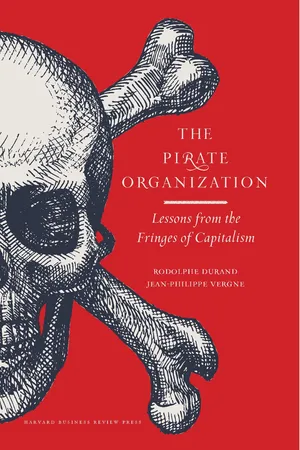
The Pirate Organization
Lessons from the Fringes of Capitalism
- 204 pages
- English
- ePUB (mobile friendly)
- Available on iOS & Android
eBook - ePub
About this book
Information
Table of contents
- Cover Page
- Title Page
- Contents
- Preface
- Acknowledgments
- 1. Introduction
- 2. What Is Piracy?
- 3. The Pirate Organization and Territorial Expansion, or Why Capitalists Shouldn’t Hate the State
- 4. Pirate or Corsair?
- 5. What Is the Pirate Organization?
- 6. Where It All Began: The Pirate Organization on the High Seas
- 7. Why Piracy Is Not Just About Economics
- 8. The Pirate Organization on the Airwaves
- 9. The Pirate Organization and the Monopolist
- 10. The Pirate Organization in Cyberspace
- 11. Hacking Property Rights
- 12. Is the Pirate Organization a Fair Competitor?
- 13. The Pirate Organization and the Building Blocks of Life
- 14. The Future of the Capitalist State
- 15. Conclusion: To the Fringes and Back
- Notes
- Bibliography
- About the Authors
Trusted by 375,005 students
Access to over 1.5 million titles for a fair monthly price.
Study more efficiently using our study tools.
Frequently asked questions
Yes, you can cancel anytime from the Subscription tab in your account settings on the Perlego website. Your subscription will stay active until the end of your current billing period. Learn how to cancel your subscription
No, books cannot be downloaded as external files, such as PDFs, for use outside of Perlego. However, you can download books within the Perlego app for offline reading on mobile or tablet. Learn how to download books offline
Perlego offers two plans: Essential and Complete
- Essential is ideal for learners and professionals who enjoy exploring a wide range of subjects. Access the Essential Library with 800,000+ trusted titles and best-sellers across business, personal growth, and the humanities. Includes unlimited reading time and Standard Read Aloud voice.
- Complete: Perfect for advanced learners and researchers needing full, unrestricted access. Unlock 1.5M+ books across hundreds of subjects, including academic and specialized titles. The Complete Plan also includes advanced features like Premium Read Aloud and Research Assistant.
We are an online textbook subscription service, where you can get access to an entire online library for less than the price of a single book per month. With over 1.5 million books across 990+ topics, we’ve got you covered! Learn about our mission
Look out for the read-aloud symbol on your next book to see if you can listen to it. The read-aloud tool reads text aloud for you, highlighting the text as it is being read. You can pause it, speed it up and slow it down. Learn more about Read Aloud
Yes! You can use the Perlego app on both iOS and Android devices to read anytime, anywhere — even offline. Perfect for commutes or when you’re on the go.
Please note we cannot support devices running on iOS 13 and Android 7 or earlier. Learn more about using the app
Please note we cannot support devices running on iOS 13 and Android 7 or earlier. Learn more about using the app
Yes, you can access The Pirate Organization by Rodolphe Durand, Jean-Philippe Vergne in PDF and/or ePUB format, as well as other popular books in Economics & Business Strategy. We have over 1.5 million books available in our catalogue for you to explore.