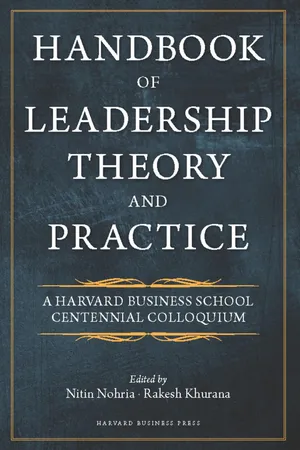
Scores of books and articles have been written in the popular press and mainstream marketplace about leadership: who leaders are, what they do, and why they matter. Yet in academia, there is a dearth of rigorous research, journal articles, or doctoral programs focused on leadership as a discipline. Why do top business schools espouse mission statements that promise to "educate the leaders of the future"- yet fail to give leadership its intellectual due?The Handbook of Leadership Theory and Practice seeks to bridge this disconnect. Based on the Harvard Business School Centennial Colloquium "Leadership: Advancing an Intellectual Discipline" and edited by HBS professors Nitin Nohria and Rakesh Khurana, this volume brings together the most important scholars from fields as diverse as psychology, sociology, economics, and history to take stock of what we know about leadership and to set an agenda for future research.More than a means of getting ahead and gaining power, leadership must be understood as a serious professional and personal responsibility. Featuring the thinking of today's most renowned scholars, the Handbook of Leadership Theory and Practice will be a catalyst for elevating leadership to a higher intellectual plane - and help shape the research agenda for the next generation of leadership scholars.
- 848 pages
- English
- ePUB (mobile friendly)
- Available on iOS & Android
eBook - ePub
Handbook of Leadership Theory and Practice
About this book
Information
SECTION TWO
THE THEORY OF LEADERSHIP
Personal Attributes, Functions, and Relationships
5
LEADERSHIP THROUGH AN ORGANIZATION BEHAVIOR LENS
A Look at the Last Half-Century of Research
LEADERSHIP IS one of the most enduring—and elusive—constructs in the organizational behavior (OB) literature; as Bass (1990:3) puts it, leadership is “one of the world’s oldest preoccupations.” Articles on leadership appeared in the early pages of major organizational behavior journals in midcentury, including Administrative Science Quarterly and the Journal of the Academy of Management, which later evolved to become the Academy of Management Journal, and the Academy of Management Review. Today, interest in leadership research remains keen. The Harvard Business Review alone has published nearly 500 articles since 1923 that reference leadership in their abstracts. And yet, in spite of all of this inquiry and interest, there seems to be little consensus within OB concerning what leadership is, how it functions, and to what effect. Podolny, Khurana and Hill-Popper (2005) comment on this state of the field, decrying the trajectory that leadership research has taken:
During the past 50 years, organizational scholarship on leadership has shifted from a focus on the significance of leadership for meaning-making to the significance of leadership for economic performance. This shift has been problematic . . . (Podolny, Khurana, and Hill-Popper, 2005:1)
Author note: We greatly appreciate the generous support of the Boston College Winston Center for Leadership and Ethics in enabling this research.
Invited paper for Harvard Business School 100th Anniversary. To be presented at the colloquium “Leadership: Advancing an Intellectual Discipline.” Manfred Kets de Vries is the Raoul de Vitry d’Avaucourt Clinical Professor in Leadership Development, INSEAD, France, Singapore, and Abu Dhabi, and Director of INSEAD’s Global Leadership Center. Elisabet Engellau is an Adjunct Clinical Professor in Management, INSEAD, France, Singapore, and Abu Dhabi, and Program Director of INSEAD’s Global Leadership Center.
Heeding this observation, we take stock of leadership research in OB, reviewing both the theoretical models of leadership that have dominated organizational discourse, as well as empirical investigations. We map the historical trajectory of leadership theories in the OB domain and show how they tend to cluster around three primary models, focusing on: leadership traits, leadership behaviors, and leadership contingencies. We examine published empirical research over the last 50 years focusing explicitly on leadership in three of the major OB journals: Administrative Science Quarterly, Academy of Management Journal , and Organization Science. Although we find evidence of a prototype design in leadership research, there is no clearly dominant theoretical perspective on leadership. Finally, we conclude with a discussion and agenda for future leadership research using an OB perspective.
Historical Trajectory of OB Leadership Theories
As much as leadership has attracted great interest, it has also attracted vigorous debate, discussion, and contestation. There has been a proliferation of definitions, theories, and models within the OB literature, but little consensus among leadership theorists. As Bass (1990:37) observes, “there has been no shortage of modeling and theorizing about leadership. However, relatively few models and theories have dominated the research community, and many have been restatements of the obvious.”
Leadership theories span levels of analysis, ranging from microlevel approaches that focus on the individual traits or behaviors of the leader to macro-level approaches that focus on leadership attributions, processes, and outcomes for a collective, an organization, or a nationstate. In any number of studies, leadership often becomes the proverbial “black box,” a bundle of processes and mechanisms that function in a multiplicity of ways with both intended and unintended results. We try to lift the lid on this “black box” by reviewing the major theoretical perspectives in the OB literature, asking: What are the dominant trends in how leadership scholars have theorized and studied leadership over the years?
Leadership Defined
The leadership research in OB seems to be a definitional quagmire: “There are almost as many different definitions of leadership as there are persons who have attempted to define the concept” (Stogdill, 1974:259). Bass cuts through the bog with this integrative definition:
Leadership is an interaction between two or more members of a group that often involves structuring or restructuring of the situation and the perceptions and expectations of the members. Leaders are agents of change—persons whose acts affect other people more than other people’s acts affect them. Leadership occurs when one group member modifies the motivation or competencies of others in the group. (Bass, 1990:19–20)
OB researchers have defined leadership in a myriad of ways. Some definitions focus on the persona of the leader. Gardner (1995:6), for instance, asserts that leaders are those “who significantly influence the thoughts, behaviors, and/or feelings of others.” Other scholars focus on the process or conduct of leadership, for example, “Leadership emphasizes the exercise of interpersonal influence and motivation to accomplish the mission” (Snook, 2002:31) or “as a process that occurs within the minds of individuals who live in a culture—a process that entails the capacities to create stories, to understand and evaluate these stories, and to appreciate the struggle among stories” (Gardner, 1995:22). Still other scholars define leadership in terms of its effects, that is, as “the act of making a difference” and evidenced “when the vision is strategic, the voice persuasive, the results tangible” (Useem, 1998:4). Focusing on leadership performance or effectiveness has been a resounding theme in the OB literature (Podolny, Khurana, and Hill-Popper, 2005). We review the relevant literature to map the theoretical and empirical trajectory of leadership research; we begin with the evolution of leadership theories.
Leadership Theorized
Over the last half-century of OB research, leadership has been theorized in a number of different ways but with a characteristic pattern:
Leadership has been conceived as the focus of group processes, as a matter of personality, as a matter of inducing compliance, as the exercise of influence, as particular behaviors, as a form of persuasion, as a power relation, as an instrument to achieve goals, as an effect of interaction, as a differentiated role, as initiation of structure, and as many combinations of these definitions. (Bass, 1990:11)
The theoretical trajectory of OB leadership research is historically patterned, developing within the broader theoretical milieu of its period as well as the needs and events of the times in which these models develop (Mayo and Nohria, 2005a, 2005b). Our brief overview of leadership theories in OB focuses on describing the dominant models chronologically; we find a general progression from leadership traits to behavioral styles, and finally, leadership contingencies as well as the dynamics of transformation, change, and networks.
EARLY HISTORY: THE SEARCH FOR TRAITS THAT DISTINGUISH LEADERS (FROM THE REST OF US)
Initially, leadership research was launched from a psychological perspective and with the overriding assumption that leaders were somehow different and in possession of special, unique, or extraordinary personality attributes, abilities, skills, or physical characteristics that others did not have (e.g., Stogdill, 1948). Leaders could seemingly accomplish what others could not: they could lead. Early scholarship was rooted in identifying this distinguishing set of traits. Stogdill (1974), for instance, identified these traits as critical to leadership: dependability, cooperativeness, assertiveness, dominance, high energy, self-confidence, stress tolerance, responsibility, achievement orientation, adaptability, cleverness, persuasiveness, organizational and speaking abilities, and social skills.
Trait theories are sometimes referred to as “Great Man” theories both because leadership was thought to be the province of males and because leadership had a mythical, heroic sense of destiny (with leaders assumed to be born, not made). However, the search for definitive and universal leadership traits met with only limited success; moreover, trait theories did little to explain why everyone who possessed these special attributes did not rise to become leaders. As a result, scholarly attention turned to other explanations, refocusing away from “who leaders are” (traits) to “what leaders do” (behaviors).
EMERGENCE OF BEHAVIORAL THEORIES OF LEADERSHIP
Behavioral theories focus on a leader’s style of action, typically categorized with regard to a task orientation, which emphasizes the achievement of work goals or objectives and organizing structures, rules, or designs; and people orientation, which emphasizes interpersonal relationships and consideration for followers. Like traits, behavioral styles are theorized to be stable properties of the individual leader and thus invariant to the particular organizational context or work situation.
This approach had its origins in the work of Lewin, Lippitt, and White (1939) who outlined three basic leadership styles: autocratic, democratic, and laissez-faire. About twenty years later, researchers at Michigan (e.g., Katz and Kahn, 1960) identified two basic leadership styles: production-oriented and employee-oriented. Working around the same time, Ohio State researchers provided a theoretical framework and operationalization that has endured; this work modeled the critical behavioral dimensions as initiating structure, whereby leaders define and organize work roles and design, as well as patterns of communication, and consideration, whereby leaders nurture warm, friendly working relationships and cultivate mutual trust and respect. Leadership style is assessed with a widely used scale, the Leader Behavior Description Questionnaire (LBDQ; originated by Stogdill, 1963).
Despite its early promise, the considerable body of behavioral research (like the trait studies that preceded it) found that a particular leadership style was not universally effective; a style that was effective in one setting was not always effective in a different setting. As well, behavioral theories tended to rely on abstracted concepts of behavioral types that were often difficult to identify (Yukl, 1989). And so leadership scholars began searching for more situationally specific theories of leadership.
CONTINGENCY THEORIES OF LEADERSHIP
In contrast to trait and behavioral theories, contingency theories explicitly assume that leadership can vary across situations and that there may not be a universally effective way to lead; different contexts may call for different kinds of leadership. Leaders are assumed to have a repertoire of leadership attributes and behavioral styles from which they can draw, adapting these as needed to the demands of the specific task situation or the particular followers they lead. Contingency theories focus on aspects of context, such as favorableness of the environment for the leader (Fiedler, 1964), the relative complexity of the task and expertise of followers (Vroom and Yetten, 1973), and the dyadic relationship between leaders and followers (Graen, Liden, and Hoel, 1982). Early iterations of contingency theori...
Table of contents
- Title Page
- Copyright Page
- Dedication
- Table of Contents
- ACKNOWLEDGMENTS
- SECTION ONE - THE IMPACT OF LEADERSHIP
- SECTION TWO - THE THEORY OF LEADERSHIP
- SECTION THREE - THE VARIABILITY OF LEADERSHIP
- SECTION FOUR - THE PRACTICE OF LEADERSHIP
- SECTION FIVE - THE DEVELOPMENT OF LEADERS
- INDEX
- ABOUT THE CONTRIBUTORS
- ABOUT THE EDITORS
Trusted by 375,005 students
Access to over 1.5 million titles for a fair monthly price.
Study more efficiently using our study tools.
Frequently asked questions
Yes, you can cancel anytime from the Subscription tab in your account settings on the Perlego website. Your subscription will stay active until the end of your current billing period. Learn how to cancel your subscription
No, books cannot be downloaded as external files, such as PDFs, for use outside of Perlego. However, you can download books within the Perlego app for offline reading on mobile or tablet. Learn how to download books offline
Perlego offers two plans: Essential and Complete
- Essential is ideal for learners and professionals who enjoy exploring a wide range of subjects. Access the Essential Library with 800,000+ trusted titles and best-sellers across business, personal growth, and the humanities. Includes unlimited reading time and Standard Read Aloud voice.
- Complete: Perfect for advanced learners and researchers needing full, unrestricted access. Unlock 1.5M+ books across hundreds of subjects, including academic and specialized titles. The Complete Plan also includes advanced features like Premium Read Aloud and Research Assistant.
We are an online textbook subscription service, where you can get access to an entire online library for less than the price of a single book per month. With over 1.5 million books across 990+ topics, we’ve got you covered! Learn about our mission
Look out for the read-aloud symbol on your next book to see if you can listen to it. The read-aloud tool reads text aloud for you, highlighting the text as it is being read. You can pause it, speed it up and slow it down. Learn more about Read Aloud
Yes! You can use the Perlego app on both iOS and Android devices to read anytime, anywhere — even offline. Perfect for commutes or when you’re on the go.
Please note we cannot support devices running on iOS 13 and Android 7 or earlier. Learn more about using the app
Please note we cannot support devices running on iOS 13 and Android 7 or earlier. Learn more about using the app
Yes, you can access Handbook of Leadership Theory and Practice by Nitin Nohria, Rakesh Khurana in PDF and/or ePUB format, as well as other popular books in Business & Management. We have over 1.5 million books available in our catalogue for you to explore.