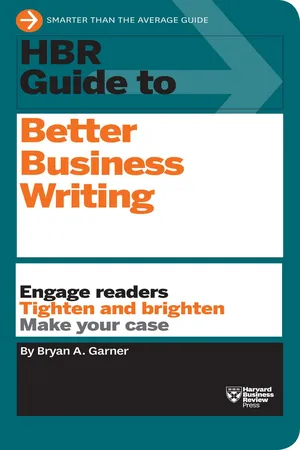
DON'T LET YOUR WRITING HOLD YOU BACK. When you’re fumbling for words and pressed for time, you might be tempted to dismiss good business writing as a luxury. But it’s a skill you must cultivate to succeed: You’ll lose time, money, and influence if your e-mails, proposals, and other important documents fail to win people over.The HBR Guide to Better Business Writing, by writing expert Bryan A. Garner, gives you the tools you need to express your ideas clearly and persuasively so clients, colleagues, stakeholders, and partners will get behind them. This book will help you:• Push past writer’s block
• Grab—and keep—readers’ attention
• Earn credibility with tough audiences
• Trim the fat from your writing
• Strike the right tone
• Brush up on grammar, punctuation, and usage
- 208 pages
- English
- ePUB (mobile friendly)
- Available on iOS & Android
eBook - ePub
HBR Guide to Better Business Writing (HBR Guide Series)
About this book
Information
Section 1
Delivering the Goods Quickly and Clearly
Chapter 1
Know why you’re writing
Many people begin writing before they know what they’re trying to accomplish. As a result, their readers don’t know where to focus their attention or what they’re supposed to do with the message. So much depends on your purpose in writing that you must fix it firmly in your mind. What do you want the outcome to be? Do you want to persuade someone to sign a franchise contract, for instance? Or to stop using your trademark without permission? Or to come to a company reception?
Say clearly and convincingly what the issue is and what you want to accomplish. With every sentence, ask yourself whether you’re advancing the cause. That will help you find the best words to get your message across.
Form follows function
Say your firm rents space in an office building that has thoroughly renovated the entrance and the entire first floor. Your general counsel has alerted you that the landlord has violated the Americans with Disabilities Act (ADA). For example, there are no wheelchair-access ramps or automatic doors. You’ve decided to write to the landlord. But why are you writing? The answer to that question determines much of what you’ll say and all of the tone that you’ll use. Consider three versions of the letter you might write:
Version #1
You’re good friends with the landlord, but you think that the law should be followed for the good of your employees and your customers. Purpose: to gather more information. Tone: friendly.
Dear Ann:
The new foyer looks fantastic. What a great way for us and others in the building to greet customers and other visitors. Thank you for undertaking the renovations.
Could it be that the work isn’t finished? No accommodations have yet been made for wheelchair accessibility—as required by law. Perhaps I’m jumping the gun, and that part of the work just hasn’t begun? Please let me know.
Let’s get together for lunch soon.
All the best,
Version #2
You’re on good terms with the landlord, but on principle, you don’t like being in a building that isn’t ADA-compliant. You have a disabled employee on staff, and you want the situation righted. Purpose: to correct the oversight. Tone: more urgent.
Dear Ann:
Here at Bergson Company, we were delighted when you renovated the first floor and made it so much more inviting to both tenants and visitors. We are troubled, however, by the lack of wheelchair-access ramps and automatic doors for handicapped employees and customers, both of which are required by state and federal law. Perhaps you’re still planning that part of the renovations. If so, please advise.
If this was a mere oversight, can you assure us that construction on ramps and automatic doors will begin within 60 days? Otherwise, as we understand it, we may be obliged to report the violation to the Vermont Buildings Commission. Without the fixes, you may be subject to some hefty fines—but we feel certain that you have every intention of complying with the law.
Sincerely,
Version #3
You’ve had repeated problems with the landlord, and you have found a better rental property elsewhere for your company. Purpose: to terminate your lease. Tone: firm, but without burning bridges.
Dear Ms. Reynolds:
Four weeks ago you finished renovating the first floor of our building. Did you not seek legal counsel? You have violated the Americans with Disabilities Act—as well as state law—by failing to provide a wheelchair-access ramp and automatic doors for handicapped visitors and employees. Because four weeks have elapsed since you completed the work, we are entitled under state law to terminate our lease. This letter will serve as our 30 days’ notice.
Although we have no doubt that your oversight was a good-faith error, we hope that you understand why we can’t stay in the building and have made plans to go elsewhere.
We hope to remain on friendly terms during and after the move.
Sincerely,
These three letters are quite different because you are writing them to accomplish different things. Focus on the reaction you’re trying to elicit from the reader. You want results. Yet notice how even the sternest letter— Version 3—maintains a civil tone to foster goodwill. No hostility is necessary.
Recap
- Consider your purpose and your audience before you begin writing, and let these guide both what you say and how you say it.
- Plainly state the issue you’re addressing and what you hope to achieve.
- Keep your goal in mind: Don’t undermine your efforts with a hostile or inappropriate tone.
Chapter 2
Understand your readers
Communication is a two-way exercise. Without knowing something about your readers—and about psychology in general, for that matter—you’ll rarely get your ideas across. What are their goals and priorities? What pressures do they face? What motivates them?
Respect readers’ time constraints
The most important things to realize about all business audiences are these:
- Your readers are busy—very busy.
- They have little if any sense of duty to read what you put before them.
- If you don’t get to your point pretty quickly, they’ll ignore you—just as you tend to ignore long, rambling messages when you receive them.
- At the slightest need to struggle to understand you, they’ll stop trying—and think less of you.
- If they don’t buy your message, you may as well have stayed in bed that day.
Each of these universal tendencies becomes magnified as you ascend the ranks of an organization. Your job as a writer, then, is to:
- Prove quickly that you have something valuable to say—valuable to your readers, not just to you.
- Waste no time in saying it.
- Write with such clarity and efficiency that reading your material is easy—even enjoyable.
- Use a tone that makes you likable, so that your readers will want to spend time with you and your message.
Do these things and you’ll develop a larger reservoir of goodwill. You’ll not only have a genuinely competitive edge, but you’ll also save time and money.
Tailor your message
If you’re writing a memo to colleagues, for example, consider where they sit in the organization and what they’re expected to contribute to its success. Or if you’re responding to a client’s request for proposal, address every need outlined in the RFP—but also think about the client’s industry, company size, and culture. Your tone will change depending on your recipients, and so will your content. You’ll highlight the things they care about most—the ever-important “what’s in it for them.”
Connect with particular readers to connect with large audiences
It’s challenging to write for a large, diverse group of readers, especially if you don’t know them. But you can make it easier by focusing on some specific person you know. In his preface to the U.S. Securities and Exchange Commission’s Plain English Handbook, Warren Buffett suggests grounding your prose by having a particular reader in mind:
When writing Berkshire Hathaway’s annual report, I pretend that I’m talking to my sisters. I have no trouble picturing them: Though highly intelligent, they are not experts in accounting or finance. They will understand plain English, but jargon may puzzle them. My goal is simply to give them the information I would wish them to supply me if our positions were reversed. To succeed, I don’t need to be Shakespeare; I must, though, have a sincere desire to inform.
If you focus on a smart nonspecialist who’s actually in your audience—or, like Buffett, imagine that you’re writing for a relative or a friend—you’ll strike a balance between sophistication and accessibility. Your writing will be more appealing and more persuasive.
Your readers may have little or no prior knowledge about the facts or analysis you’re disclosing. But assume that they’re intelligent people. They’ll be able to follow you if you give them the information they need, and they won’t be bamboozled by empty, airy talk.
| NOT THIS: | BUT THIS: |
|---|---|
| We aspire to be a partner primarily concerned with providing our clients the maximal acquisition of future profits and assets and focus mainly on clients with complex and multi-product needs, large and midsized corporate entities, individual or multiple entrepreneurial agents, and profit-maximizing institutional clients. By listening attentively to their needs and offering them paramount solutions, we empower those who wish to gain access to our services with the optimal set of decisions in their possible action portfolio given the economic climate at the time of the advice as well as the fiscal constraints that you are subject to. Against the backdrop of significant changes within our industry, we strive to ensure that we consistently help our clients realize their goals and thrive, and we continue to strengthen the coverage of our key clients by process-dedicated teams of senior executives who can deliver and utilize our integrated business model. On the back of a strong capital position and high levels of client satisfaction and brand recognition, we have achieved significant gains in market share. We hope that you have a favorable impression of our company’s quantitative and qualitative attributes and will be inclined to utilize our services as you embark on your financial endeavors. | We’re a client-focu... |
Table of contents
- Cover
- Harvard Business Review Guides
- Other Books by Bryan A. Garner
- Title Page
- Copyright
- Dedication
- What You'll Learn
- Table of Contents
- Introduction: Why you need to write well
- Section 1: Delivering the Goods Quickly and Clearly
- Section 2: Developing Your Skills
- Section 3: Avoiding the Quirks That Turn Readers Off
- Section 4: Common Forms of Business Writing
- Appendixes
- Desk References
- Index
- Acknowledgments
- About the Author
- More Books from Harvard Business Review
Trusted by 375,005 students
Access to over 1.5 million titles for a fair monthly price.
Study more efficiently using our study tools.
Frequently asked questions
Yes, you can cancel anytime from the Subscription tab in your account settings on the Perlego website. Your subscription will stay active until the end of your current billing period. Learn how to cancel your subscription
No, books cannot be downloaded as external files, such as PDFs, for use outside of Perlego. However, you can download books within the Perlego app for offline reading on mobile or tablet. Learn how to download books offline
Perlego offers two plans: Essential and Complete
- Essential is ideal for learners and professionals who enjoy exploring a wide range of subjects. Access the Essential Library with 800,000+ trusted titles and best-sellers across business, personal growth, and the humanities. Includes unlimited reading time and Standard Read Aloud voice.
- Complete: Perfect for advanced learners and researchers needing full, unrestricted access. Unlock 1.5M+ books across hundreds of subjects, including academic and specialized titles. The Complete Plan also includes advanced features like Premium Read Aloud and Research Assistant.
We are an online textbook subscription service, where you can get access to an entire online library for less than the price of a single book per month. With over 1.5 million books across 990+ topics, we’ve got you covered! Learn about our mission
Look out for the read-aloud symbol on your next book to see if you can listen to it. The read-aloud tool reads text aloud for you, highlighting the text as it is being read. You can pause it, speed it up and slow it down. Learn more about Read Aloud
Yes! You can use the Perlego app on both iOS and Android devices to read anytime, anywhere — even offline. Perfect for commutes or when you’re on the go.
Please note we cannot support devices running on iOS 13 and Android 7 or earlier. Learn more about using the app
Please note we cannot support devices running on iOS 13 and Android 7 or earlier. Learn more about using the app
Yes, you can access HBR Guide to Better Business Writing (HBR Guide Series) by Bryan A. Garner in PDF and/or ePUB format, as well as other popular books in Business & Business Communication. We have over 1.5 million books available in our catalogue for you to explore.