Succeed by mastering the art of the who Why surround yourself with the best? Because it matters—in all aspects of life.In fact, in professional environments, getting people right—what global leadership authority Claudio Fernández-Aráoz calls "the art of great 'who’ decisions”—marks the difference between success and failure. To thrive, you need to identify those with the highest potential, get them in your corner and on your team, and help them grow. Yet surprisingly very few of us are able to meet that challenge.This series of short and engaging essays outlines the obstacles to great "who” decisions and offers solutions to address them in a systematic way. Drawing from several decades of experience in global executive search and talent development, as well as the latest management and psychology research, Fernández-Aráoz offers wisdom and practical advice to improve the choices we make about employees and mentors, business partners and friends, top corporate leaders and even elected officials.The personal stories and cutting-edge studies described in the book will help you understand both your own failings and the external forces commonly at play in staffing decisions. The author shares concrete recommendations on how to select the best people, bring out their strengths, foster collective greatness in the groups you’ve assembled, and create not only better organizations but also a better society.Starting with the cases of Amazon pioneer Jeff Bezos and Brazilian tycoon Roger Agnelli and continuing with individual and corporate examples from around the world, Fernández-Aráoz paints a vivid picture of what great "who” decisions look like and presents a fresh and commanding argument about why they matter more than ever today.
eBook - ePub
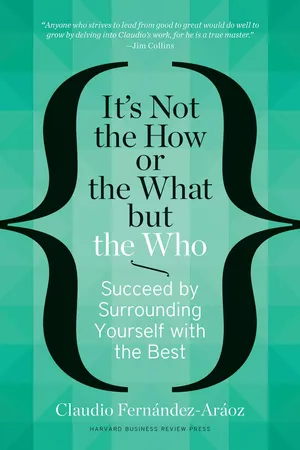
It's Not the How or the What but the Who
Succeed by Surrounding Yourself with the Best
- 240 pages
- English
- ePUB (mobile friendly)
- Available on iOS & Android
eBook - ePub
It's Not the How or the What but the Who
Succeed by Surrounding Yourself with the Best
About this book
Information
Topic
Negocios y empresaSubtopic
Habilidades empresarialesPART ONE
The Enemy Within
Humans aren’t programmed to make great people decisions. The first step in surrounding yourself with the best is to recognize—and correct—your own failings.
{1}
Prehistoric Hardware; Victorian Software
In October 2011, I spoke at the World Business Forum, a gathering of four thousand senior executives and middle managers in New York. I started by asking the audience, “How many of you have made major mistakes while making crucial people choices?” All four thousand people raised their hands.
That group was not alone. All managers struggle to get people right (and if they say they don’t, they’re lying). As Jack Welch, the legendary former CEO of General Electric, put it to me a few years ago, “Making great people decisions is brutally hard.” He confessed that, as a junior manager at GE, he probably got 50 percent of his appointments wrong; thirty years later, as CEO, he was still wrong 20 percent of the time. If it took one of the twentieth century’s top corporate leaders three decades to improve his error rate from 50 percent to 20 percent, it’s no wonder it’s so challenging for the rest of us.
Why are people choices so hard? There are, of course, many reasons; it’s difficult to predict your future needs and to quickly and accurately assess traits and skills. I’ll address these and other obstacles in later chapters. But first I want to discuss the fundamental problem: we have the wrong brain and the wrong education to get these decisions right.
The human animal is 2 million years old.1 We have evolved a lot since then, but evolution is very slow, and our brains now are not significantly different than those of the primitive hunters who chased deer in the savanna in prehistoric times. We are therefore thinking, acting, working, deciding on people today with a piece of hardware that is ten thousand years old.2
What types of decisions did our primitive ancestor have to make? They involved the four F’s: fight, flight, food and . . . well, fornication. The most important question arose when watching something move. It was: “Is that thing going to eat me, or can I eat that thing?” Get it wrong and you might die, either because the deer escaped and you couldn’t eat, or because you couldn’t escape and the tiger ate you. Those early humans had to do the same with each other. If a stranger arrived at the campfire, how did you decide between fight, flight, or partnering with the person to pursue one of the other F’s? You looked for similarities between yourself and the new arrival. If he (or she) looked familiar, you accepted him. If not, you would fight or flee the area. This was an effective strategy then. You’re reading this book today because your ancestors, day after day, millions of times, made the right people (and animal) choices. They were the fittest, and they passed their genes—their evolving neural circuitry—on to future generations.
As a result, we humans are still hardwired to make choices in the lower, unconscious parts of our brains—in fractions of seconds, with no deliberation—based on similarity, familiarity, and comfort.3 We appreciate and trust people similar to us from the moment we’re born. For example, a recent study in Psychological Science shows that babies prefer not only people similar to them but also people who are mean to dissimilar individuals.4 And we don’t grow out of this tendency. Studies show that adults gravitate toward those with whom they share something, whether it’s a common nationality, ethnicity, gender, education, or career path—even the same first-name initial!
As recently as a hundred years ago, when the world was more insular, business less complex, and careers more stable, this primitive, instinctive behavior might not have been such a liability. But today it is a huge one. You cannot be successful in a highly connected, cross-cultural, globally minded environment if you seek support only from others exactly like you. You need to surround yourself with people who have diverse backgrounds and complementary skills, and who properly challenge you.
To make things even worse, our “software” is also obsolete. At the World Business Forum I also asked, “How many of you have studied how to assess people?” Only twenty people—out of the four thousand—raised their hands. That’s half of 1 percent! I have asked this question time and again, in some forty different countries, and the response is similar. The vast majority of managers and leaders haven’t received the proper education and training on assessing others and helping those around them to reach their highest potential.
As Ken Robinson so powerfully explained it in his 2006 TED talk “How Schools Kill Creativity,” our education is dangerously outdated.5 Kids learn reading and math to a curriculum, but social skills are expected to happen naturally. Even MBA training was born with a major deficit: by 1928, all thirty-four business schools in the United States taught accounting and economics, yet only two taught anything related to what was then called “personnel.”6 That might have made sense at the time, when physical assets and capital were the key production factors, and efficiency paramount. But today, when human capital and innovation determine the future of most companies, it certainly doesn’t. And, unfortunately, not much has changed. Erich C. Dierdorff and Robert S. Rubin of DePaul University conducted a big research study to check the relevance of the typical MBA education by comparing it to an empirically based model of managerial competence (hard evidence about what makes leaders effective) as well as working managers’ opinions.7 The three competencies rated most important in the real world were managing human capital, managing decision-making processes, and managing strategy and innovation. But those three were the least represented in required MBA courses. Only 29 percent of programs offered two or more courses in managing human capital, and a mere 19 percent had two or more focused on managing decision-making processes. By contrast, 87 percent gave that same high weight to managing administrative activities.
We are so lucky to live in a fabulous time, in an extraordinary global village with unprecedented possibilities. You might be reading this on a Kindle, an iPad, or a Samsung tablet, amazing products unthinkable just ten years ago (and developed, I would note, by three of the high-performing, people-master-led companies I talked about in the introduction to this book). While the cutting-edge hardware and software of those devices have optimal functionality for the world we live in, our brains and education systems do not.
The good news is that our neural wiring is much more plastic than we used to believe, and we can teach ourselves to manage it, damping down our primitive instincts and instead tapping into our brain’s prefrontal region, or “executive center,” to force ourselves into better people decisions.8 Through disciplined learning and practice Jack Welch became much better at surrounding himself with the best and developing standout leaders. So did Jeff Bezos, Roger Agnelli, Steve Jobs, and Yun Jong-Yong. And you can too—that’s the point of this book, after all.
Start by simply acknowledging that you are hardwired for unconscious biases, and that your schools, universities, or organizations haven’t worked very hard to change that. It’s your job and your opportunity.
{2}
So Sure, but So Wrong
For several years, professors at Duke University asked CFOs of large American companies to estimate the return of the S&P index over the twelve months to come.1 Realizing how hard it is—even for seasoned professionals—to make such a prediction, the researchers also asked the CFOs to offer an “80 percent confidence interval” (that is, the range of returns they would expect with 80 percent probability) as wide as they wanted. By definition, you would expect only 20 percent of surprises. But, when the results came in the following year, a full 67 percent of the actual returns fell out of the CFOs’ expected ranges.
We’re not talking about amateur individual investors but about some of the world’s most successful financial executives. They were quite confident about their estimates, and yet two-thirds of them were wrong. So sure, but so wrong!
Overconfidence in predictions is a pervasive human bias that has a dramatic impact not just on our financial or weather forecasts but also on our people decisions. We all think we’re able to accurately judge others even though most of us haven’t studied how to do so and, in a business context, typically have fairly limited experience. Those just promoted to a managerial level start from scratch, and even some senior executives lack specific, relevant prior experience. Research my Egon Zehnder colleagues and I conducted showed that some 70 percent of the board members of the largest public companies in the United States and the United Kingdom had never participated in a CEO succession, or had participated in only one. And yet they were the ones responsible for those senior appointments—the most important for any company.
Why are we so sure but so wrong? Because we tend to place too much weight on the information in front of us, without stopping to ask what else we need to know in order to make sound assessments and accurate predictions.
As discussed in chapter 1, our brain is hardwired to make fast people choices based on similarity, familiarity, and comfort. But a more subtle type of bias also comes into play. Princeton economist Daniel Kahneman, who won a Nobel Prize for his work with Amos Tversky on decision making, calls it WYSIATI—“what you see is all there is.”2 Daily faced with an infinite series of inputs and decisions, our minds tend to work mostly on automatic in an effort to preserve energy. This fast, basically unconscious form of thinking (which Kahneman labels System 1) is useful a lot of the time. But it also allows us to make up stories out of limited, unreliable, often irrelevant information—and then wholeheartedly believe them—instead of engaging in the conscious, deliberate, analytic thinking (System 2) that some decisions (indeed, all people decisions) call for. This explains why the CFOs, the board members, and all of us usually feel pretty sure about our views and very rarely consider whether we’re wrong.
To illustrate, consider this statement: “Mary graduated with honors from an Ivy League university five years ago and has since worked at an outstanding consumer goods company, where she has been promoted twice.” Aren’t you immediately attracted by her profile? If you were looking to hire someone in her field, wouldn’t you call her right away?
Now consider this statement: “Joe took twice as long as required to graduate and has worked for the last four years for quite an unprofessional family company, from which he was recently fired.” What’s your immediate impression of Joe? If you were looking to hire someone in his field, would he even make it through your door?
So Mary gets a series of unchallenging interviews and sails through them all. Joe’s résumé is meanwhile thrown in the bin. But there are several things I haven’t told you about these two candidates. Mary was a C student in college, got her job through a family connection, and is frequently mean and abusive to her colleagues. Joe worked night shifts to pay his way through school and, despite his great contribution and commitment to his previous job, his boss fired him to make room for her own son. In Mary’s case, a lack of further inquiry would probably lead you to choose the wrong person. In Joe’s case, you’d be likely to prematurely reject a good candidate.
In my experience as an executive search consultant, I see the WYSIATI problem all the time. I have personally handled some five hundred appointments, typically presenting four finalist candidates for each, which adds up to about two thousand people. I attend every interview, carefully watch the interaction between client and candidate, and talk to the client immediately afterward. In the vast majority of cases, the clients focus only on the candidate attributes and experiences that have been explicitly discussed either at the meeting or in the confidential report that I’ve provided. Very rarely do people ask: “What else do we need to know about this person, the role, our company, or our market in order to make a sound hiring or promotion decision?” Unconsciously, we make choices based on what we already know.
In later essays, I’ll discuss all the essential elements to check for when assessing people, but for the time being, my advice is simply to become more aware of your overconfident, WYSIATI tendencies. The next time you’re about to bring someone into your circle—whether it’s a team member, business partner, doctor, or nanny—remember that making people judgments is extremely hard and can’t be done on automatic. Make a list of what you know and ask yourself what other information you need to make sure you’re surrounding yourself with the best. Never miss this step!
{3}
Inertia
A few years ago, I spoke at a leadership retreat for a leading US life sciences company and asked one group of three hundred executives, “If you were building your organization from the ground up, what percentage of the people would you rehire?” They submitted their responses electronically (and anonymously) and the most common was “about 50 percent.” It reminded me of the reply Pope John XXIII gave when a journalist asked him how many people worked at the Vatican. “About half!” he joked.
A few months later, during a workshop for executives at a big equipment manufacturer, I asked the same question of seventeen top leaders. Their confidential answers ranged from 10 percent to 100 percent, but the median answer was 60 percent. That means that, on average, the leaders thought four of ten colleagues were not right for their jobs. When I gave the same quiz to several managers who were participating remotely from seven other locations in Europe, Asia, and Latin America, average answers ranged from 80 percent for those in Switzerland to a dismal 30 percent for their counterparts in one Latin American office.
I ask this question all the time now, and, while the results vary across companies and regions, the fundamental problem is evident: Most of us are bad and slow at getting the wrong people off the bus.1 As Capital One’s CEO Richard Fairbank put it several years ago, “At most companies, people spend 2 percent of their time recruiting and 75 percent managing their recruiting mistakes.” It happens in life with poorly chosen friends and romantic partners, as well as at the office.
Whether you made a flawed “who” decision in the first place, you inherited people not of your choosing, circumstances changed, or the people themselves changed, you can’t let inertia triumph. If someone isn’t panning out, you need to let them know and, often, let them go.
Why is that so hard? Three powerful psychological forces work against us: procrastination, loss aversion, and compassion.
We procrastinate simply because we want to avoid unpleasant things: cleaning out the garden shed, visiting a boring uncle, engaging in tense conversations that involve tough feedback. We don’t like to feel uncomfortable. How do you beat procrastination? By making formal commitments. The neuroscientist David Eagleman refers to these as “Ulysses contracts.”2 Just as the mythological hero lashed himself to his ship’s mast to make sure he would resist the call of the sirens, you need to prevent your future self from procrastinating on potentially uncomfortable evaluations and decisions. Commit to evaluate each of your team members at regular intervals. Write it down in your calendar, ask your assistant to remind you, and tell your boss you’re doing it. In fact, tell your boss you’d like to make those reviews a key personal objective, linked to your bonus.
Our inclination toward inertia is exacerbated by the powerful force of loss aversion. Even if we know we don’t have the right people around us, we spend more time worrying about what we might lose than dreaming of what we could possibly gain. For example, most people would reject a bet that offered equal chances of winning $10,000 and losing $10,000. In fact, several experiments have found that the winnings need to be bumped up to at least $20,000—twice as much as the loss—before any significant number of subjects will accept the bet.3 So, unless the situation is dramatic and the wrong employee becomes a clear and obvious hindrance to others’ performance, we prefer to stay with the person we have. We have simply invested too much time, energy, and money, and we aren’t willing to gamble that the next hire will be any better. The way to deal with loss aversion is by learning to think like a trader. People who maintain large portfolios of stocks, bonds, or any other assets realize that they’re going to win some and lose some. The worst mistake isn’t picking a loser but clinging to it as it sinks. It takes discipline to cut your losses and invest your remaining resources elsewhere, but it’s as necessary with people as it is with investments.
One more reason for our inertia is compassion. We are all social animals, and most of us find it difficult to create situations that put othe...
Table of contents
- Cover
- Title Page
- Copyright
- Dedication
- Contents
- Introduction
- Part One: The Enemy Within
- Part Two: Outside Obstacles and Opportunities
- Part Three: The Right People
- Part Four: The Bright Future
- Part Five: Teams That Thrive
- Part Six: A Better Society
- Conclusion
- Notes
- Acknowledgments
- About the Author
Trusted by 375,005 students
Access to over 1.5 million titles for a fair monthly price.
Study more efficiently using our study tools.
Frequently asked questions
Yes, you can cancel anytime from the Subscription tab in your account settings on the Perlego website. Your subscription will stay active until the end of your current billing period. Learn how to cancel your subscription
No, books cannot be downloaded as external files, such as PDFs, for use outside of Perlego. However, you can download books within the Perlego app for offline reading on mobile or tablet. Learn how to download books offline
Perlego offers two plans: Essential and Complete
- Essential is ideal for learners and professionals who enjoy exploring a wide range of subjects. Access the Essential Library with 800,000+ trusted titles and best-sellers across business, personal growth, and the humanities. Includes unlimited reading time and Standard Read Aloud voice.
- Complete: Perfect for advanced learners and researchers needing full, unrestricted access. Unlock 1.5M+ books across hundreds of subjects, including academic and specialized titles. The Complete Plan also includes advanced features like Premium Read Aloud and Research Assistant.
We are an online textbook subscription service, where you can get access to an entire online library for less than the price of a single book per month. With over 1.5 million books across 990+ topics, we’ve got you covered! Learn about our mission
Look out for the read-aloud symbol on your next book to see if you can listen to it. The read-aloud tool reads text aloud for you, highlighting the text as it is being read. You can pause it, speed it up and slow it down. Learn more about Read Aloud
Yes! You can use the Perlego app on both iOS and Android devices to read anytime, anywhere — even offline. Perfect for commutes or when you’re on the go.
Please note we cannot support devices running on iOS 13 and Android 7 or earlier. Learn more about using the app
Please note we cannot support devices running on iOS 13 and Android 7 or earlier. Learn more about using the app
Yes, you can access It's Not the How or the What but the Who by Claudio Fernández-Aráoz in PDF and/or ePUB format, as well as other popular books in Negocios y empresa & Habilidades empresariales. We have over 1.5 million books available in our catalogue for you to explore.