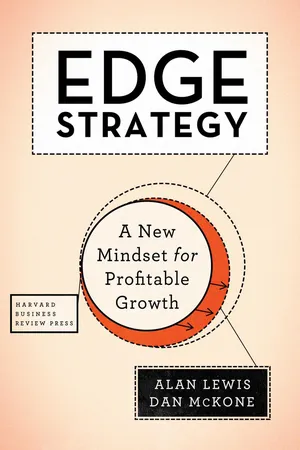
Are you missing opportunities for growth that are right in front of you? In today’s volatile economic environment, filled with uncertainty and sudden change, the forces pushing you to stay focused on the core business are extremely powerful. Profiting from the core is crucial, but the danger is that overfocus on the core can blind companies. Scanning the horizon for new markets and new products can also be tempting, but risky. Fixating too much on either strategy can cause you to miss the substantial opportunities for growth that are often hidden in plain sight, at the edge of the core business.In this insightful yet practical book, strategy experts Alan Lewis and Dan McKone articulate a mindset that helps leaders recognize and capitalize on these opportunities.The Edge Strategy framework challenges how the boundaries of your existing products and services map to your customers’ views of the world and then provides three different lenses through which you can see and leverage value:• Product edge. How to capture incremental profits and other benefits by slightly altering the elements and composition of a core offering
• Journey edge. How to create and capture extra value by adjusting your role in supporting the customer’s journey to and through your offering
• Enterprise edge. How to unlock additional value from resources and capabilities that support your core offering by applying them in a different context, for a different offering or different set of customersWith engaging examples across many industries, Lewis and McKone coach you on how to identify and assess each of the different "edges” and then provide concrete insights and advice on applying edge strategy and tactics to use in specific business contexts. The book concludes with a ten-step process to help executives and managers find and leverage the edges in their own companies. Edge Strategy is the concise, hands-on guide for growing your business by getting more yield from assets already in place, relationships already established, and investments already made.
- 224 pages
- English
- ePUB (mobile friendly)
- Available on iOS & Android
eBook - ePub
About this book
Information

CHAPTER 1
THE EDGE EFFECT
Why Edges Are Powerful
Everyone is looking for an edge, or advantage, in business. How do we win? How do we get ahead? What is the angle that will drive our company’s success? But an edge is not just a term for advantage itself; it can also be the place where you can find that advantage.
We define an “edge” as the outer rim that frames what you do and separates it, quite conveniently, from what you don’t. Edges are frontiers beyond which something changes. When you proceed beyond this border in business, the main thing that changes is risk (see figure 1-1).
Edges are not necessarily clear. To the contrary, many edges are quite fuzzy. When you look to the horizon, are you always sure where the sea ends and the sky begins? In business, strategy edges are like that too. Rare is the exact definition of how a product is positioned, what value a product delivers, or where different customers give a business permission to play. We argue that opportunity resides in this very ambiguity. If its edges are not well defined, a business can redefine them, ever so slightly, in its favor. And by staying within this nebulous but familiar space instead of moving to the less comfortable adjacent expanse or beyond, a business can find brilliant new ways to leverage its existing assets.
FIGURE 1-1
The outer rim or “edge” of your business

The edge of your business is the delineation of where your current offering begins and ends.
Edges have another interesting property; they are the places where the inside and the outside meet. As such, they tend to be where the action is. In nature, in civilization, and, indeed, in business, the peripheries teem with the most fascinating interactions. Where things meet, opportunities abound. Let’s start there.
The Edge Effect
Ecologists call the phenomenon we just described “the edge effect.” In the 1930s, Aldo Leopold, an American environmentalist, coined the term when explaining why quail, grouse, and other game birds were more prevalent in transitional agricultural landscapes than in single (homogenous) habitats like fields and forests. He posited that “the desirability of simultaneous access to more than one habitat” and “the greater richness of edge vegetation” supported a greater diversity and abundance of species.1
Since then, scientists have given these borderlands a name—“ecotones.” Eugene Odum, whose classic text, Fundamentals of Ecology, helped to popularize this idea in the 1950s, described an ecotone as “an area or zone of transition between two or more diverse communities.”2 He was thinking about the border between forest and grassland or between sea and shore. Places of transition between two ecosystems, such as the edge of forests, shorelines, wetlands, cliffs and mountain sides, estuaries, savannah, tundra, and deserts, are where the greatest diversity and opportunity exist for both flora and fauna. At the edges, the populations, resources, nutrients, lights, and food from both ecosystems mix. Some species exist only in ecotones, given the uniquely fertile environment that the combination of the two worlds creates.3
Odum’s work illuminated why these transitions are particularly fecund and helped explain why 90 percent of marine species live within the 10 percent of ocean nearest the shore.4 But the edge effect also helps to answer other questions that stretch far beyond the natural world.
For instance, why is it that 75 percent of Canadians live within a hundred miles of the US border?5 Here, along a 4,400-mile stretch of land, lies the possibility of doing business with the biggest economy in the world.6 Throughout history, people have focused on edges and built ports—literally, “doors” or gateways—to facilitate trade between different communities that exist on either side.
Karl Polanyi, a Hungarian-American economist, has written extensively on the subject of “ports of trade,” providing detailed explanation of how these locations served to drive the cogs of the economy and commerce from as long ago as 2000 BC.7 These edges are highly varied. Terrel Gallaway, expanding on the work of Polanyi, noted that “[p]orts of trade, like any ecotone, cannot be defined in solely spatial terms.”8 These crossroads also promote the establishment of the enablers of commerce. Some, such as Hong Kong or Singapore, are located on the coast. Others, such as Timbuktu, an old Saharan caravan town linking ancient trade routes, are located on the edge of the desert. Istanbul was built on a border where continents meet—the blurred area that is neither exactly Europe nor Asia, but has a strong cultural influence from both.
It is no surprise that academics draw parallels between the ecotones of nature and the “economic ecotones” of ports of trade and even extend the logic further to the routes that exist between them. Typically, these are also situated at the edges between civilizations. Great trade routes have seeded the major cities of the world and been the conduits for advancement. “Such a river of life as nowhere else exists in the world” is how Rudyard Kipling described the collection of cultural meeting points that make up the Grand Trunk Road.9
Three Types of Business Ecotones
We can also apply this concept of ecotones to individual businesses, to powerful effect. In our work, we have observed that this “transitional bonanza,” this “opportunity between things,” is alive and well at the level of individual corporations. As in nature, these phenomena are often familiar; once recognized, they may even seem obvious. However, before they are exploited, they must be spotted. Consider the many edges that frame a business.
First, there is the boundary where you and your customers come together. Of all the activities that an organization undertakes, this transition is the most important and certainly where all the money is generated. But just like the ecotones we discussed, the lines around a product or service are often imprecise (see figure 1-2). Companies frequently misgauge the desires of their customers, and those customers, in turn, can misconstrue the propositions of companies.
If you have ever been to a theme park or taken a cruise, you will recognize what we mean. While you could consider the booking or ticket of admission as your payment to enjoy all these suppliers have to offer—and, indeed, you have no obligation to spend any more to participate—you know that you are presented with endless opportunities to enhance your experience for a small (or not so small) incremental charge. These companies are masters of navigating the blurred lines around their core product.
Second, the temporal component of this interaction creates its own edges. In our nature analogy, the disruption and coming together, which occurs at the twilight transition between day and night, presents unique opportunities for animals to feed. As a result, a host of mammals, birds, and insects are most active during these times.10 Businesses, too, focus on temporal transitions. The relationship with customers can span everything from an exploratory shopping event to a lifetime of commerce. Even slightly modifying this period of interaction—the edge where the customer relationship begins and ends—is intuitively powerful.
FIGURE 1-2
Opportunities at the edge

The edge of your business is rarely a sharp perimeter but rather a nexus of opportunity.
Consider your own search for food. We expect that if you were in a grocery store today, you wouldn’t have given a second thought to the opportunities such a business has with a product as mundane as lettuce. Yet, someone had the insight to see that the journey to a meal for a customer who buys a head of lettuce isn’t complete: he has to wash it and chop it first before consuming it. This simple insight enabled the transformation of a commodity produce item to a highly profitable prepared food. As we will explore in chapter 3, helping the consumer by going a step further is now an important way that companies like Whole Foods Market have transformed their economics and enhanced their relationship with the customer.
Third, there are all the assets, tangible and intangible, that collectively define a business. These have edges, too. If an enterprise takes careful inventory, it will find that many of the parameters that describe what is core and noncore to its business are equally vague. It may even find that there is some room for interpretation in the very use of these resources and capabilities. In this way, the edges of assets themselves create opportunities.
You may not be surprised that a company like Toyota uses technology it installs in all the cars it sells in Japan to produce data that powers its onboard GPS service. You may be more interested to know that Toyota recognized that the value of this data was not uniquely associated with its primary use. As we will discover in chapter 8, this insight enabled Toyota to successfully launch a new business offering traffic telematics services to businesses and municipalities across Japan using the same data.
Companies Are Stacks of Foundational Assets
Most corporate mission statements and strategies attempt to answer some variation of the question, “What are we best at?” Firms tend to answer this question—and base their entire identities—by referring to their foundational assets. These can take the form of hard assets, such as a fleet of airplanes or a chain of retail stores. Or they can take the form of more intangible assets, such as smart employees or strong intellectual property based on a given skill.
Every business has a stack of foundational assets that contributes to the delivery of its core offering. At the bottom of this stack are any hard resources that your firm might have: land, buildings, equipment, mining rights, what have you. Above these are typically some softer resources: your labor force, the data you collect, and so on. On top of these lie the capabilities that you employ, the particular skills your company has acquired and honed over the years to make it more effective in its core business. At the top of the stack lies the more metaphysical properties of your organization—the culture, the ethos, the stuff that makes your company unique (see figure 1-3).
FIGURE 1-3
A company’s foundational assets

Your enterprise is built on a unique set of foundational assets to deliver your core offering.
These foundational assets are important. They help form the barriers to entry a company fosters to protect its market share. In most cases, these assets are the basis of how companies compete and seek to differentiate themselves from rival companies; they are the tools of the (win-lose) competition at the core of most corporate strategies today.
Players who invest early and well—or perhaps are a bit lucky—can capture a dominant position in their market that then creates the platform to sustain this advantage, returning the cost of capital and keeping shareholders happy. These are the core strategy winners, the exceptional performers. The first problem is that few (if any) companies are able to sustain core dominance over the long term. The second, bigger problem is that by definition, this route to success doesn’t even apply to most companies.
Rarely do most (if not all) companies realize the inherent value of their foundational assets. Despite their complexity, foundational assets are typically built to execute on a relatively narrow set of activities, delivering the core offering of the company and, ideally, doing so better than competitors. Companies typically devote much less time to additional, creative ways that they can leverage these assets.
Deriving Leverage from Foundational Assets
In our edge analogies, fundamental systems have evolved that allow magic to happen at the places of transition. Life is abundant at the ocean edge because a confluence of interactions there makes gathering nourishment easier.11 The twilight migration creates similar conditions for predators; the relative effort of hunting at a nexus of ac...
Table of contents
- Cover
- Title Page
- Copyright
- Contents
- Preface: An Alternative Path to Growth
- PART ONE: The Edge Framework and Mindset
- PART TWO: Building the Emotional Intelligence of Groups
- Notes
- Index
- Acknowledgments
- About the Authors
Trusted by 375,005 students
Access to over 1.5 million titles for a fair monthly price.
Study more efficiently using our study tools.
Frequently asked questions
Yes, you can cancel anytime from the Subscription tab in your account settings on the Perlego website. Your subscription will stay active until the end of your current billing period. Learn how to cancel your subscription
No, books cannot be downloaded as external files, such as PDFs, for use outside of Perlego. However, you can download books within the Perlego app for offline reading on mobile or tablet. Learn how to download books offline
Perlego offers two plans: Essential and Complete
- Essential is ideal for learners and professionals who enjoy exploring a wide range of subjects. Access the Essential Library with 800,000+ trusted titles and best-sellers across business, personal growth, and the humanities. Includes unlimited reading time and Standard Read Aloud voice.
- Complete: Perfect for advanced learners and researchers needing full, unrestricted access. Unlock 1.5M+ books across hundreds of subjects, including academic and specialized titles. The Complete Plan also includes advanced features like Premium Read Aloud and Research Assistant.
We are an online textbook subscription service, where you can get access to an entire online library for less than the price of a single book per month. With over 1.5 million books across 990+ topics, we’ve got you covered! Learn about our mission
Look out for the read-aloud symbol on your next book to see if you can listen to it. The read-aloud tool reads text aloud for you, highlighting the text as it is being read. You can pause it, speed it up and slow it down. Learn more about Read Aloud
Yes! You can use the Perlego app on both iOS and Android devices to read anytime, anywhere — even offline. Perfect for commutes or when you’re on the go.
Please note we cannot support devices running on iOS 13 and Android 7 or earlier. Learn more about using the app
Please note we cannot support devices running on iOS 13 and Android 7 or earlier. Learn more about using the app
Yes, you can access Edge Strategy by Alan Lewis, Dan McKone in PDF and/or ePUB format, as well as other popular books in Business & Business Strategy. We have over 1.5 million books available in our catalogue for you to explore.