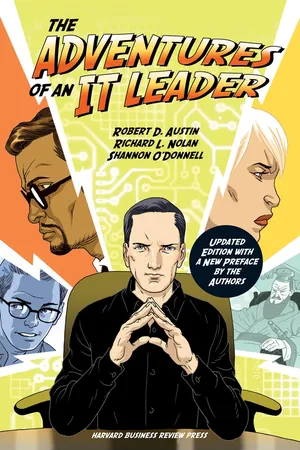
What does it take to lead and manage your company’s tech? Becoming an effective IT leader and manager presents a host of challenges—from anticipating emerging technologies, to managing relationships with senior executives, vendors, and employees, to communicating with the board. A good IT leader must also be a strong business leader.This book—now thoroughly updated with a new preface by the authors and current tech details and terminology—invites you to accompany new CIO Jim Barton as he steps up to leadership at his company. You’ll get a deeper understanding of the role of IT in your own organization as you see Jim struggle through a tough first year, handling (and fumbling) all kinds of management challenges. Although fictional, the scenarios are based on the authors’ long experience working with real-life companies across industries and sectors. The Adventures of an IT Leader is both an insightful story and an instructive guidebook. You can read it from beginning to end or treat it as a series of cases, skipping around to different chapters that address your most pressing needs. (For example, if you need to learn about crisis management and security, read chapters 10–12.) You can also test yourself and think about how to use the book’s lessons in your own company by reading the authors’ "Reflection” questions at the end of each chapter.This book is your indispensable manual for IT management and leadership, no matter what business you’re in.
eBook - ePub
The Adventures of an IT Leader, Updated Edition with a New Preface by the Authors
- 320 pages
- English
- ePUB (mobile friendly)
- Available on iOS & Android
eBook - ePub
The Adventures of an IT Leader, Updated Edition with a New Preface by the Authors
About this book
Information
PART ONE
THE HERO CALLED TO ACTION

CHAPTER ONE
THE NEW CIO
Friday, March 23, 11:52 AM . . .
Jim Barton sat motionless in a blue leather chair, one of several positioned around an elegant glass table at one end of the CEO’s corner office. At the other end of the room, Carl Williams stood looking out a window. The silence lengthened. Finally, Williams turned to look at Barton. “Speechless” was not a word most people could imagine applying to Jim Barton. His energy and outspokenness as head of the Loan Operations department had made him one of IVK’s most dynamic executives, a key player and a likely CEO someday—of a different company, if not this one.
But the news Williams had delivered moments before had left Barton dumbfounded.
A few minutes earlier, Barton had rushed to Williams’s office, summoned for his turn with the new chief. All morning, the leadership team members had marched, one at a time, down that hallway, each on a journey to discover his or her fate. As the executive assistant greeted him courteously and waved him in, Barton allowed himself some optimism.
Most likely, he thought, he was about to receive a promotion. He’d done a good job, been a big contributor as the company had grown to its present size. Something like “Chief Operating Officer” would fit him nicely.
On the other hand, to hear that he was being asked to leave would not have enormously surprised him. He hadn’t done anything to warrant such treatment, but unexpected things happen when companies are in crisis. The logic behind executive appointments, retirements, resignations, and firings was rarely transparent. Sometimes, Barton thought, there was little logic to it at all.
The timing of his meeting gave Barton reason for hope. According to word going around, firings, resignations, and forced retirements had been handled in the first meetings of the day. Since midmorning, he’d heard mostly about reassignments. Executives called in to the early-morning meetings had departed as soon as they’d finished, but for a while now, the people emerging from meetings with the CEO had been going back to their desks. It was late enough in the day—he might just be in line for that plum job.
But his mood darkened when Williams, standing by the window, not looking at Barton, began to speak. The CEO’s words struck Barton with near-physical force.
“Jim, I don’t think you’re going to like this very much.”
Barton’s mind raced. Why would he wait this late in the day to fire me? What have I missed or misunderstood? He pulled himself together well enough to answer, “Just tell me, Carl. We’re all grownups here.”
Williams chuckled. “It’s not what you think. We’re not asking you to leave or anything like that. But when you hear what I have to offer, your first inclination may be to think along those lines yourself. Though I sincerely hope not.”
To Barton, Williams’s gestures, standing across the room, staring out the window—the entire scene—appeared overly dramatic. Although the view from the thirty-fourth floor was enticing, Williams wasn’t admiring the panorama, he was avoiding eye contact. Barton glanced around, seeking additional clues to what might be going on. The office, he noticed, had been completely transformed, all signs of the previous occupant obliterated. That was too bad. Barton had gotten along well with Kyle Crawford, the former CEO. There had been rocky moments, but suddenly, looking back, those didn’t seem too awful.
“As you know,” Williams continued, “the board is determined to get things on track. They want us back on our earlier, steeper growth trajectory. They believe, and I agree, that the controversy that has dogged us for the last eight months has been a damaging distraction. When they brought me in from outside, they asked me to take a look at the company and to formulate a recovery plan.
“As you probably suspected, the board asked me to reconstruct the leadership team, to clear away the rot that might remain from the way some things were done in the past—to recommend the composition of a team that could rise to the challenges we are facing in the coming months. I’d like you to be on that team.”
Relief. It didn’t sound like a demotion. Williams continued.
“It has been a difficult process. I haven’t told anyone else this, but the first time I went to the board with my proposed team, they balked. They asked for additional changes. I had originally proposed a very different role for you than the one you’ve ended up in.”
An unusual assignment. I can live with that. Spirits lifting, Barton made a constructive noise: “I’m willing to do whatever will help,” he offered. “You know me, Carl. I’m a team player.”
“I’m delighted that you are taking that attitude,” said Williams, who smiled but maintained his place at the window.
“You see, after a considerable amount of shuffling and reshuffling, and having discussed this with the board extensively, we’ve . . .” Here Williams drew in a deep breath, “Well, we’ve decided that you should be our new chief information officer.”
This was the news that had knocked the air out of Jim Barton, reducing him to this unfamiliar wordless state. After allowing Barton a moment, Williams finally turned from the window. Barton felt his boss’s gaze burn into him. Finally, Barton managed to babble: “CIO? You want me to be the CIO?”
“Davies has been overwhelmed in that role. You’ve been one of his most outspoken critics.”
“I know, but . . . I’ve got no background in information technology.”
“By all accounts, you have a lot of ideas on how IT should be run. Many people think they’re pretty good ideas. I think you’ve said a few things along those lines to me, even in my short time here. Unlike Davies, you’ll report directly to me.”
Not yet able to unpack a tangle of additional objections crammed together in a ball at the top of his mind, Barton simply repeated himself: “But I’ve got no background in IT.”
“And Davies has a lot. That clearly didn’t work, so we’ve decided to try something else.” Williams moved to the table and sat down. The CEO leaned forward, locking eyes with Barton. “You’re a good manager, one of our best. You may not know much about IT, but we think you’ll figure it out.”
“I’ll figure it out?”
“Yes.” He nodded and leaned back in his chair. “It’s very important, you know.”
“I know it’s important. I’ve been saying that myself.”
“A lot of people have heard you, loud and clear. The members of the board of directors agree. We’re not a small firm anymore. Haven’t been for a while. Increasingly, we’re more of a financial services factory. But we don’t come close to running the company that way yet. That’s got to change. And a huge part of the change will be IT.”
Barton could hardly object. Williams was paraphrasing arguments that Barton had made many times. When he’d made these arguments, though, he’d never imagined that it might become his job to act on them. The sobering thought that he might need to figure out how to implement his own recommendations helped him recover.
“What’s going on with Davies?” asked Barton.
“Gone,” said Williams. “This morning.”
So there would not even be a transition period. Just as well. Barton had never gotten along with Davies. Davies didn’t like Barton, and who could blame him? Barton had been very critical of IT. He wasn’t proud of it, but he’d even occasionally stooped to making fun of Davies’s weird taste in neckties.
“Carl,” said Barton, “I just don’t think I’m the right choice. It’s not the place I can add the most value. Can I ask you to reconsider?”
Williams stood, strode to his desk, ready to move on to his next meeting. “It’s done,” he said. “I know it’s a shock, but I think this is a fundamentally sound choice. Think about it. If you can manage a modicum of objectivity, I think you’ll see that it’s a good idea. As unexpected as this may seem, it’s not a punishment. IT is a problem area. You are a highly regarded fixer. It’s going to be hard, but if you succeed, it will be very good for this business.”
“I just can’t see it at the moment,” said Barton.
“Give it time,” said Williams, impatience creeping into his voice, “but not too much time. I sincerely hope you won’t do anything stupid, like walking out. Let me know what you decide.”
The meeting was over. Williams still had many others to talk to before his day was finished.
Barton stood and walked slowly toward the door, but turned back as he approached it.
“Thanks, Carl,” he said, automatically.
Williams looked up, trying to determine whether Barton intended sarcasm, deciding that he did not. “You are most welcome,” he said. Then he looked down at a sheaf of papers on his desk to remind himself who was next on the day’s meeting schedule.
Friday, March 23, 2:41 PM . . .
A small crowd was forming outside Barton’s office. All day, eager IVK employees had been working on a whiteboard in the back of a storage room to create a chart showing the new management team for the company, as well as they could discern it. It was detective work, following clues to possible scenarios and likely conclusions. All of it would be announced soon enough, of course—probably as soon as Monday—but curious souls could not wait that long. Besides, it was fun, in a fatalistic sort of way, this sleuthing for facts that might have implications for all, their jobs and careers. Certainly, it was more fun than fretting or doing their desk jobs.
Much was known. Some executives had told people of their new assignments. Others’ roles had been determined by mysterious, undisclosed means. Still others had been escorted from the building and were presumed gone for good.
Jim Barton remained the biggest puzzle. He hadn’t been let go, but had said nothing to anyone about what Williams had offered him, and he was an obvious fit in none of the remaining slots. When inquisitiveness overwhelmed them, people gravitated to the corridor outside Barton’s office. The bold ones squinted through glass and half-closed blinds to try to see what he was doing.
Barton was oblivious to their attention, lost in a thick fog, oscillating between anger and excitement, as unsure as he had ever been about anything. One minute he’d decided to resign, the next he was jotting notes for improvements to IT processes. He’d skipped lunch, a bad idea, he realized now. At 1:35 pm, he’d begun searching the web. His eyes were locked on his screen. From within his sphere of intense concentration, he could not have seen people peering in at him even if he’d looked right at them.
The first thing he had typed was “IT Management.” His search had produced 2,510 million web pages on that subject. He clicked on the first of these; what looked like a table of contents for a magazine appeared. He scanned it. “Outsourcing IT.” That seemed like a legitimate management issue. The next few items, reviews of new devices, not so much. Then came stories about companies that had succeeded with things that had tech-sounding names. Acronyms littered the pages. Most of what he saw didn’t look like “management” at all. This was one of Barton’s pet peeves. He used to say it to Davies all the time: “IT management has to be about management. Talk to me about management. Profit. Risk. Return. Process. People. Don’t tech-jargon me.”
Barton stood up, moved to his whiteboard, and erased everything on it. Then, at the top, in big letters he wrote, “IT management is about management.” He underlined the second “management” and looked around unsuccessfully for a pen of a different color that he could use to emphasize the word even more.

For a while, he just stared at what he had written. Then he rolled his eyes and slapped the pen back onto the whiteboard tray. “That helped a lot,” he said sarcastically.
He moved back to his chair and started surfing from link to link, not pausing to read most pages. In the blur of passing words and graphics, a sentence caught his eye, prompting him to stop: “More than any other group within a company, IT is positioned to understand the business end-to-end, across departmental boundaries; no other department interacts with as many different parts of the business as IT.” What a bunch of crap, he thought. As he’d seen again and again, IT people did not understand the business. That was one of his big problems with them. But as he read the sentence again, as he thought about it carefully, he realized it didn’t say, “IT understands the business better than any other group.” It said IT is positioned to see better into more corners of the company. IT people have an advantage in gaining a deep understanding of the business. Doesn’t mean ...
Table of contents
- Cover
- Title Page
- Copyright
- Dedication
- Contents
- Preface
- Introduction
- PART ONE: THE HERO CALLED TO ACTION
- PART TWO: THE ROAD OF TRIALS
- PART THREE: THE HERO’S ORDEAL
- PART FOUR: THE HERO BREAKS THROUGH
- PART FIVE: MASTER OF TWO WORLDS
- Epilogue
- Notes
- Ways of Using This Book
- Glossary of Acronyms and Terms
- Index
- Acknowledgments
- About the Authors
Trusted by 375,005 students
Access to over 1.5 million titles for a fair monthly price.
Study more efficiently using our study tools.
Frequently asked questions
Yes, you can cancel anytime from the Subscription tab in your account settings on the Perlego website. Your subscription will stay active until the end of your current billing period. Learn how to cancel your subscription
No, books cannot be downloaded as external files, such as PDFs, for use outside of Perlego. However, you can download books within the Perlego app for offline reading on mobile or tablet. Learn how to download books offline
Perlego offers two plans: Essential and Complete
- Essential is ideal for learners and professionals who enjoy exploring a wide range of subjects. Access the Essential Library with 800,000+ trusted titles and best-sellers across business, personal growth, and the humanities. Includes unlimited reading time and Standard Read Aloud voice.
- Complete: Perfect for advanced learners and researchers needing full, unrestricted access. Unlock 1.5M+ books across hundreds of subjects, including academic and specialized titles. The Complete Plan also includes advanced features like Premium Read Aloud and Research Assistant.
We are an online textbook subscription service, where you can get access to an entire online library for less than the price of a single book per month. With over 1.5 million books across 990+ topics, we’ve got you covered! Learn about our mission
Look out for the read-aloud symbol on your next book to see if you can listen to it. The read-aloud tool reads text aloud for you, highlighting the text as it is being read. You can pause it, speed it up and slow it down. Learn more about Read Aloud
Yes! You can use the Perlego app on both iOS and Android devices to read anytime, anywhere — even offline. Perfect for commutes or when you’re on the go.
Please note we cannot support devices running on iOS 13 and Android 7 or earlier. Learn more about using the app
Please note we cannot support devices running on iOS 13 and Android 7 or earlier. Learn more about using the app
Yes, you can access The Adventures of an IT Leader, Updated Edition with a New Preface by the Authors by Robert D. Austin, Shannon O'Donnell, Richard L. Nolan in PDF and/or ePUB format, as well as other popular books in Business & Information Management. We have over 1.5 million books available in our catalogue for you to explore.