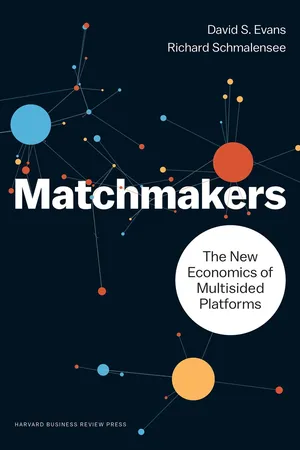
Many of the most dynamic public companies, from Alibaba to Facebook to Visa, and the most valuable start-ups, such as Airbnb and Uber, are matchmakers that connect one group of customers with another group of customers. Economists call matchmakers multisided platforms because they provide physical or virtual platforms for multiple groups to get together. Dating sites connect people with potential matches, for example, and ride-sharing apps do the same for drivers and riders. Although matchmakers have been around for millennia, they’re becoming more and more popular—and profitable—due to dramatic advances in technology, and a lot of companies that have managed to crack the code of this business model have become today’s power brokers.Don’t let the flashy successes fool you, though. Starting a matchmaker is one of the toughest business challenges, and almost everyone who tries to build one, fails.In Matchmakers, David Evans and Richard Schmalensee, two economists who were among the first to analyze multisided platforms and discover their principles, and who’ve consulted for some of the most successful platform businesses in the world, explain how matchmakers work best in practice, why they do what they do, and how entrepreneurs can improve their chances for success.Whether you’re an entrepreneur, an investor, a consumer, or an executive, your future will involve more and more multisided platforms, and Matchmakers —rich with stories from platform winners and losers—is the one book you’ll need in order to navigate this appealing but confusing world.
- 272 pages
- English
- ePUB (mobile friendly)
- Available on iOS & Android
eBook - ePub
About this book
Information
Part One
Economics and Technologies
Chapter 1
A Table for Four at Eight
How a Matchmaker Took the Friction out of Restaurant Reservations
It’s Saturday morning in the summer of 1998. Julie Templeton’s mom and dad are coming into town the next weekend. She and her husband, Chuck, want to treat them to a gala restaurant weekend in San Francisco, with dinners out Friday, Saturday, and Sunday nights.
Julie starts dialing for reservations. No answer. She leaves a message. She keeps calling, restaurant after restaurant. Some don’t have anything on the evenings she wants. One she wants to go to on Sunday isn’t open. Almost four hours later, after a lot of calling and juggling, she’s got the weekend planned.1
Back then, making dinner reservations was hard. Taking them was, also. Most restaurants still took reservations over the phone. Someone wrote them down with a pencil, on paper, in a notebook. Often, tables went empty if the phone didn’t ring enough. Restaurants had no way to let people know when they had tables available.
Julie Templeton’s persistence paid off. Most people, though, just aren’t willing to work that hard to get a restaurant reservation. As a result, in 1998, on a typical Saturday night in San Francisco, there were unhappy couples sitting at home, perhaps having takeout pizza, who had given up trying to get a table for their date night, and unhappy restaurant owners with tables sitting empty, not making ends meet in a tough business.
The market for matching up diners with tables at restaurants wasn’t working very well. Restaurants and diners spent a lot of resources—time and effort—getting together, and even so tables went empty and diners stayed home. That’s the sort of problem that an important, but until recently overlooked, type of business sets out to solve by helping parties who have something valuable to exchange find each other, get together, and do a deal.
Multisided Platforms
In 1998, this important type of business didn’t have a name. That’s surprising, in retrospect. Many businesses had been built to reduce these sorts of market frictions, which economists tend to call transaction costs. Their basic business model had been around for thousands of years. But business schools didn’t teach classes on how to start or run businesses that help different parties get together to exchange value. Economists didn’t have a clue how these businesses worked. In fact, the companies that reduced these market frictions charged prices and adopted other strategies that economic textbooks insisted no sensible business would do.
Now we call these businesses multisided platforms.2 Don’t let the economists’ unsexy name fool you.3 Multisided platforms are anything but boring. Some even facilitate mating. Multisided platforms can create great value for society and fortunes for their entrepreneurs and investors. Three of the five most valuable companies in the world in 2015—Apple, Google, and Microsoft—use this business model.4 So do seven of the ten start-ups with the highest market values—including Uber and Airbnb.5
Let’s get one thing clear, though, before you invest more time in learning about multisided platforms from us. This isn’t a gee-whiz “use the [fill in the buzzword] strategy and you’ll make a billion, impress your boyfriend or your mom, and retire by the age of thirty-five” book. We aren’t going to tell you that the matchmaker strategy, which did make Bill Gates the richest person on earth, will work for you. It probably won’t.
Many entrepreneurs—and many otherwise highly successful businesses—have tried this “simple” strategy and failed. Everything they and their investors put into their multisided platform ventures went up in smoke.
A multisided platform is one of the toughest business models to get right. The entrepreneur has to solve a tough puzzle and use counterintuitive strategies to make a go of it. Just ask Julie Templeton’s husband, a former Army Ranger. He found out exactly how hard it was to fight the frictions in the restaurant-reservation business. And he’s one of the rare success stories.
OpenTable’s Quest for Critical Mass
After his wife’s frustrating morning, Chuck Templeton figured there had to be a better way to get people and restaurants together. In October 1998, at age twenty-nine, two months after getting married, he quit his job to do just that.
Like many others that year in Silicon Valley, he started a dot-com and quickly got funded. OpenTable was ready to rock.6 Droves of consumers were coming online. Chuck thought at first that he just needed a website to which they could connect. The rest would be easy.
Except, as he soon discovered, most restaurants didn’t even have a computer, much less Internet connectivity at the host stand, where they managed reservations. Three years after the commercial Internet got kicking and two decades after Apple introduced the first mass-market personal computer, restaurants were still doing things the old-fashioned way. There was no way to connect to restaurants online, much less to make a reservation online.
Templeton realized he needed to get restaurants to ditch their reservation notebooks for a computer-based table management system. And to get that hooked up to the Internet at the host stand. So his company first built a table management system. With it, restaurants could type reservations into a database, monitor table availability, record cancellations, keep track of their best customers, and, in principle at least, take reservations online.
Finding that restaurants were reluctant to make large investments to purchase table management systems, OpenTable decided to charge a small installation fee and a monthly rental for its new system instead of requiring purchase. It then went knocking on the doors of restaurants in San Francisco to get them to lease the new software.7 Even without the promise of new reservations, this was good enough for some of the better restaurants that needed more help with managing their tables and tracking their best customers than with filling seats. One by one, restaurants signed on. By early 1999, the company had about ten.
OpenTable also built a consumer website where people could make reservations. That opened in March 1999. People didn’t have to pay to use it. In fact, the company offered to give people points for making reservations. If they got enough points, they could redeem them to get a discount on their next meal. Restaurants, though, had to pay $1 for every person who sat at one of their tables as a result of a reservation made through the OpenTable site.
Even with the subsidies for making reservations, however, the website wasn’t attractive to customers at first. There just weren’t that many restaurants to choose from. The odds were slim to none of making a reservation at a restaurant in San Francisco where a diner wanted to go at a time when he or she wanted to go. Hardly anyone used the website. That made it difficult to recruit more restaurants beyond the early adopters who were content with just the table management software.
With limited time and resources, OpenTable had to strike the right balance between getting consumers and restaurants on board. Money wasn’t a problem. Chuck raised $36 million in venture capital financing between 1998 and early 2000.8 He also helped recruit an experienced CEO who joined the company in May 2000.9
OpenTable, with a flush bank account and a new CEO, decided to focus on signing up as many restaurants as it could. By the summer of 2001, the company had restaurants in fifty cities. But, more than two years after its launch, and a year after its new CEO pursued aggressive growth, OpenTable had a serious problem.
While it had some restaurants in many cities, it didn’t have a lot of restaurants in any city. If you want to go out to dinner on Saturday night in San Francisco, a table for four in Seattle doesn’t do you much good. In fact, OpenTable found that diners wanted to have at least a dozen choices of restaurants for the time, cuisine, and part of town where they wanted to go.10 To give diners that many options in any city, OpenTable had to sign up many restaurants there. Because it offered few choices in every city, consumers weren’t using its website much to make reservations in any city.
OpenTable was floundering. It was burning through $1.1 million a month. The investors considered cutting their losses and shutting it down. They decided, however, to double down but with yet another CEO and strategy. A board member and investor, Thomas Layton, took the helm in the fall of 2001.
The company shifted its focus to recruiting restaurants in just four cities: San Francisco, Chicago, New York, and Washington, DC. The idea was that once OpenTable had signed up enough restaurants in a city, its website would become attractive to consumers in that city. As consumers began making online reservations, it would persuade more restaurants to sign up, which in turn would lead even more consumers to use the website.
That worked. OpenTable got enough restaurants in San Francisco to get many consumers to come to its website and make reservations. And as more people used its website, it became easier to recruit more restaurants in San Francisco. Restaurants, particularly new ones, realized the value of filling up empty seats. Since most of the cost of running a restaurant is fixed in the short run, a restaurant can make a significant profit on every additional seat it fills.
By 2004, around the time Chuck Templeton left the start-up to pursue other endeavors, OpenTable had ignited. It was growing rapidly in its four target cities as diners attracted more restaurants, which attracted more diners, and the process continued. It then adopted the same approach in other cities. It had learned that it should initially focus on recruiting the most popular restaurants in every town. Its salespeople just went down the lists provided by Zagat.11 OpenTable went public in 2009 with a market cap on its first trading day of $626 million.12 It was sold to Priceline for $2.6 billion in 2014.
In 2015, seventeen years after Templeton’s insight that technology could be used to reduce the friction that kept diners and restaurants apart, thirty-two thousand restaurants, mainly fine-dining establishments with tablecloths, use OpenTable’s table management software. Sixteen million people use its website to make reservations every month. Since its inception, acting as the matchmaker between restaurants and diners, it has put more than 830 million diners in seats at restaurants in the United States, Canada, Germany, Japan, Mexico, and the United Kingdom.13
OpenTable still has the same business model that Chuck Templeton proposed to investors back in 1999. Let people make reservations for free and even give them a little reward. Charge restaurants a buck for every seat the reservation website fills and a monthly fee for the software. Secure a critical mass of restaurants and diners in each city, and they will ignite growth by attracting still more restaurants and diners.
Ancient Roots, Weird Economics, and a Puzzle
OpenTable used software and Internet technology to match restaurants and diners. It made it easier for consumers to make reservations and gave them more choices than they had in the dialing-for-a-table days. It made restaurants money by filling empty tables and thus generating extra margin. OpenTable employed a mu...
Table of contents
- Cover
- Praise
- Title Page
- Copyright
- Table of Contents
- Introduction
- Part I: Economics and Technologies
- Part II: Building, Igniting, and Operating Matchmakers
- Part III: Creation, Destruction, and Transformation
- Glossary
- Notes
- Index
- Acknowledgments
- About the Authors
Trusted by 375,005 students
Access to over 1.5 million titles for a fair monthly price.
Study more efficiently using our study tools.
Frequently asked questions
Yes, you can cancel anytime from the Subscription tab in your account settings on the Perlego website. Your subscription will stay active until the end of your current billing period. Learn how to cancel your subscription
No, books cannot be downloaded as external files, such as PDFs, for use outside of Perlego. However, you can download books within the Perlego app for offline reading on mobile or tablet. Learn how to download books offline
We are an online textbook subscription service, where you can get access to an entire online library for less than the price of a single book per month. With over 1.5 million books across 990+ topics, we’ve got you covered! Learn about our mission
Look out for the read-aloud symbol on your next book to see if you can listen to it. The read-aloud tool reads text aloud for you, highlighting the text as it is being read. You can pause it, speed it up and slow it down. Learn more about Read Aloud
Yes! You can use the Perlego app on both iOS and Android devices to read anytime, anywhere — even offline. Perfect for commutes or when you’re on the go.
Please note we cannot support devices running on iOS 13 and Android 7 or earlier. Learn more about using the app
Please note we cannot support devices running on iOS 13 and Android 7 or earlier. Learn more about using the app
Yes, you can access Matchmakers by David S. Evans, Richard Schmalensee in PDF and/or ePUB format, as well as other popular books in Business & Business Strategy. We have over 1.5 million books available in our catalogue for you to explore.