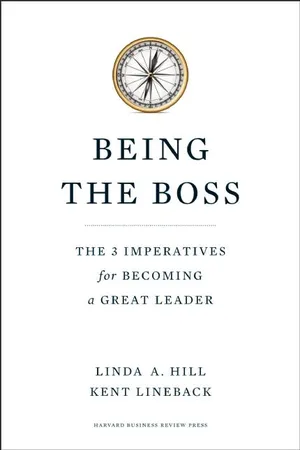
You never dreamed being the boss would be so hard. You're caught in a web of conflicting expectations from subordinates, your supervisor, peers, and customers.You're not alone. As Linda Hill and Kent Lineback reveal in Being the Boss, becoming an effective manager is a painful, difficult journey. It's trial and error, endless effort, and slowly acquired personal insight. Many managers never complete the journey. At best, they just learn to get by. At worst, they become terrible bosses.This new book explains how to avoid that fate, by mastering three imperatives:· Manage yourself: Learn that management isn't about getting things done yourself. It's about accomplishing things through others.· Manage a network: Understand how power and influence work in your organization and build a network of mutually beneficial relationships to navigate your company's complex political environment.· Manage a team: Forge a high-performing "we" out of all the "I"s who report to you.Packed with compelling stories and practical guidance, Being the Boss is an indispensable guide for not only first-time managers but all managers seeking to master the most daunting challenges of leadership.
- 304 pages
- English
- ePUB (mobile friendly)
- Available on iOS & Android
eBook - ePub
About this book
Information
1
YOUR 3 IMPERATIVES
AS A MANAGER
Making Sense of Your Journey
7:52 a.m. Jason picks up his phone messages. The first came at 9:25 p.m. yesterday from Dr. Schmidt, a computer scientist at a major U.S. university who's on the Project Emerge editorial advisory board. Speaking rapidly, Schmidt presents a litany of problems with the outline of the initial course, Introduction to Programming. The second message is from Barry Hultgrund, a call Jason didn't take when it came earlier. Barry is the finance analyst assigned full-time to Project Emerge—he more or less works for Jason—and he's reminding Jason that preliminary budget numbers are due today for the next fiscal year, which begins in less than four months.
Jason feels another twinge of anxiety. He knows the budget is looming but he forgot the numbers are due today. He adds it to his list.
7:58 a.m. Jason sends an e-mail to Sumantra Tata, his senior editor, telling him to get back right away to Dr. Schmidt, the adviser who called, and reminding him it's the second message from Schmidt in two days.
8:00 a.m. Jason receives a call from Jacques Levanger, his contact and a senior official at the IFTE. Levanger has been out all week until today; he and Jason are scheduled to meet on Monday when Jason will take the train to Paris, where the IFTE is headquartered. Levanger is calling to ask whether there's a problem, because, like Jason, he arrived at the office early and found a message from Dr. Schmidt. Jason tells Levanger he'll be in touch with Schmidt today. “Yes, please do,” says Levanger. “We don't need more problems with Project Emerge now. In any case, I look forward to our meeting.”
Jason adds a note about Schmidt and the IFTE to his list. The International Fund for Technical Education is a strategic partner crucial to Project Emerge. Funded by the aid organizations of the world's largest economies, philanthropic foundations, and international companies desperate for skilled local talent, its strategy is to jump-start commercial interest in markets that might not yet seem attractive. For Jason, the IFTE's specific role and critical contribution is to help create partnerships between Project Emerge and the over two thousand local educational institutions in its network.
8:05 a.m. Jason's mobile vibrates. A text message from Laraba Sule, Project Emerge marketing manager. A Nigerian who attended the London School of Economics, she's worked in media and marketing at Reynolds for eight years and is a recent mother who works flextime. Her message reads, “We want to conduct an orientation session at International Sales Conference for the sales team assigned to help sell our programming course. But people in sales claim no time is available on the agenda. Please approach Mr. Jack Cavit about this important matter. It is very important for our plans.”
Jason sighs. This is not good news. Cavit is vice president of international sales, and his people pitch instructors at schools outside North America to adopt Reynolds' materials for their courses. Every publisher's sales live or die on the attention received from these people. Sales Conference, where they all gather to learn about coming new products, is a critical forum for convincing them yours is worth their interest. Publishers vie to get on the agenda. Other publishing groups have apparently convinced Cavit they're more important than Project Emerge.
8:09 a.m. Jason looks at Cavit's online calendar and sees that he's not free today and will be traveling next week. With apprehension, Jason calls Cavit's assistant, gets no answer, and leaves a phone message asking for a callback ASAP.
8:12 a.m. Jason leaves a note on the desk of his assistant, Kim Young, asking Kim to bring in the analyses Jason assigned to various people earlier in the week.
8:16 a.m. Glancing at his laptop, Jason sees a new e-mail from Sumantra, who's forwarding an e-mail exchange with Kathy Wu, an assistant editor in New York assigned half-time to Project Emerge. Wu's role, as Jason understands it so far, is to identify and take a first look at possible additional courses for the Project Emerge portfolio. Sumantra insists that she works for him. She insists that she works for the project publisher. Sumantra ends his e-mail to Jason with “We must have a VERY serious talk about this VERY soon. Please let me know your pleasure.”
8:19 a.m. Jason adds this to his list in the section for miscellaneous problems that includes a potpourri of other issues about salaries, performance reviews, promotions, sour work relationships, family problems, and who should get an empty cubicle with windows. He's put off dealing with any of these until he gets to know people better. He's still figuring out whom he can trust, who's good and who's not.
8:23 a.m. Jason tries Cavit's assistant again. She's just in and Jason explains why it's important that he talk to Cavit.
“Project Emerge,” he says, “is supposed to have four sales people assigned to it full-time for three months. They'll work with the IFTE in placing the new Project Emerge programming course with schools in the IFTE network. And we're supposed to run an orientation session for them at Sales Conference. But no salespeople have been assigned so far, and now I'm hearing there's no time available at Sales Conference.”
Cavit's assistant promises to check with her boss and get back.
As he hangs up the phone, Jason realizes that if nothing happens at the conference and the salespeople can't get started on schedule, it will throw into doubt all the projections for the coming academic year. And if Project Emerge is in trouble, he thinks, then his position, his career at Reynolds Ed, is in trouble too.
In the introduction, we said becoming a manager is a difficult journey of personal transformation that requires you to learn from experience over a long period, typically years, a journey most managers stop short of completing.
But why is management so difficult?
What Is Management and Why Is It Difficult?
What makes management difficult isn't the idea of management. That couldn't be more straightforward.
Management is responsibility for the performance of a group of people. It's a simple idea. The people you manage do the work and you're responsible. Yet, if the idea isn't difficult, putting it into practice is. Why? Because …
To carry out this responsibility, you must influence others, which means you must make a difference not only in what they do but in the thoughts and feelings that drive their actions. Management is defined by responsibility but it's done by exerting influence. That, in a nutshell, is what you do as a boss—influence others in ways that make them more productive as individuals and, especially, as a group. Thus, the central question we address in Being the Boss is this: How do you exert influence? What do managers actually do to shape and even change the behavior, thoughts, and feelings of others?
Watching real managers in action provides clues but no clear answers to these questions. We know from systematic observation that managers spend their time in an unending parade of mostly small events consisting mainly of person-to-person interactions, the majority of them unplanned encounters, with a wide variety of people, and covering a seemingly random mix of topics. Half the managers' activities took mere minutes to complete. Only a small percentage received more than an hour.1
Even at higher levels of an organization, general managers who run significant business units spend 70 to 90 percent of their working time with others, face-to-face, on the phone, conferencing on the Web, or interacting online through e-mail or more sophisticated social networking tools. Whatever form they take, most of their interactions are reactive, not proactive; many are interruptions. Most interchanges are quick; a single topic seldom gets more than ten minutes. Even brief exchanges typically cover a wide range of topics, both business and nonbusiness. The business issues discussed are a mix of the trivial, mundane, and important. Rarely is any subject explored in great depth. Time working alone occurs mostly at home, while commuting, or when traveling for work.
In all their interactions, managers rarely make definitive major decisions. They do spend much time trying to influence people, but mostly by asking, requesting, kidding, cajoling, nudging, persuading, and coercing—almost anything but issuing direct orders, which they do rarely.
Because much of what they do is fragmented and unpredictable, what they actually do is often different from what they planned to do. As one manager said, “Each day I go into the office with some preplanned action and at the end of the day, I have to regret that all the various things I [did] are very different.”2
Many managers think the problem is their lack of knowledge, experience, or skill, especially their inability to manage time. In fact, the problem in large part is the fundamental nature of management itself, which at virtually all levels is unavoidably pressured, time-constrained, fragmented, and hectic.
So forget the notion that managerial work is organized, reflective, and carefully planned, or that a good manager moves thoughtfully and systematically from planning, to organizing, to coordinating, to controlling, to the other activities on the traditional list of what managers do. As one researcher concluded, “Managers do one darn thing after another!”
Management Is Difficult Because of Its Inherent Paradoxes
The work of managers seems so fragmented, improvisational, and superficial because it embodies a panoply of paradoxes.3
A paradox is a statement that contains contradictory elements but is true or useful nonetheless. For example: “To focus on the work people do, focus on the people doing the work.” To make sense of this, you must find either the right balance point between the contradictions (focus on work versus focus on people) or the right way to combine them (deal with the work through the people doing it).
We describe here some of the more fundamental and difficult paradoxes that reside at the heart of management. This list is hardly exhaustive, and we'll point out others as they apply in subsequent chapters.
Paradox: You Are Responsible for What Others Do
Performance is the point of it all—the work done by your group. That's what you're responsible for. When your boss wants to know why an initiative is in trouble, he won't call in your whole group. He'll call you in, and you alone will sit in the hot seat. You're responsible and no one else. Yet you don't, or shouldn't, do the work.
How can anyone be truly responsible for what someone else does? Good question. We say it easily—responsible for the work of others—without appreciating its obvious and inherent difficulty. It makes complete sense only if you assume that in every situation you know what should be done and that people will do exactly what you say. Obviously, those assumptions are flawed, and only when you relinquish them can you understand what a difficult undertaking it is to answer for the work of others. To be successful at it requires that you work through others—that you include and work with them, rather than simply issue directives they must follow—a difficult task for anyone who prefers direct action and personal results.
Paradox: To Focus on the Work, You Must Focus on
People Doing the Work
Many managers think they manage the work. They don't. They're responsible for the work, but they get work done by influencing the people who do the work. What makes this complicated is what Peter Drucker pointed out: when you hire a hand, it comes with a head and heart attached.4 So you must pay attention, lots of attention, to the whole person—head and heart—because you need more than your people's time and attention. Most work now requires knowledge, judgment, thinking, and decision making, and so it matters if people care about what they do. You cannot simply give them orders and criticism. That rarely produces the kind of engagement you need. Other, less direct but more effective forms of influence—such as support, development, and encouragement—are needed that engage the whole person.
Paradox: You Must Both Develop Your People
and Evaluate Them
It is a boss's dual responsibility both to foster the development of her people and to determine if and when those same people must be removed because they cannot do the work. Logically, assessment is necessary for development, but the conflict of the paradox arises when the boss must abandon the goal of development and act solely in the interest of the group by releasing a person who cannot perform the work needed by the group. How do you, as manager, determine when it is time to make that tough choice? How do you work to develop someone and invest yourself in that person's progress—and then abandon him? How do you find the right balance between someone's need to learn and their need to perform? It's as much a psychological as a logical paradox, which makes it all the more difficult. Dealing with the opposing roles of coach and judge will present some of the most d...
Table of contents
- Cover Page
- Epigraphs
- Title Page
- Copyright
- Dedications
- Contents
- Acknowledgments
- Why We Wrote This Book
- Introduction: Where Are You on Your Journey?
- 1 Your 3 Imperatives as a Manager
- PART ONE Manage Yourself
- PART TWO Manage Your Network
- PART THREE Manage Your Team
- 12 Completing Your Journey
- Epilogue
- Appendix: Reynolds Education Organization Chart and List of Characters
- Notes
- Selected References
- About the Authors
Trusted by 375,005 students
Access to over 1.5 million titles for a fair monthly price.
Study more efficiently using our study tools.
Frequently asked questions
Yes, you can cancel anytime from the Subscription tab in your account settings on the Perlego website. Your subscription will stay active until the end of your current billing period. Learn how to cancel your subscription
No, books cannot be downloaded as external files, such as PDFs, for use outside of Perlego. However, you can download books within the Perlego app for offline reading on mobile or tablet. Learn how to download books offline
Perlego offers two plans: Essential and Complete
- Essential is ideal for learners and professionals who enjoy exploring a wide range of subjects. Access the Essential Library with 800,000+ trusted titles and best-sellers across business, personal growth, and the humanities. Includes unlimited reading time and Standard Read Aloud voice.
- Complete: Perfect for advanced learners and researchers needing full, unrestricted access. Unlock 1.5M+ books across hundreds of subjects, including academic and specialized titles. The Complete Plan also includes advanced features like Premium Read Aloud and Research Assistant.
We are an online textbook subscription service, where you can get access to an entire online library for less than the price of a single book per month. With over 1.5 million books across 990+ topics, we’ve got you covered! Learn about our mission
Look out for the read-aloud symbol on your next book to see if you can listen to it. The read-aloud tool reads text aloud for you, highlighting the text as it is being read. You can pause it, speed it up and slow it down. Learn more about Read Aloud
Yes! You can use the Perlego app on both iOS and Android devices to read anytime, anywhere — even offline. Perfect for commutes or when you’re on the go.
Please note we cannot support devices running on iOS 13 and Android 7 or earlier. Learn more about using the app
Please note we cannot support devices running on iOS 13 and Android 7 or earlier. Learn more about using the app
Yes, you can access Being the Boss by Linda A. Hill, Kent Lineback in PDF and/or ePUB format, as well as other popular books in Business & Leadership. We have over 1.5 million books available in our catalogue for you to explore.