You have a great idea, now what? That first mile—where an innovation moves from an idea on paper to the market—is often plagued by failure. In fact, less than one percent of ideas launched by big companies end up having real impact. The ideas aren’t the problem. It’s the process. The First Mile focuses on the critical moment when an innovator moves from planning to reality. It is a perilous place where hidden traps snare entrepreneurs and roadblocks slow innovators inside large companies.In this practical and enlightening manual, strategic adviser Scott Anthony equips innovators with new tools, questions, and examples to speed through this crucial early stage of innovation. You’ll learn:• How to evaluate your idea’s strengths and weaknesses using the "DEFT” process—Document, Evaluate, Focus, and Test
• Fourteen recipes from an "experiment cookbook” to gain confidence in your idea or business
• Why "spinouts,” "wrong turns,” and other challenges commonly trip up innovation—and the practical strategies you can use to avoid them
• Why innovators need to seek chaos in an age of constant change—and other essential leadership skillsDrawing on his decade of experience as an innovation adviser and investor, Anthony describes hard-won lessons from disruptive start-ups and global giants alike. The First Mile will give you the knowledge and confidence to travel this perilous—but ultimately promising—terrain.The first mile can be a scary place, but you don’t have to traverse it alone. This book can help.
- 256 pages
- English
- ePUB (mobile friendly)
- Available on iOS & Android
eBook - ePub
About this book
Information
PART I
The First Mile Toolkit
The following chapters build the First Mile Toolkit—a four-step process to manage strategic uncertainty. The chapters that follow describe how to:
• Document an idea to help surface hidden assumptions
• Evaluate that idea from multiple angles
• Focus on the most critical strategic uncertainties
• Test rigorously and adapt quickly
The acronym DEFT serves as an apt reminder that you’ll need to be adroit at handling the unpredictable twists and turns the first mile often involves, which makes a rigorous process that much more important.
CHAPTER 2
Document What You Plan to Do
The first stage in the DEFT process—document your idea—sounds innocent enough: write down what it is you are actually hoping to do. Amazingly enough, however, it is a step many innovators miss. As an example, our investment unit has reviewed close to four hundred plans over the past few years. Most of those plans deeply describe a cool technology or a massive market opportunity. Only a subset covers both. An even smaller number also describes the idea’s economics. Ever fewer talk about nitty-gritty operational details.
Adherents of the lean start-up methodology sometimes take the extreme perspective that research and thinking are useless—that learning comes only from developing prototypes and testing in-market. That’s not right. Any initial strategy for a new growth business will be partially wrong, but the thinking that went into it is likely to be partially right too. Consider the research Jeff Bezos did before he founded Amazon.com, which led him to focus on books rather than on music, clothing, or electronic appliances. Studying the book market then led Bezos to locate his company near some of the major book distributors in the Northwest of the United States. Sure, he might have gotten there through experimentation, but studying market dynamics helped him to cut a couple of corners. There’s no doubt that people inside large companies can over-engineer business plans, but don’t let the pendulum swing too far the other way. Good innovators invest the time to research their opportunities and formulate the most robust hypotheses they can so that they focus experiments on areas where the learning will have the greatest impact.
Because there isn’t one best way to document an idea, this chapter lays out a few different approaches to consider. It also describes a few tools that can help with documentation and highlights the most common mistakes innovators make.
A Starting Point: The First Mile Trinity
What does it take to successfully do something different that creates value? At the simplest level, any successful innovations share three characteristics:
• It must address a legitimate market or customer need (“Is there a need?” or in plain language “Who cares?”).
• It must address that need in a reliable and compelling way (“Can we do it?” or “Can we deliver?”).
• It must successfully create value along whatever metrics are pertinent for a particular effort (“Do the numbers work?” or “Does it matter?”).
So, at a basic level, you should be able to describe the specific problem you are targeting, the way in which you will address that problem (both in the short term and in the long term), and how that solution will translate into meaningful impact along whatever dimensions matter to you (revenue, profits, cash flow, process improvement, and so on).
The Next Step: Twenty-Seven Innovation Questions
While those three areas seem straightforward, providing good answers requires more detailed thinking. For example, to explain the nature of the need for your innovation, you have to understand who are the actual customers or end users and who influences them. You need to know how and why customers will use your idea and stakeholders will support it. Determining the viability of an idea requires thinking through elements such as production and distribution, and competitive response as well. Understanding whether it matters requires developing detailed understanding of how revenues are earned, what costs are required, and the flow of cash in the business.
So, a second-order description of an idea should consider (at least) twenty-seven specific questions that good innovators should be able to answer:
THE TARGET CUSTOMER
1. Who is the customer (or customers, if it is a multi-sided business like a media business that attracts an audience of consumers and then sells advertising to companies hoping to reach those consumers)?
2. What job is the customer struggling to get done?1
3. What suggests that the job is important and unsatisfied?
KEY STAKEHOLDERS
4. Who else is involved in the decision to purchase and use an offering?
5. What are their jobs to be done?
6. Why will they support the idea?
THE IDEA
7. What is the essence of the idea?
8. How will the idea ease the pain of the customers and key stakeholders?
9. How does it compare with other ways the customers could get the job done?
10. What makes it different and better?
11. What will it look and feel like?
THE ECONOMICS
12. What are the most likely revenue streams?
13. What is the cost of earning those revenues?
14. What infrastructure will be required?
15. What capital expenditures are required?
THE COMMERCIALIZATION PATH
16. What is the foothold market where you will start?
17. What is the plan to expand from the foothold?
18. Which competitive solutions are you most worried about? How will you beat them? How might you get them to ignore you?
OPERATIONS
19. What are the key activities involved in the opportunity?
20. Who is doing what?
21. What will you do?
22. What partnerships will you need to form?
23. What will you need to acquire?
THE TEAM
24. Who is on the team?
25. What have they done in the past that suggests that they have any chance of succeeding?
THE FINANCING
26. How much money is required to execute the plan?
27. How long will it take to earn a return on that money?
Obviously, some of these questions are easier to answer than others—and that’s okay. Part of the value of documenting is to get a better sense of what you actually know as opposed to what you are assuming. Documenting assumptions also makes it easier to revise a plan if basic assumptions change in the market. If you are working on a team, answer these questions as a group. Even people who work together on a daily basis frequently have differing underlying assumptions about an idea.
Capture Tools
There are three tools that we’ve found helpful to document a concept.
The first is something we call an idea resume. Just like a person’s resume condenses his or her professional history to one to two pages, an idea resume captures all of the salient components of an idea on a single page. We introduced the concept in our 2008 book, The Innovator’s Guide to Growth, and continue to believe in the usefulness of writing down the key elements of an idea. Fitting an idea on a page means making choices about which elements to include—a typical “vertical” idea resume on Microsoft Word has ten to twelve factors. A PowerPoint slide might have only four or five elements. Ideally, an idea resume should have more than just words—it should have a visual depiction (that’s a fancy way to say a drawing) of the idea. Figure 2-1 shows one version of a blank idea resume (note, some of the concepts here, such as the calculation of impact, critical uncertainties, and testing plan, are covered in more depth in subsequent chapters). A blank version of this tool can be downloaded from the companion website to this book.
Another popular tool is the business model canvas, described in detail in the international best-seller Business Model Generation, by Alexander Osterwalder and Yves Pigneur. The tool’s simplicity and visual clarity has made it a go-to source for many innovators. The canvas captures on a single page key elements of the business model—namely the customer, the offering, the channel to market, the marketing approach, and more. To capitalize on the tool’s popularity, Osterwalder has built a set of capture tools that work on laptops and tablets like the Apple iPad; these are available at Osterwalder’s website (www.businessmodelalchemist.com).

FIGURE 2-1
The third approach is to create a so-called business plan. Our bias is to avoid overly dense one hundred–plus page documents covering every conceivable component of an idea.2 Since every idea is partially right and partially wrong, obsessing about perfectly polished business plans is a waste of time. Rather, innovators should spend just enough time to make sure they have captured the essence of their idea so they can easily share it with others and move on to the next steps of the First Mile Toolkit.
Our venture capital arm has reviewed hundreds of business plans. One memorable one was the pitch for Wildfire in 2010. The idea was to develop a systematic approach to word-of-mouth marketing in China. There was a clearly demonstrated market need—a lack of media inventory made traditional advertising vehicles (thirty-second television commercials, newspaper advertisements, and the like) very expensive. To get their messages out, companies would blanket a city with leaflets or invest in in-store promoters who would push products. Further, global research consistently shows that recommendations from trusted sources carry significantly more weight than mass-market advertising messages. The strong social norms around guanxi, which essentially describes the power of trust-based relationships between people, makes China an even better market for word-of-mouth marketing.
Wildfire’s founding team met while studying at INSEAD’s campus in Singapore. Benjamin Duvall had previously worked at BzzAgent, a company that developed a word-of-mouth marketing business in the United States, and spoke fluent Chinese. His cofounder, Christoph Zrenner, had developed software that could help manage the myriad details that would form the backbone of the business.3
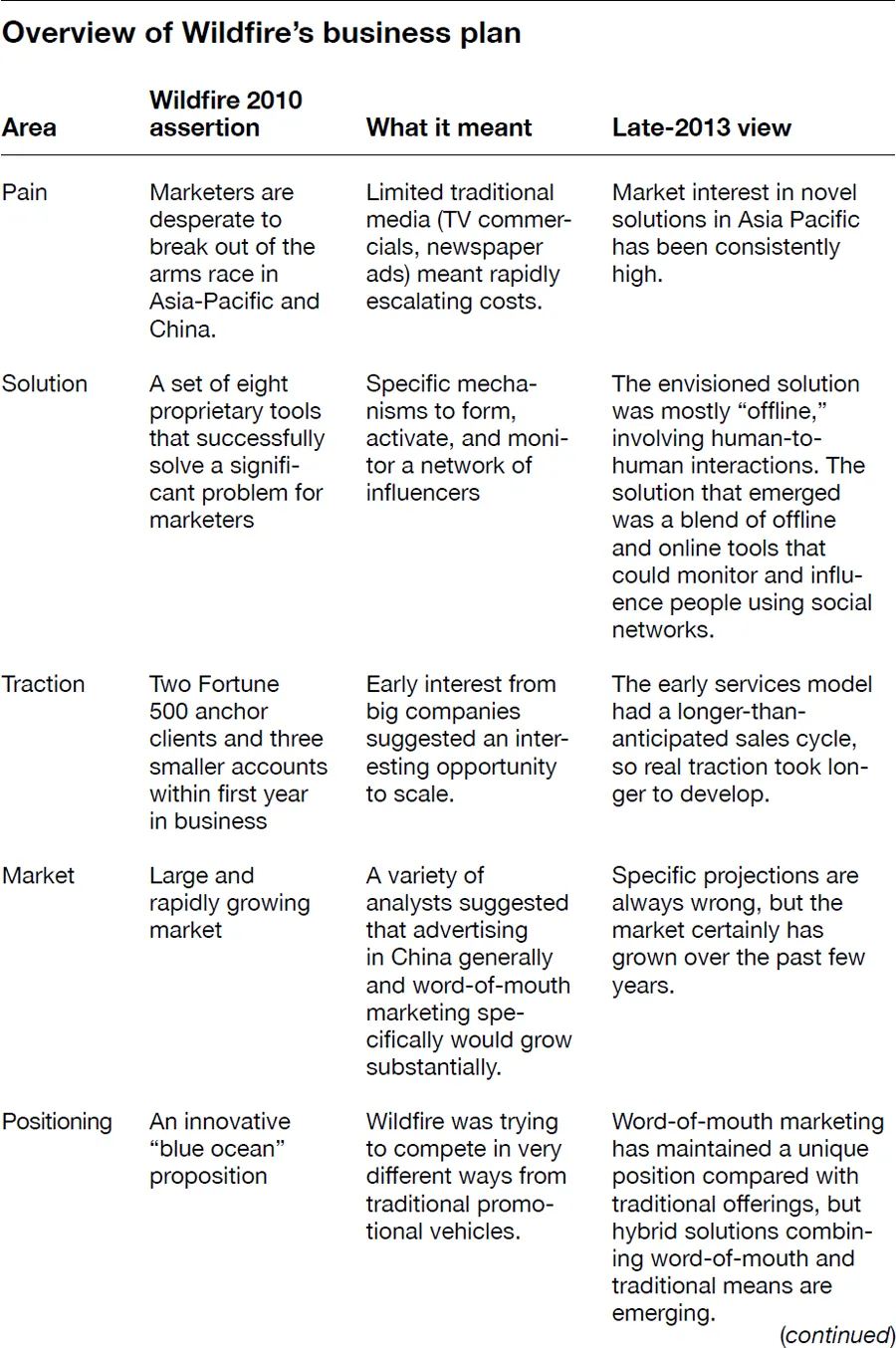
The core of Wildfire’s document was all of fourteen pages long, organized around ten unique aspects of Wildfire. Table 2-1 details those areas and evaluates how correct the team’s assertions were.
Wildfire (which rebranded itself ActSocial in early 2014), got some things right but had some significant misses as well. That’s normal. The comprehensive nature of the plan made it clear that the team had thought about their business, increasing our confidence in making an investment. It also was a nice blend of strategic thinking, analytics, and visual descriptions. The plan is available at a companion website to this book.
When we work with corporations, we typically use a mini business plan that bears strong similarities to Wildfire’s plan. While the nature of each plan is very client specific, the table of contents generally includes:
• An executive summary
• The target consumers and their problem
• The proposed solution (including a sketch or a picture of an early prototype)
• Key business model elements
• Plan to scale the idea
• Thumbnail financials (see chapter 3 for suggested approaches)
• Critical assumptions
• Proposed testing plan
You can download a blank business plan template and an example for the Kraft pizza truck (discussed in chapter 6) at innovationsfirstmile.com.
TABLE 2-1

Four Watch-Outs
It takes diligence and discipline to document an idea. No matter what approach you follow, watch out for these four common mistakes.
1. Confusing a Concept and a Business
Many innovation efforts start with a simple question. “What if we . . .” often starts the question. “What if we brought word-of-mouth marketing to China?” asked Wildfire. “What if I could use the internet to sell books at low price points?” Jeff Bezos wondered. “What if we could rid the word of malaria?” Bill Gates asked when he set up his foundation. A fragment of an idea is a great starting point but an insufficient ending point. Assuming your intent is to start a business or create new growth inside an existing business, the reason you are innovating is ultimately to create revenue that translates into profits that translate into free cash flow. And you can’t dream of revenues, profits, and cash flow unless you solve operational issues such as production, distribution, postsales support, and so on. Financial and operational issues can be intimidating to innovators who lack training in how to read financial statements or design and manage a supply chain. Fortunately, a number of readily accessible tools can demystify the jargon that makes it seem like Wall Street analysts are speaking a different langua...
Table of contents
- Cover
- Praise for The First Mile
- Also by Scott D. Anthony
- Title Page
- Copyright
- Dedication
- Contents
- Prologue. The Promise and Perils of Innovation’s First Mile
- Part I. The First Mile Toolkit
- Part II. Overcoming First Mile Challenges
- Appendix A: Innosight Ventures Assessment Tool
- Appendix B: Cognitive Biases and the First Mile
- Notes
- Key References
- Index
- Acknowledgments
- About the Author
Trusted by 375,005 students
Access to over 1.5 million titles for a fair monthly price.
Study more efficiently using our study tools.
Frequently asked questions
Yes, you can cancel anytime from the Subscription tab in your account settings on the Perlego website. Your subscription will stay active until the end of your current billing period. Learn how to cancel your subscription
No, books cannot be downloaded as external files, such as PDFs, for use outside of Perlego. However, you can download books within the Perlego app for offline reading on mobile or tablet. Learn how to download books offline
We are an online textbook subscription service, where you can get access to an entire online library for less than the price of a single book per month. With over 1.5 million books across 990+ topics, we’ve got you covered! Learn about our mission
Look out for the read-aloud symbol on your next book to see if you can listen to it. The read-aloud tool reads text aloud for you, highlighting the text as it is being read. You can pause it, speed it up and slow it down. Learn more about Read Aloud
Yes! You can use the Perlego app on both iOS and Android devices to read anytime, anywhere — even offline. Perfect for commutes or when you’re on the go.
Please note we cannot support devices running on iOS 13 and Android 7 or earlier. Learn more about using the app
Please note we cannot support devices running on iOS 13 and Android 7 or earlier. Learn more about using the app
Yes, you can access The First Mile by Scott D. Anthony in PDF and/or ePUB format, as well as other popular books in Business & Business Strategy. We have over 1.5 million books available in our catalogue for you to explore.