An organisation's fate hinges on its CEO—right? Not according to the authors of Senior Leadership Teams. They argue that in today's world of neck-snapping change, demands on leaders in top roles are rapidly outdistancing the capabilities of any one person - no matter how talented. Result? Chief executives are turning to their enterprise's senior leaders for help. Yet many CEOs stumble when creatinga leadership team. One major challenge is that senior executives often focus more on their individual roles than on the top team's shared work. Without the CEO's careful attention to setting the team up correctly, these high-powered managers often have difficulty pulling together to move their organisation forward. Sometimes they don't even agree about what constitutes the right path forward.The authors explain how to determine whether your organisation needs a senior leadership team. Then, drawing on their study of 100+ top teams from around the world, they explain how to create a clear and compelling purpose for your team, get the right people on it, provide structure and support, and sharpen team members' competencies - and your own. Timely and practical, this book enables you to create and sustain a leadership team whose members learn from one another while collaborating to pursue your company's objectives.
eBook - ePub
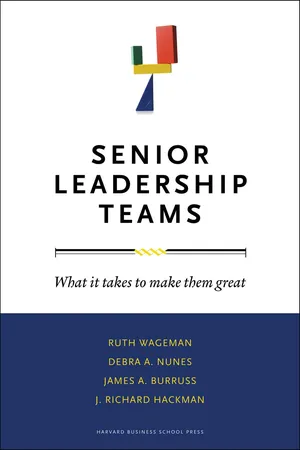
Senior Leadership Teams
What It Takes to Make Them Great
- 272 pages
- English
- ePUB (mobile friendly)
- Available on iOS & Android
eBook - ePub
Senior Leadership Teams
What It Takes to Make Them Great
About this book
Information
1
The Fall of the Heroic
CEO and the Rise of the
Leadership Team
Diego Bevilacqua is an experienced executive, a respected leader, and a veteran of the usual corporate team-building exploits, including trekking through the steamy rain forests of Costa Rica. But nothing, including grinning crocodiles and howling monkeys, prepared him for the challenge he was handed at the end of 2000: to put together a leadership team that could, with few new resources or technology, rapidly build a successful business.
Bevilacqua talks about the food service business he took over after the merger of Bestfoods and Unilever as “a child with no family.”1 His challenge: to integrate Bestfoods’ highly successful food service business with Unilever’s much less effective counterpart. Although Bestfoods was the smaller entity, it had the stronger business. Bringing these two organizations together would be a politically charged process and an uphill battle against skeptics on both sides who believed that the merger would destroy rather than expand the food services business.
Bevilacqua inherited a set of leaders on both sides who knew the industry deeply and who had their own ideas about how the business should be run. But Patrick Cescau, then head of Unilever’s Foods Division, now Group CEO, wanted Bevilacqua to take these two entities and create a business that “would be a ‘formidable force in food service,’ ” says Bevilacqua. “The way I saw it, what I could do was give some leadership to this new group of people, this new business. And create a culture that would allow for the experts to openly challenge each other and actually co-create an agenda for the future.”2
Bevilacqua and his key advisers developed a business model that had the new Foodsolutions—the two merged entities—operating primarily as a business independent of its parent. But it also would be interdependent with the rest of Unilever for back office support (including technology and R&D) and for collaborative relationships with the other high-value Unilever brands. “We saw that the retail business and food services had much in common,” Bevilacqua says. “There was really no justification to create a separate superstructure. We wanted to create the focus, clarity, and independence needed to do what was right for that particular set of customers and market, but without creating costs that were not adding value.” This “independent but interdependent” model represented a significant shift in the operations of the food services business, and it escalated the need for collaboration among the leaders of the new entity.
To foster greater unity of understanding and purpose, Bevilacqua brought together what we term an alignment team. This team consisted not only of his direct reports, the eleven people who made up his core leadership team, but also the next level—a total of forty-six executives. Bevilacqua spent a week with them clarifying and planning the implementation of the new strategic direction. “The challenge I put to them was as follows . . . ‘Unilever has allowed us to be independent. So we’ve achieved independence, that’s great. Tick. We are now accountable, though. So with independence comes accountability. And you are part of that. Help us define the future of the business. And how we are going to achieve it.’ ”
Bevilacqua knew he was surrounded by a team of experienced professionals, industry veterans who understood the business and their markets and were successful themselves. Together they would succeed.
But it wasn’t that simple.
Within a few months it was clear that something was wrong. Although the team had what Bevilacqua believed was a solid business plan with specific marching orders, there was little unity among the members. Only a few of them were fully on board. The rest either continued to operate as they always had or put their own unique spin on the new strategy. To call the group a “team” was, at best, a stretch. More accurately, it was a loose confederation of individual managers, all with their own agendas.
It wasn’t long before the organizational chaos was reflected in lackluster business results, leaving Bevilacqua frustrated and angry. Why all the difficulty? Why couldn’t a group of sophisticated, experienced business leaders come together to create a solid, strong-performing team? What was he, as their leader, doing wrong? “I knew we needed to create a team that was facing the same direction—that spoke the same language, talked about the same issues, focused on the same goals, and added real value to the rest of the organization,” he recalls. “We tried a combination of tactics, pushing and pulling to get people to understand.”
But little seemed to work. Bevilacqua knew that he had to take drastic action to stem the growing revolt and save the business. A clear sign that his leadership team was not working was that members repeatedly returned to the same issues—concerns that should have been addressed in a single meeting. Bevilacqua described a victim mentality taking hold of the group and a similar malaise affecting him. He began convincing himself that his ineffective and poorly united team was a problem he could not do much about. Like many other senior leaders, he began seeing the dysfunction at the top as inevitable in a group of thoroughbreds. “I thought, ‘This is just nonsense. I can’t manage a business in this fashion with every Tom, Dick, and Harry interfering at local, regional, and global levels. So if I am going to die, I would rather die of my own doing than because the world has interfered.’ ”
Leading in the Cauldron of Change and Competition
Bevilacqua is not the first experienced and talented executive to suddenly find himself and his organization in a dangerous tailspin. Nor will he be the last. A growing number of leaders are discovering that effectively running an organization, whether a business unit, a small company, a corporation, or a conglomerate, is harder than ever before.
It isn’t that top leaders are less skilled or less experienced than leaders of the past. Nor are the teams they lead. The challenge is the change in roles of both leader and team member, roles that have been reshaped in the cauldron of intense competition and relentless change. Regionalization may have worked in the past. But today, with the emphasis on globalization and growth, it’s all about scope, speed, and customer intimacy. Leadership teams must consistently ensure that clients’ needs are met, and do it right now.
Consider Bevilacqua’s challenge of developing a successful global food services business. What that meant was (1) combine the resources of two organizations having different values, cultures, processes, and leadership styles; (2) create a strategy for dozens of countries around the globe, each with its own culture, climate, and culinary demands; (3) do it all within twelve months, and (4) grow the business several percentage points that first year.
The difficulty is not always a factor of size and scale. Even leading a small organization has become more complex and challenging than it was a decade ago. Just ask people who head up a local not-for-profit. They will tell you about the increased public scrutiny, the ever-expanding list of regulations, and the elevated expectations of donors and recipients.
It is no wonder that, despite the lure of the executive suite, a growing number of senior leaders either are declining the top job or choosing to drop out. As one executive told us after taking himself out of consideration to head his conglomerate’s fastest-growing division, “I know this job. It consumes your life. It’s not what I want for me and my family.”
Even if it is their goal to get to the top and they are fortunate enough to achieve that goal, many chief executives find tenure elusive. “Perform or perish” has become the rule. Study after study shows how tough and tenuous the top job is: in 1995, 72 percent of departing U.S. and U.K. CEOs either retired or died in office. By 2001 that group had dropped to 47 percent. During that same period, CEO turnover went up 53 percent.3
What such studies don’t show is the struggle these executives go through long before they make their exit. These top players are not quitters by nature. They want to be successful. They will go through considerable pain to be successful. And so they continue to soldier on, realizing all the while that despite their best efforts, they are not reaching the results they need.
As leadership guru Warren Bennis puts it, “Our mythology refuses to catch up with us. And so we cling to the myth of the Lone Ranger, the romantic idea that great things are usually accomplished by a larger-thanlife individual working alone. Despite evidence to the contrary—including the fact that Michelangelo worked with a group of 16 to paint the Sistine Chapel—we still tend to think of achievement in terms of the Great Man or the Great Woman, instead of the Great Group.”4
The Heroic CEO Versus the
Two-Heads-Are-Better-Than-One Approach
Going it alone is not just a romantic notion. It’s human nature, at least in individualistic cultures. Despite all the talk of the importance of “the team” or “the organization” we still, in some parts of the world, celebrate the achievement of the individual leader in successfully maneuvering to the top of the organization. Just look at a cover of any popular business periodical. As often as not, the photo is of a single person, arms folded across the chest: the Lone Ranger, the Heroic CEO standing proudly atop the organization.
But this one-leader approach is starting to give way to the Great Group idea. In some countries, a division of leadership is legally mandated. In the United Kingdom, for example, regulatory bodies strongly recommend that the chairman and CEO roles be held by different individuals, and most publicly traded companies comply. In other places, including the United States, a few organizations have simply begun dividing the work of the CEO role among two or more coleaders, and others have taken a team approach in which senior executives work together to guide their organization.5
In many organizations the co-CEO option has met with limited success for a number of reasons, not the least of which is the inability of most leaders to share the top role no matter how good their intentions or persistent their efforts. Citicorp tried it following its merger with Travelers but quickly found that the structure did not work. Co-CEOs John Reed and Sandy Weill, who had cordially agreed to share the position after the merger, soon found themselves embroiled in a messy power struggle. In the end, Weill stayed, Reed left, and another board learned that as big as the CEO’s role is, it’s almost always too small for two strong leaders. Other high-profile attempts at corporate crown sharing, including Daimler-Chrysler, Kraft, and Time Warner, have met similar fates.
Actually, the poor track record of experiments with co-CEOs is nearly inevitable because of the way humans are wired. One product of our evolutionary heritage is the inevitability of hierarchies whenever groups form.6 Organisms that win the competition for dominance have a better chance to reproduce and thereby pass their genes to successive generations, contributing to the long-term survival and strength of the species. This phenomenon is seen in creatures from ants to wolves.
It occurs even in insect groups such as swarms of wasps, a species that probably seems about as far from the top management suite as one can get. Female paper wasps quickly and definitively form a hierarchy when they come together, with consequences not only for their behavior but also for their physiology: dominant females become better able to reproduce, whereas subordinates become unable to do so.7
Despite the extraordinary ability of humans to transcend many of our evolutionary impulses, we also form ourselves into hierarchies whenever we come together, no matter what the purpose.
Those organizations that have succeeded with dual leaders typically have done so in title only. If you scratch the surface of the organizational chart you’ll see that despite the same titles these co-CEOs actually have different roles. Frequently it is more of a CEO-COO kind of arrangement, with one leader externally focused and the other more internally or operationally focused. Until recently, for example, Bill Gates as chairman of Microsoft focused more on the firm’s technology and external constituents while Steve Ballmer as CEO focused on the business side. True coleadership may be almost impossible in the executive suite. In the words of corporate governance expert Ram Charan, appointing co-CEOs is “not going to be the new best practice in business.”8
The Senior Team as an Alternative Leadership Model
Evolution has wired us not merely to form dominance hierarchies but to work together when a vital task demands more than any single individual can accomplish alone. Organisms from ants to antelopes work closely together to fend off attacks from other groups, to capture resources that others enjoy, to cope with developing disasters, and to create structures that promote the collective well-being. Leading a complex organization is at least as demanding of coordinated collective work as is protecting territory, harvesting food, or constructing colonies. Might leadership teams offer a viable alternative to both the heroic leader and the co-CEO models?
The premise of this book is that teams are not only a feasible means of providing organizational leadership but that they are also increasingly necessary as the demands of top roles outdistance the capacities of any single person. That is why a growing number of chief executives are forming teams to help them lead their enterprises. This practice has a number of advantages, at least in theory. For one thing, leaders can avoid the messy coleader problem of who ultimately is in charge while at the same time sharing critical responsibilities and decision making. In addition, when a leadership team addresses strategic issues that cut across the enterprise, most of the people who will be responsible for implementing those decisions will be in the room.
Moreover, the chief executive can draw on the rich pool of knowledge, talent, experience, perspective, and creativity of the company’s most accomplished leaders in making key organizational decisions. When harnessed, this creative energy can bridge boundaries, as the team deals with the opportunity-rich “white spaces” between areas where a lack of command and control must be replaced with collaboration.9
For many top leaders, increased reliance on a team for mission-critical issues has been a subtle and seemingly natural shift. After all, a group of senior leaders already exists. Why not simply lean more heavily on them for help and support? After all, isn’t that why they’re there?
Yes—and no. Certainly most top executives surround themselves with a cadre of top advisers, senior managers they trust to carry out the mission of the organization. But the members of this group also have specific leadership responsibilities that keep them working as individuals, each representing a function or business unit and not the enterprise—and this structure is at the center of the problem.
The Myth of the Spontaneous and
Self-Sustaining Senior Team
In our work with chief executives around the world, we have seen the same scenario play out repeatedly. A new, talented executive—let’s call her Julia—takes over the leadership of an enterprise, be it a business, a public service organization, or a foundation. Julia believes she has the lay of the land. She has done due diligence. She has reviewed the numbers. The financials and other fundamentals of the enterprise look sound.
Next she considers the leadership team. Due diligence here is a bit more difficult. There is less concrete information, less hard data. Perhaps she starts with the existing team and brings in some talented thoroughbreds to counter the weaknesses.
With a supposedly strong team in place, Julia immediately turns to what she sees as the most critical enterprise issues. As a...
Table of contents
- Cover Page
- Title Page
- Copyright Page
- Dedication
- Table of Contents
- Preface
- Acknowledgments
- 1 The Fall of the Heroic CEO and the Rise of the Leadership Team
- PART I THE ESSENTIALS
- PART II THE ENABLERS
- PART III LEADING A LEADERSHIP TEAM
- Notes
- References
- Index
- About the Authors
Trusted by 375,005 students
Access to over 1.5 million titles for a fair monthly price.
Study more efficiently using our study tools.
Frequently asked questions
Yes, you can cancel anytime from the Subscription tab in your account settings on the Perlego website. Your subscription will stay active until the end of your current billing period. Learn how to cancel your subscription
No, books cannot be downloaded as external files, such as PDFs, for use outside of Perlego. However, you can download books within the Perlego app for offline reading on mobile or tablet. Learn how to download books offline
Perlego offers two plans: Essential and Complete
- Essential is ideal for learners and professionals who enjoy exploring a wide range of subjects. Access the Essential Library with 800,000+ trusted titles and best-sellers across business, personal growth, and the humanities. Includes unlimited reading time and Standard Read Aloud voice.
- Complete: Perfect for advanced learners and researchers needing full, unrestricted access. Unlock 1.5M+ books across hundreds of subjects, including academic and specialized titles. The Complete Plan also includes advanced features like Premium Read Aloud and Research Assistant.
We are an online textbook subscription service, where you can get access to an entire online library for less than the price of a single book per month. With over 1.5 million books across 990+ topics, we’ve got you covered! Learn about our mission
Look out for the read-aloud symbol on your next book to see if you can listen to it. The read-aloud tool reads text aloud for you, highlighting the text as it is being read. You can pause it, speed it up and slow it down. Learn more about Read Aloud
Yes! You can use the Perlego app on both iOS and Android devices to read anytime, anywhere — even offline. Perfect for commutes or when you’re on the go.
Please note we cannot support devices running on iOS 13 and Android 7 or earlier. Learn more about using the app
Please note we cannot support devices running on iOS 13 and Android 7 or earlier. Learn more about using the app
Yes, you can access Senior Leadership Teams by Ruth Wageman, Debra A. Nunes, James A. Burruss, J. Richard Hackman in PDF and/or ePUB format, as well as other popular books in Business & Management. We have over 1.5 million books available in our catalogue for you to explore.