You may not realize it but simple, irrelevant factors can have profound consequences on your decisions and behavior, often diverting you from your original plans and desires. Sidetracked will help you identify and avoid these influences so the decisions you make do stick—and you finally reach your intended goals.Psychologist and Harvard Business School professor Francesca Gino has long studied the factors at play when judgment and decision making collide with the results of our choices in real life. In this book she explores inconsistent decisions played out in a wide range of circumstances—from our roles as consumers and employees (what we buy, how we manage others) to the choices that we make more broadly as human beings (who we date, how we deal with friendships). From Gino’s research, we see when a mismatch is most likely to occur between what we want and what we end up doing. What factors are likely to sway our decisions in directions we did not initially consider? And what can we do to correct for the subtle influences that derail our decisions? The answers to these and similar questions will help you negotiate similar factors when faced with them in the real world.For fans of Dan Ariely and Daniel Kahneman, this book will help you better understand the nuances of your decisions and how they get derailed—so you have more control over keeping them on track.
eBook - ePub
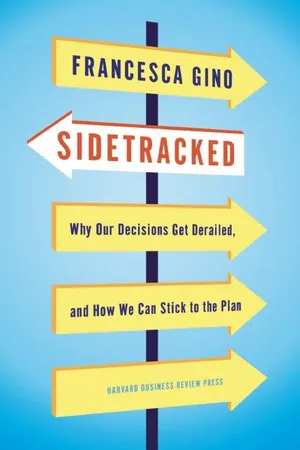
Sidetracked
Why Our Decisions Get Derailed, and How We Can Stick to the Plan
- 256 pages
- English
- ePUB (mobile friendly)
- Available on iOS & Android
eBook - ePub
About this book
Information

Forces from Within

Better Than Mother Teresa
Inaccurate Views of Ourselves
During a visit home to Tione di Trento, Italy, a few years ago, I started a new after-dinner routine: watching the TV show Affari Tuoi (translated literally, “Your Business”) with my family. Before each episode, an independent notary company randomly assigns monetary prizes and nonmonetary ones (such as a cork or a one-year supply of soap) to twenty boxes. The monetary prizes range from 1 euro cent to hundreds of thousands of euros. The maximum prize is €500,000 (about $630,000), which is always contained in one of the boxes. The twenty boxes are sealed, consecutively numbered from 1 to 20, and randomly assigned to twenty contestants, who represent different regions of Italy. At the start of each episode, the contestants have the opportunity to answer a general knowledge question. The person who answers the question in the shortest amount of time is selected to be the first contestant.
The structure of the game is rather simple. The contestant has a sealed, numbered box in her possession (the one she was assigned at the beginning of the game). The nineteen other numbered boxes are arrayed before her. In each of five rounds, she is given an opportunity to choose a fixed number of boxes to open: six boxes in the first round, then groups of three boxes in the remaining rounds. The contestant is responsible for choosing each of the boxes to open. Once a chosen box has been opened, the cash value of that box is revealed and then eliminated from the list of possible prizes. A screen keeps track of the available prizes and those that were eliminated in earlier rounds.
At the end of each round, “the bank” (a disembodied male voice) makes a proposal: he offers the contestant either a “swap”—that is, the opportunity to exchange her box for one of the remaining boxes of her own choosing—or a definite amount of money to quit the game. If the contestant accepts the bank’s offer to quit, the game ends; if she chooses a different box, she proceeds to the next round. If the contestant reaches the final round (after opening all nineteen boxes) and rejects the bank’s offer to quit in this round, she receives the contents of the box in her possession at that time.
Imagine that you are a contestant in this game. Your lucky number is 8, so you choose box number 8 first. After quite a bit of suspense, the host opens the box, revealing a prize of €25. You feel relieved and quite excited to have eliminated this minor prize, and you keep on going. Eighteen boxes are left. You come up with another lucky number, the date of your college graduation, and soon discover that it was another lucky day: the hidden prize is another humdrum prize, a chair. You are feeling great about your ability to pick numbers, and you keep on going.
The game progresses, and the number of unopened boxes declines. You have eliminated fifteen of the boxes, and you know that the grand prize is still hidden in one of the remaining ones. When only five boxes are left (including yours), you receive a call from the bank, which offers you the opportunity to sell your box for €46,000 (and walk away with this amount of money) or exchange it for another box. The €500,000 is still out there, together with the following prizes: €50,000, €50, €1, and a picture frame. You can keep opening boxes (a risky move), or you can say yes to a sure amount (the bank’s offer of €46,000). What would you do? Would you keep going through your lucky numbers?
There is a third possibility for you to consider: you are allowed to ask the audience for advice about whether to accept or reject the amount offered. If you do this, you will learn which percentage of the audience thought you should accept the monetary offer and which thought you should reject it.
You know the rules: the game will end if you accept the bank’s monetary offer. Alternatively, you can continue to choose boxes to open. You might get the grand prize, a prize better than what the bank offered you, or a better offer from the bank later on—or you might get next to nothing. You are not sure what to do. You have successfully opened so many boxes already, and you want to trust in your streak of good luck. After much deliberation, you decide to consult the audience. Do you think your decision would be influenced by their advice?
If you are like most contestants, you would likely ignore the audience’s advice. In fact, the audience’s advice has little impact on the decisions contestants make in this game, even if following that advice would be the best objective choice. In fact, more generally, in situations where others’ opinions are available to us on the right decision to make and these opinions are independent from one another, we’re better off listening to them than to ourselves.1 Evidence collected from over one hundred television episodes and four hundred decisions suggests that contestants tend to ignore the audience’s advice, even though a later analysis of contestants’ decisions indicates that following the advice would have increased their earnings.2
I know what you are thinking: this is just a game. In real life, when facing high-stakes decisions (such as how to invest retirement savings, whether to accept a job offer, or how to best propose to a significant other), we would not ignore useful advice from others. We would be open to what others who are just as knowledgeable or more knowledgeable about the decision have to say. We would surely consult others for their independent opinions, weigh their advice carefully, and make a decision after rationally weighing our opinion with theirs.
Actually, I bet we would not.
In support of my claim, I offer the fact that the business press regularly covers stories of CEOs and other leaders who failed to listen to the advice of colleagues, peers, or other constituencies and suffered the consequences. In early August 2008, for example, the New York Times reported an interesting tale of advice ignored: the story of Richard Syron, then the CEO of the mortgage giant Freddie Mac.3 As recounted in the article, in 2004, David A. Andrukonis, then the company’s chief risk officer, warned Syron that the firm’s underwriting standards had slipped and that the company could face significant losses. According to Andrukonis, many of the loans the company had bought “would likely pose an enormous financial and reputational risk to the company and the country” and that Syron ignored the advice, insisting that “we couldn’t afford to say no to anyone.” Freddie Mac continued to purchase riskier loans over the next three years and at a faster pace. And though Syron was warned that Freddie Mac needed to expand its capital, he allowed the company’s safety net to shrink.
At the time the New York Times ran its article, Freddie Mac was in trouble. Its stock price tumbled 60 percent between February and August 2008, destroying more than $80 billion in shareholder value. The company had just posted a second-quarter loss of $821 million, and it clearly needed good advice to change its fortunes. Yet Syron released a statement calling the Times story “superficial” and defending the company’s records. He called the company’s mortgage default and credit loss rates “a fraction of the industry averages.”
Interestingly, this was not the first time Syron had ignored advice from trusted advisers. Beginning in 2001, Federal Reserve governor Edward Gramlich began to warn Syron about the risks of subprime mortgages (home loans to high-risk borrowers).4 Gramlich’s advice was supported by solid 2006 data from a Merrill Lynch analyst indicating that companies could suffer as a result of their subprime investments. But Syron refused to listen. In September 2008, the US Treasury placed Freddie Mac into a conservatorship overseen by the Federal Housing Finance Agency, thus allowing the government to temporarily run the company until it was on stronger footing. Syron was no longer in charge.
Or consider the story of Ken Olsen, a leader in the minicomputer sector as a cofounder of Digital Equipment Corporation (DEC) back in 1957.5 During the following two decades, DEC dominated the scientific and engineering workstation market and, by the late 1970s, was number two in the computer industry under Olsen’s leadership, thanks to the company’s development of a unified hardware architecture and operating system. But in the early 1980s, Sun Microsystems appeared on the market with a superior technology, a leaner business model, and a more aggressive sales force that used its “open” Unix operating system as a compelling pitch. Throughout the 1990s, Sun’s revenues exceeded $2 billion as the company came to dominate the workstation market that DEC had once ruled. As DEC lost ground in the marketplace, Olsen ignored advice from board members to retire. The decline of DEC’s advantage continued until 1992, when the board finally decided to replace Olsen with an insider.
Let me add one more example to this list of valuable advice ignored: Walmart’s 2006 failure to expand its success into Germany. Walmart landed in Germany with what appeared to be an unbeatable business model, but the model quickly failed, and the company started selling its German stores at a loss. So spectacular was Walmart’s failure that it is cited in textbooks as an example of how leaders should not behave. The mistakes Walmart made in Germany were numerous. But one that caught my eye was the fact that Walmart’s CEO, H. Lee Scott, and other high-level executives ignored the advice of the company’s midlevel German managers regarding the intricacies of German laws and German corporate culture, including laws on opening hours and price setting. Although the German managers were of lower rank than Walmart senior management, they were clearly more experienced and more knowledgeable regarding the way “things get done” in Germany—yet their advice was ignored.6
Beyond the business world, we can also find stories of ignored advice that have had costly consequences in other spheres, including politics, medicine, and education, not to mention personal experience. At some point or another, most of us have probably ignored a doctor’s advice—to stop smoking or start exercising, for example. Similarly, politicians in Washington, DC, regularly ignore sound advice to make tough budget decisions, cooperate with each other more, and so on.
Why do we so often ignore advice from others, even when it would lead to better decisions? One possibility is that it can be difficult to assess whether advice is good or bad. After the fact, it is easy to condemn Richard Syron and Ken Olsen for failing to listen to sound advice; at the time, however, it might have been difficult for them to assess the quality of the advice they received. A second possibility is worth further consideration: that we find the opinions of others to be less compelling and less convincing than our own, especially when we have invested time and effort in forming our opinions. As a result, it could be that we ignore advice we receive from others even when it is more accurate than our own perspective.
Do you think this is unlikely? I was not convinced myself, so I went to the laboratory to test these ideas on a group of college students from the University of North Carolina at Chapel Hill. I recruited about one hundred participants for a study examining how people reason through business problems. As a cover, the students were told that the study was part of a broader initiative to find ways to advise college students interested in applying for consulting jobs, which often use case analyses in the recruiting and selection process. The study employed business cases that students commonly face and are asked to reason through during interviews. In the first part of the study, participants were presented with the following business problem:
Your client is a company that makes specialized batteries for mobile homes (motor homes) in the USA. The battery is very powerful, long lasting, and of high quality. New industry conditions are occurring, and motor home dealers are starting to use a cheaper battery as the “factory standard” in an attempt to lower the overall price of motor homes. Your client’s product is now only offered as an added feature for which the customer must pay an extra $500. In this case question, you are to discuss how your client should go about maintaining profits given these new market conditions.
Study participants were given twenty minutes to read the problem and think about how they would answer the question asked in the case. They were allowed to take notes. Before they got to work on their answers, the experimenter informed them that MBA students with consulting experience had been presented with a similar case in an earlier session and had spent twice as much time (forty minutes) working through the case and preparing an answer for it. The undergraduate participants were given notes that the MBA students had prepared with their advice on how to successfully reason through the problem. Each participant received one page containing the notes of one MBA student.
Imagine you are one of our participants, sitting in a cubicle working through this business problem. You have practiced answering this type of problem before, as you prepared carefully for consulting interviews many times throughout college. You are confident in your ability to formulate a solid answer. Just to satisfy your curiosity, however, you read the notes left by one of the experienced MBA students. Do you think you would follow the advice?
Most of the study participants did not. About 60 percent of them completely ignored the advice, and the remaining 40 percent weighed it into their final answers but did not fully follow it. In fact, most participants reported believing they had better information for effectively solving the problem than their adviser did.
In general, when asked to justify their choice to ignore others’ opinions, decision makers who discount advice from others typically reference the fact that they lack access to the adviser’s internal thought processes, while having privileged access to the rationale behind their own opinions. From their perspective, weighing their opinions much more heavily than those of an external adviser makes a lot of sense. Yet they continue to unduly discount advisers’ counsel even when the advisers clearly express why they hold certain opinions or consider certain information to be important.
So let’s put aside this first explanation for discounting advice.
A second reason people might tend to ignore advice has to do with the perceptions they hold regarding their own intelligence and competence. For example, the college students in my study reported feeling more competent and capable than their advisers. They reported believing their own opinions and choices were superior to those of others, including their advisers and fellow study participants. These findings suggest that our own perceptions of how competent and capable we are can sidetrack our decisions. Whether we recognize it or not, our perceptions are often inaccurate.
Let’s use a simple test to explore this issue in more detail. Grab a pen and a piece of paper. For each item in the following test, try to rate yourself, using percentiles, in comparison with the other people who decided to buy this book (as you imagine them to be). For example, for item 1, if you think your decision-making abilities are worse than those of all other readers of this book, enter “0” for the item. If you think your decision-making abilities fall in the middle, enter “50.” If you think your decision-making abilities are superior to those of all other readers of this book, enter “100.” All numbers between 0 and 100 are acceptable responses. Be open and honest: after all, you will be the only one who knows what you answered.
Ready? Here is the test:
| 1. Your decision-making abilities: | __________ |
| 2. Your intelligence: | __________ |
| 3. Your cooperativeness: | __________ |
| 4. Your honesty: | __________ |
| 5. Your physical attractiveness: | __________ |
| 6. Your level of life experiences: | __________ |
| 7. Your driving ability: | __________ |
| 8. The refinement of your eating preferences: | __________ |
| 9. Your aesthetic skills: | __________ |
| 10. Your number of close friendships: | __________ |
Now, let’s see if this simple test can help you discover something new about yourself. Do you think you drive better than the average reader of this book? Do you believe you’re more intelligent than most readers? Do you make better decisions than they do? I obviously cannot see your answers, but I bet most of the numbers you wrote down were higher than 50. In fact, when people are asked to answer this type of questions and compare themselves with others on a variety of socially desirable dimensions, they tend to report numbers that are in the seventieth or eightieth percentile.
One of my favorite examples of this human tendency comes from a survey conducted by U.S. News and World Report in 1997. The survey asked one thousand Americans the following question: “Who do you think is most likely to get into heaven?” Respondents indicated a 52 percent likelihood for ...
Table of contents
- Cover Page
- Title Page
- Contents
- Introduction: What Gets Us Off Track?
- Part I: Forces from Within
- Part II: Forces from Our Relationships
- Part III: Forces from The Outside
- Conclusion
- Notes
- Bibliography
- Acknowledgments
- About the Author
Trusted by 375,005 students
Access to over 1.5 million titles for a fair monthly price.
Study more efficiently using our study tools.
Frequently asked questions
Yes, you can cancel anytime from the Subscription tab in your account settings on the Perlego website. Your subscription will stay active until the end of your current billing period. Learn how to cancel your subscription
No, books cannot be downloaded as external files, such as PDFs, for use outside of Perlego. However, you can download books within the Perlego app for offline reading on mobile or tablet. Learn how to download books offline
Perlego offers two plans: Essential and Complete
- Essential is ideal for learners and professionals who enjoy exploring a wide range of subjects. Access the Essential Library with 800,000+ trusted titles and best-sellers across business, personal growth, and the humanities. Includes unlimited reading time and Standard Read Aloud voice.
- Complete: Perfect for advanced learners and researchers needing full, unrestricted access. Unlock 1.5M+ books across hundreds of subjects, including academic and specialized titles. The Complete Plan also includes advanced features like Premium Read Aloud and Research Assistant.
We are an online textbook subscription service, where you can get access to an entire online library for less than the price of a single book per month. With over 1.5 million books across 990+ topics, we’ve got you covered! Learn about our mission
Look out for the read-aloud symbol on your next book to see if you can listen to it. The read-aloud tool reads text aloud for you, highlighting the text as it is being read. You can pause it, speed it up and slow it down. Learn more about Read Aloud
Yes! You can use the Perlego app on both iOS and Android devices to read anytime, anywhere — even offline. Perfect for commutes or when you’re on the go.
Please note we cannot support devices running on iOS 13 and Android 7 or earlier. Learn more about using the app
Please note we cannot support devices running on iOS 13 and Android 7 or earlier. Learn more about using the app
Yes, you can access Sidetracked by Francesca Gino in PDF and/or ePUB format, as well as other popular books in Business & Decision Making. We have over 1.5 million books available in our catalogue for you to explore.