In a marketplace fueled by intangible assets, anything less than optimal workforce success can threaten a firm's survival. Yet, in most organizations, employee performance is both poorly managed and underutilized. The Workforce Scorecard argues that current management and human resources practices hinder employees' ability to contribute to strategic goals. To maximize the power of their workforce, organizations must meet three challenges: view their workforce in terms of contribution rather than cost; replace benchmarking metrics with measures that differentiate levels of strategic impact; and make line managers and HR professionals jointly responsible for executing workforce initiatives. Building on the proven model outlined in their best-selling book The HR Scorecard, Mark Huselid, Brian Becker, and co-author Richard Beatty show how to create a Workforce Scorecard that identifies and measures the behaviors, competencies, mind-set, and culture required for workforce success and reveals how each dimension impacts the bottom line. Practical and timely, The Workforce Scorecard offers crucial lessons for leveraging human capital to achieve strategic success.
eBook - ePub
The Workforce Scorecard
Managing Human Capital To Execute Strategy
- 304 pages
- English
- ePUB (mobile friendly)
- Available on iOS & Android
eBook - ePub
The Workforce Scorecard
Managing Human Capital To Execute Strategy
About this book
Information
1
THE THREE CHALLENGES OF WORKFORCE MEASUREMENT AND MANAGEMENT
THIS BOOK is based on a very simple premise. Of all the factors affecting firm performance that CEOs and senior managers can directly influence, workforce success—or the extent to which a firm can generate a workforce with the culture, mindset, competencies, and strategic behaviors needed to execute its strategy—is the both the most important and most underperforming asset in most businesses. The majority of managers know that despite proclamations that “people are our most important asset,” their organizations struggle to make this slogan a reality. In an economic environment marked by hypercompetition and international expansion, where intangible assets are increasingly the basis of competitive advantage and growth opportunities, anything less than optimal workforce success is not just a missed opportunity; in many cases it is a direct threat to the very survival of the firm.
Throughout this book we describe the dimensions of this strategic opportunity and provide clear and unambiguous recommendations for management action. Our approach contains several key elements that some readers might find surprising. First, many managers believe that workforce performance and success is a “people” issue that is largely the responsibility of HR professionals. Instead, our analyses demonstrate, and our recommendations reflect, that workforce success depends on a shared responsibility between line managers and HR professionals. As a result, because we define workforce success primarily in terms of successfully achieving business goals rather than HR goals, this book is written for senior line managers as well as HR professionals.
Second, strategic success for the organization requires that both line managers and HR professionals adopt a different perspective on managing workforce success. Traditional perspectives on workforce success, which often focus on standardization and cost reduction, have little to do with the demands of successful strategy execution. Indeed, conventional thinking about workforce management may actually work at cross purposes with the firm’s larger strategic goals. A central theme in this new perspective is the need for greater differentiation—of employees, of jobs, and of the way that firms manage workforce performance—based on the firm’s competitive strategy and operational goals. Successful strategies and competitive advantage nearly always rely on some form of differentiation in the marketplace; yet traditional workforce strategies are remarkably undifferentiated both within and across firms. That is, we often see firms with very different organizational strategies adopting highly similar workforce strategies. And as a result, one of the firm’s most important strategic assets, the workforce, becomes one of its most underperforming assets. For firms that compete on the basis of their strategic workforce capabilities, this can spell disaster. All too often these same firms end up downsizing the workforce in the hope of improving financial performance.
Finally, we show that this problem is magnified by workforce measurement systems that focus managers on the nonstrategic at the expense of the strategic. This is especially true for commonly used measures of “HR performance” that rely on industry benchmarking studies, which simultaneously focus managers on simple transactions that can be compared across firms and encourage those same managers to reduce strategic investments in the workforce to the lowest common denominator.1 To provide a solution to these problems, we show how to develop a Workforce Scorecard that is focused directly on the strategic measures of workforce success required by senior executives.
THE WORKFORCE SCORECARD
We chose the term Workforce Scorecard for a very specific reason. First, while the term Scorecard has become increasingly prominent in performance measurement parlance, we use it in the tradition of the Kaplan and Norton Balanced Scorecard framework.2 Like Kaplan and Norton, we are focusing on a specific kind of business performance: strategy execution. This measurement process is based on a system of leading and lagging indicators of firm success and recognizes the potential importance of both tangible and intangible assets. This is an important distinction because while “scorecards” have become quite common in the management literature, quite often they focus on the operational at the expense of the strategic. Our focus on strategy execution means that the Workforce Scorecard framework is as much about managing workforce success as it is about measuring workforce success. Indeed, it reflects a different perspective on how to manage workforce success in the same way that it reflects a different approach to measuring that success.
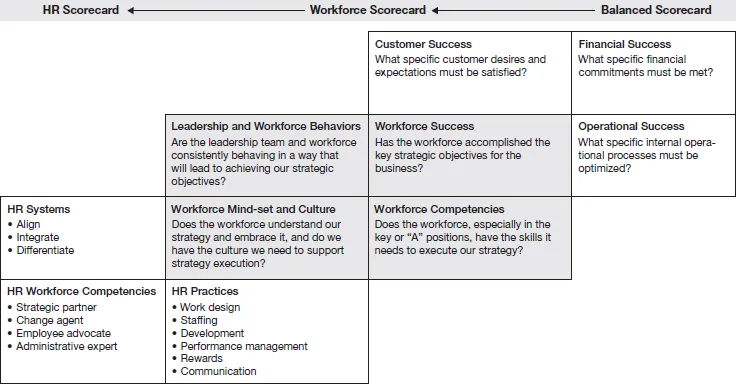
Secondly, we use the term Workforce to highlight our focus on the strategic performance of employees rather than the contribution of the HR function to business success. The Workforce Scorecard is intended to provide the CEO and executive team members with timely and strategically relevant measures of workforce performance and the leading indicators of that performance. Figure 1–1 shows how the Workforce Scorecard fits in the larger picture of strategic performance measurement.
We believe that firms need a business strategy, a workforce strategy, and a strategy for the HR function. These strategies are operationalized in the Balanced Scorecard, the Workforce Scorecard, and the HR Scorecard, respectively. As a result, the Workforce Scorecard is a crucial lever in the strategy execution process. The key dimensions of that process include operational and customer success, which in turn help create financial success. Workforce success is often the key performance driver, directly or indirectly, for these other elements of strategic success. Unfortunately, senior executives usually have very limited tools for measuring workforce success or holding line managers accountable for workforce performance. In fact, many of the same firms that have highly detailed information about their inventories and physical plant have almost no information about their own workforces—presumably one of the key drivers of their strategic success. The Workforce Scorecard is designed to solve that problem.
FIGURE 1–1
Managing Human Capital to Execute Strategy
At the other end of the value creation process is the HR function and the role played by HR professionals. These elements were the focus of our earlier book, The HR Scorecard, which highlighted the strategic role HR professionals and the HR management system play in the successful implementation of an organization’s strategy.3 Many of the same themes first introduced in The HR Scorecard are carried forward in this book. However, our experiences with HR professionals and line managers in designing and implementing HR Scorecards in a wide variety of firms and industries have made it clear to us that firm success requires an increased emphasis on the roles of the workforce and line managers in the strategy execution process. While HR professionals and the HR management system lay the foundation for building the workforce into a strategic asset, the responsibility for workforce success increasingly falls to line managers, who perform most of the workforce management activities in any firm. Senior executives and line managers need to understand how and why an effective workforce strategy is crucial for the successful execution of their own strategic responsibilities, and there needs to be an appropriate measurement system to guide those decisions. The Workforce Scorecard fulfills both of these needs.
The arrows at the top of figure 1–1 move from the Balanced Scorecard toward the HR Scorecard. This reflects a development process that begins with a clear statement of the firm’s strategy and operational goals, as well as a strategy map showing the significant causal linkages in the value creation process. The next step in the process is the development of a workforce strategy and scorecard, and the process concludes with the development of an HR function strategy and scorecard. However, the value creation process runs in the opposite direction. In other words, the foundation of workforce success begins with the HR function, which is responsible for the design and implementation of HR management systems (e.g., recruiting, selection, rewards) that can have a long-term impact on the performance of the firm. As an example of HR’s “long shadow,” many members of the senior management team in most large corporations have a long tenure in the business, often twenty years or more. Because most HR practices are relatively stable in large companies, this may mean that the current senior management team may have been recruited, selected, and acculturated with an HR management system that was designed forty years ago! Recognizing this responsibility, an organization where HR professionals are solely focused on operational efficiency and administrative compliance can never fully capture the strategic value of its workforce.
The Workforce Scorecard is a key value creating link between the Balanced Scorecard and the HR Scorecard. Does that mean that a firm needs to have all three scorecards in place to benefit from these ideas? We don’t believe that it does. Figure 1–1 represents an optimal approach to managing and measuring workforce success. For many firms the most important step is simply a change in direction that begins to move them toward the framework described in figure 1–1, which includes a consideration of HR function, workforce, and business-level outcomes. Adopting a new perspective on workforce success is the foundation of this more formal measurement system, and much progress can be made with the right perspective and a much less formal and comprehensive measurement system. Organizations will often begin by identifying one business outcome (workforce success) and then examining the relationship between that business outcome and a single leading indicator in the Workforce Scorecard (like leadership competencies). This builds a shared enthusiasm for these ideas among line managers and HR professionals and builds the foundation for further elaboration of the framework.
The Workforce Scorecard (figure 1–1) has four dimensions: workforce success, leadership and workforce behaviors, workforce competencies, and workforce mind-set and culture.
Workforce Success
This is the most important dimension on the Workforce Scorecard because it captures “bottom-line” workforce performance. These are the measures that reflect how well the workforce has contributed to the execution of the firm’s strategy. They are performance measures with two key characteristics. First, they capture business objectives of greatest concern to line managers. These are the strategic performance drivers that contribute to successful execution of the firm’s strategy, and they are the direct responsibility of one or more line managers. Second, these business outcomes are significantly (though not entirely) driven by workforce performance. Take the example of a retail firm that relies on its workforce to create a world-class buying experience for customers, and in turn increase customer satisfaction, sales growth, and financial performance. Workforce success in that firm would be measured by improved buying experience, a key strategic performance driver. Figure 1–2 highlights the perspective that workforce success focuses on the impact of your workforce strategy on business success. While business success will ultimately mean financial success, the more immediate impact of interest is on the strategy drivers that execute strategy, which are unique in each firm. Firm-level workforce success would be represented by the cumulative performance of all strategy drivers that are highly workforce intensive.
FIGURE 1–2
Workforce Success: The Impact of Workforce Strategy on Business Strategy Execution
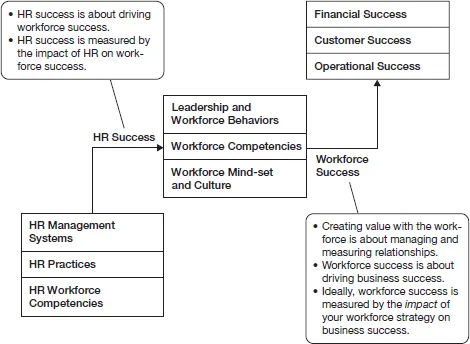
The Workforce Scorecard is designed to reflect a balance of leading and lagging indicators. Workforce success is the principal lagging indicator for measuring workforce performance. But workforce success is not exclusively an attribute of the workforce. In the earlier retail example, it is very likely that customer buying experience is influenced by more than just the workforce. So why do we recommend a business outcome as a measure of workforce success? Because line managers and HR professionals in too many firms treat workforce issues and business issues as separate, and largely independent of one another, when successful strategy execution requires a much more integrative approach. Our measure of workforce success is designed to move the focus of line managers down the value chain and the focus of HR professionals up the value chain so that both accept a shared responsibility for driving strategy through workforce performance.
The other elements of the Workforce Scorecard are leading indicators of workforce success, and elements of workforce management that are strongly influenced by line managers. Compared with workforce success, these measures focus much more on attributes of just the workforce itself. These measures are important because they capture the drivers of workforce success and point to where line managers need to invest in order to maximize workforce success. They also describe those elements of workforce management for which line managers should be held accountable.
Leadership and Workforce Behaviors
As we move back down the value chain from workforce success, the most immediate lagging indicator is the behaviors of the leadership team and the workforce. These are the actual performance behaviors required by the workforce and managers if the firm is going to enjoy workforce success. In the earlier retail example, specific workforce behaviors that influenced the customer buying experience had been identified, e.g., the proportion of frontline staff that were rated as knowledgeable, timely, helpful, and courteous. To capture the key elements of these behaviors, the appropriate points of measurement include both the frontline staff that interact with the customer and the leadership behaviors of line managers responsible for those staff.
Workforce Competencies
Workforce competencies are the knowledge, skills, abilities, and personality characteristics that serve as the foundation for workforce behaviors. We consider competencies a foundational driver of workforce success because they only represent potential workforce performance. However, knowing that 90 percent of a workforce segment is “skill ready” or rates as satisfactory or above on a particular competency is just the beginning, not the end, of measuring workforce success. The key aspect of these competencies is not just their level on some generic competency, like teamwork, thought to be important for all workers. It is also important that competency requirements be differentiated by strategic performance drivers. That is, different parts of the business will require different competency profiles, and the entire workforce measurement and management systems need to be sensitive to these distinctions. Line managers responsible for a particular strategy driver (new product cycle time in R&D) need a workforce with the specific competencies required to maximize workforce success for that specific strategy driver (knowledge sharing and cross-functional teaming skills in R&D scientists).
Workforce Mind-set and Culture
Workforce behaviors are in part driven by the larger culture of the organization, particularly around the role of performance. Culture reflects a firm’s fundamental assumptions and values about what behaviors are appropriate throughout the organization, and it is critical that a firm have a workforce culture that is both high performance and strategic. This follows from our emphasis on differentiation. Workforce culture needs to reinforce the notion that some jobs (what we will define in chapter 2 as “A” jobs) and positions are more strategic, and...
Table of contents
- Cover Page
- Title Page
- Copyright Page
- Dedication Page
- Contents
- Foreword
- Preface
- 1 The Three Challenges of Workforce Measurement and Management
- Part One: The Perspective Challenge
- Part Two: The Metrics Challenge
- Part Three: The Execution Challenge
- Notes
- About the Authors
Trusted by 375,005 students
Access to over 1.5 million titles for a fair monthly price.
Study more efficiently using our study tools.
Frequently asked questions
Yes, you can cancel anytime from the Subscription tab in your account settings on the Perlego website. Your subscription will stay active until the end of your current billing period. Learn how to cancel your subscription
No, books cannot be downloaded as external files, such as PDFs, for use outside of Perlego. However, you can download books within the Perlego app for offline reading on mobile or tablet. Learn how to download books offline
We are an online textbook subscription service, where you can get access to an entire online library for less than the price of a single book per month. With over 1.5 million books across 990+ topics, we’ve got you covered! Learn about our mission
Look out for the read-aloud symbol on your next book to see if you can listen to it. The read-aloud tool reads text aloud for you, highlighting the text as it is being read. You can pause it, speed it up and slow it down. Learn more about Read Aloud
Yes! You can use the Perlego app on both iOS and Android devices to read anytime, anywhere — even offline. Perfect for commutes or when you’re on the go.
Please note we cannot support devices running on iOS 13 and Android 7 or earlier. Learn more about using the app
Please note we cannot support devices running on iOS 13 and Android 7 or earlier. Learn more about using the app
Yes, you can access The Workforce Scorecard by Mark A. Huselid, Brian E. Becker, Richard W. Beatty in PDF and/or ePUB format, as well as other popular books in Business & Human Resource Management. We have over 1.5 million books available in our catalogue for you to explore.