![]()
Section 1
Preparing to Coach Your Employees
![]()
Chapter 1
Shift Your Thinking to Coach Effectively
by Candice Frankovelgia
Do you ever say to yourself (or others), “This person just doesn’t get it” or “This person will never have what it takes”? If so, you may have what Stanford psychologist Carol Dweck calls a fixed mind-set, which will severely limit your ability to make a difference as a coach. Low expectations rarely yield growth and often lead to frustration on both sides. You may occasionally encounter someone who truly can’t develop, but the real barrier is most often the belief that the person won’t make progress.
It’s easy to fall into this trap. After you’ve acquired a lot of experience and knowledge in your field, doing things yourself may seem simpler and faster than helping your direct reports improve their critical thinking, technical, or organizational skills. But that’s a short-term solution that leads to long-term problems. If you keep providing all the answers, people will keep lining up at your door looking for them.
Shifting Your Mind-Set
In the end, it’s actually less time-consuming to embrace a growth mind-set—one that assumes your people can learn. If you invest in their coaching and development early on, you’ll reap benefits later: They’ll start solving more of their own day-to-day problems, freeing you to focus on strategic issues and developing more leaders.
Shifting to a growth mind-set takes effort. In the coaching workshops I teach to managers, participants talk about how hard it can be at first—but once they make the switch, they start seeing better outcomes.
An R&D director at a manufacturing company had an employee who struggled to give clear, concise, organized presentations. When that person asked for input on a draft slide deck, the manager’s impulse was to mark it up with suggestions to reorganize the information and cut down on the length. But then she caught herself. She called the employee in for a conversation and asked clarifying questions: What are the key points you want to convey? How much does your audience already know? What points will be difficult for people to grasp? If you were in their place, would this presentation help you reach your goals? What can you do to bring it more in line with what your stakeholders are hoping to achieve? With renewed energy and focus, the employee went back to work and improved the presentation without heavy-handed intervention from the manager.
A growth mind-set can feel risky because it forces you, the coach, to develop skills of your own that go beyond subject-matter expertise. You must ask questions and really listen without jumping in to provide what you believe is the “right” answer. And you must be honest about the performance you expect and where your employee stands, to make sure you’re on the same page about the development work that needs to be done. Otherwise, you’re resigning yourself to the status quo—so why even bother to coach?
Sharpening Your Coaching Skills
Here are the key skills you’ll need to hone before you can help others learn and grow:
Reconciling intent and impact
You can gauge an employee’s impact on the organization by observing him in action and using performance metrics such as satisfaction surveys and sales figures. But you won’t know his intent—the driving force behind his behavior—unless he shares it with you.
When employees underperform, there’s often a gap between intent and impact, and that can lead to great misunderstanding and frustration. Coaching them effectively involves clarifying their intent so that you can close that gap. How? By asking them what impact they meant to have. For instance, you might say to someone, “You were quiet at the last sales meeting—can we talk about why?” You and others may have viewed his silence as resistance or disengagement, but perhaps he was just trying to cede the floor for a change, knowing that he can be domineering in group discussions.
Once you’ve asked the question, listen closely to the answer. (See the sidebar “Active Listening Tactics.”) Discuss behaviors that confuse or surprise you, especially those that don’t match the intent he describes.
ACTIVE LISTENING TACTICS
Pay attention. Build rapport by giving your full attention. Maintain comfortable eye contact and an open posture (avoid hunching, crossing your legs, or hunkering behind a desk). Be genuinely curious. Allow time and opportunity for the other person to think and speak. Avoid distractions such as e-mail.
Notice nonverbal cues. “Hear” the speaker’s nonverbal messages and body language. Do the tone of voice and facial expression match what’s being said? If not, comment on what you notice and ask your employee to tell you more about it.
Affirm what you hear. Indicate understanding: “I hear what you are saying” or “I’m following you. Could you say more?” This simply means that you are listening closely—not that you agree.
You’re likely to miss out on critical information if you find yourself:
- Talking more than listening
- Suggesting solutions before the employee has the chance to do so
- Interrupting
- Thinking about what you want to say next instead of focusing on what your employee is saying
Reflect what you see and hear. Reflect (like a mirror) the other person’s emotions without agreeing or disagreeing: “You seem worried about . . .” This encourages the speaker to express feelings and deepen exploration.
Paraphrase what you hear. Periodically restate basic ideas to check your grasp of key points: “If I understand, your idea is . . . Did I get the essence of it? If not, please tell me more.”
Summarize key themes. Briefly sum up the other person’s point of view to show you’ve listened and to check your understanding: “It sounds like your main concern is . . .” or “These seem to be your main points . . . Is that right?”
- Using body language that signals impatience or distraction—checking your e-mail, accepting phone calls, leaning back in your chair
- Saying what you would have done differently in the same situation
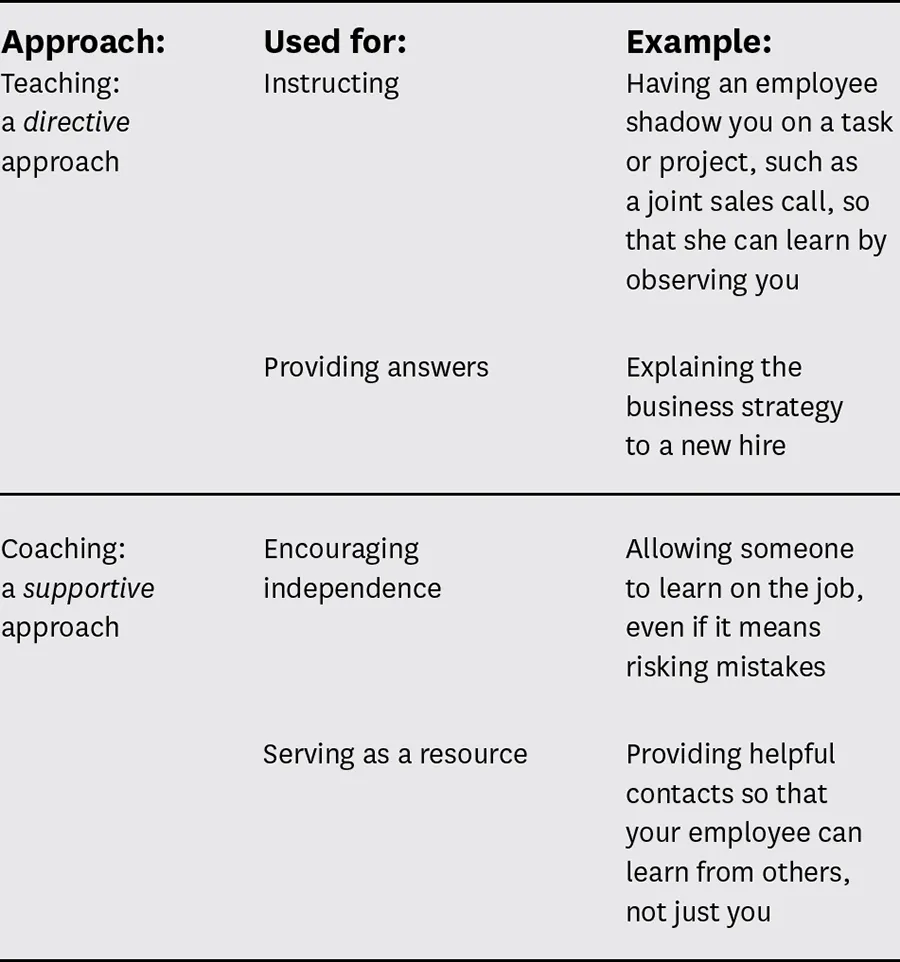
As a rule of thumb, ask more than you tell—aim for a ratio of about 4:1. If you flip that ratio, you’re teaching, not coaching. Though teaching plays an important role in developing others, it’s limited to what you know. Coaching is an interactive opportunity to discover and create previously unknown solutions. (See the sidebar “Teaching Versus Coaching.”)
Always assume positive intent, even when dealing with difficult behavior. People usually mean well—and if you give them the benefit of the doubt, they’ll be more forthcoming about their intent and more receptive to feedback.
Recognizing your biases
Your own preferences can get in the way of discovering others’ intent. Maybe you have a gut reaction against certain personality types or struggle to identify with colleagues whose work styles differ from yours. Whatever your biases, recognizing them allows you to move past them by inquiring about intent rather than jumping to conclusions or filling in the blanks.
To spot your biases, use frustration as your guide. Think about what gets on your nerves at work and then ask a few trusted colleagues for feedback. What do they think your bugbears are? Compare their thoughts with yours—look for similarities and patterns.
TEACHING VERSUS COACHING
To develop employees’ skills, you must first decide whether to teach or coach. Are you working with an inexperienced colleague or one who requires immediate improvement? If so, you’ll want to teach, which means showing or telling her what to do. Otherwise, you’re probably better off coaching—asking questions that prompt her to think and solve problems on her own. That way, your employee will gain the independence and confidence she needs to grow, whether she’s trying to achieve greater mastery in her role or take on new responsibilities.
Adapted from Harvard Business Essentials: Coaching and Mentoring (Harvard Business School Press, 2004)
That exercise helped one manager recognize her tendency to jump right into action rather than spend time defining and aligning processes. She noticed how impatient she became when team members kept pulling conversations back to “process” instead of “just getting the work done.” When she asked them for candid feedback on this, they explained that her impatience actually slowed them down (the last thing she wanted to do) because they often had to loop back to clarify expectations with her. So her impact—as well as her team’s—didn’t match her intent. She met her employees halfway by doing a better job of clarifying expectations up front. She also encouraged them to make more adjustments on the fly so they wouldn’t get paralyzed by planning and slavish adherence to process. As the general level of impatience and frustration dropped, the group began to operate more efficiently and enjoyed the work more.
Matching people’s skills with big-picture needs
As a coach to your employees, you’re not just helping them grow for their own sake—noble as that is. You’re also boosting their ability to support the company’s mission and goals. By explicitly connecting their skills with big-picture needs, you’ll give them a sense of purpose and belonging, which will motivate them to grow. If you explain how improving their communication skills will make the team more efficient, for example, or increase sales to clients, they’ll be more likely to take their development in that area as seriously as you do.
How can you get better at connecting the dots between their skills and the organization’s needs? There’s no magic here—again, you’ll get a wealth of information simply by asking. Where do they feel their skills are best used? What excites them about their work? What areas do they struggle with? What would they like to do more of? Less of? How do they see all that fitting into the organization’s objectives? (For more on channeling employees’ passions and strengths, see chapter 2, “Set the Stage to Stimulate Growth.”)
Make it clear that you’re looking out for their interests as well as the company’s. They’ll be eager to help you figure out how they can best serve the organization—and how the organization (and you) can best serve them.
Developing a growth mind-set means you’re learning right along with your employees. The more coaching practice you get, the sharper your skills will become—but give yourself a running start by favoring inquiry over advocacy. Ask questions about others’ intent, your own biases, and individuals’ place in the big picture. And resist the temptation to coach by explaining how you do things. With prompting, not lecturing, your employees will discover solutions of their own and make greater, more lasting progress toward their developmental goals.
____________
Candice Frankovelgia is a coaching portfolio manager and a senior faculty member at the Center for Creative Leadership.
Adapted from the Center for Creative Leadership’s course “Coaching for Greater Effectiveness.” For further information, visit www.ccl.org.
![]()
Chapter 2
Set the Stage to Stimulate Growth
by Edward M. Hallowell, MD
Editor’s note: Before you begin coaching your employees, set the stage for success. Make sure they’re doing the right jobs to begin with, they feel connected to their work and to one another, they’re receptive, and they’re capable of mastering the skills and ta...