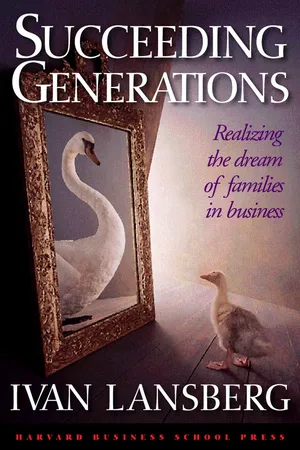
Finding the right successor to a well-loved founder or president is often the most difficult task an organization can face—and the challenge can be even greater for family-run businesses. Succeeding Generations explores leadership transitions in family businesses, offering a clear-eyed assessment of the different options, from direct succession to building partnerships between siblings and cousins.Family-owned companies may dominate the worldwide business landscape, yet surprisingly few are successfully passed down from one generation to the next, and fewer still reach the third generation intact. Author Ivan Lansberg, an organizational psychologist who grew up in a family business, examines the reasons behind this high failure rate and reveals the factors that contribute to long-term success. He offers practical advice on how to mentor successors, how to set up a systematic selection process, and how to make the best use of the board of directors during times of transition.With a wealth of examples from companies in the United States, Europe, and Latin America, Succeeding Generations provides a thoughtful and comprehensive look at the sensitive dynamics of leadership succession in family businesses.
- 400 pages
- English
- ePUB (mobile friendly)
- Available on iOS & Android
eBook - ePub
About this book
Information
PART I
Family Business Forms
CHAPTER 1
Designing New Road Maps for the Journey
IN thinking about succession, family business owners and the professionals who advise them have generally had only one road map to follow: The literature in the field has been largely limited to transitions from one controlling owner to another controlling owner (CO to CO). This has virtually eliminated from view a large number of family businesses that either have a system of multiple leaders or would prefer to transfer the company in the next generation to a leadership group.
The deep-rooted bias in favor of CO-to-CO successions conforms to the hierarchical patterns of authority that the public has come to accept as the norm in business. Every business is supposed to have one, and only one, boss who is the ultimate decision maker. Executive committees, offices of the president, or other such arrangements that convey the idea that leadership responsibilities are shared, are seen as suboptimal compromises. Clients, suppliers, and even employees often do not understand them.
Having a single leader does tend to be less complicated from the point of view of corporate decision making. When power is concentrated in the hands of one individual, major decisions can be made quickly and informally. When there are several owner-managers looking after the business, leadership responsibilities may become diffuse, sometimes leading to slow and ineffective action. To many family business owners rule by one leader seems clean and simple, while a system of multiple leaders is messy and complex (if not dangerous!).
I held this same bias for many years—until I began to meet more and more brothers and sisters or groups of cousins who professed to run their businesses as equal partners. Members of these families told me that they made all major decisions as a group, by consensus. Skeptical, I would sometimes ask them, “But who is really in charge here? Who has the final say when push comes to shove?” The reply was usually, “We are the leaders here.” I was still suspicious of these claims, believing the formal team structure was merely a way of allowing weaker family members to accept the rule of a stronger brother or sister without hurt feelings. When I observed these businesses closely, I found that in some of them, indeed, the “we” was really an “I.” There was a perception that power was shared, but one person was actually the ultimate decision maker.
In other shared leadership arrangements, however, I could not identify an “ultimate boss.” While responsibilities were often divided—with each partner having virtual autonomy within his or her own bailiwick—decisions that involved the company as a whole were reached by consensus. The partners were loath to make a major investment or divestiture, for example, unless all were in agreement. In their titles and perks, in the size of their offices and other trappings of power, they were careful to preserve their equality. They often invented ingenious techniques for getting along, fostering agreement on potentially divisive issues, and maintaining unity. As we shall see, some of the rules that sibling partners adopt in order to minimize conflict seem to violate many rules of sound administration. Indeed, members of sibling partnerships are often sensitive about how their idiosyncratic organizational structures and quirky rules look to outsiders.
Some years ago a group of scientists studied the bumblebee and concluded that, according to basic principles of aerodynamics, it could not possibly fly. Of course, we know that although bumblebees may not be as aerodynamically designed as mosquitoes, they do, in fact, fly. Although the sibling and cousin partnerships I observed were often as strangely designed as bumblebees, they did, in fact, fly. Some of these partners had been together for twenty-five years or more. They were making money and having fun.
This realization led me to question the lack of attention to collective systems in the family business literature. Why had these systems been ignored for so long? How and why do shared leadership arrangements come about, and what does it take to make them work? Why were they becoming more numerous?
This chapter traces what appears to be a major shift in attitudes toward shared leadership systems. An interest in shared leadership in family companies grows out of the preference of many parents for shared ownership—that is, for dividing their assets more or less equally among members of the next generation. I will cite evidence that, in their succession planning, a growing number of family business owners are showing an interest in collective systems and many are already experimenting with them. If these statistics are any indication, many family companies are headed into terra incognita. My experience and the research I have conducted suggest the challenges associated with these kinds of transitions have been greatly underestimated.
Clearly, collective systems are not feasible for every family and company. They are almost certain to fail when siblings’ or cousins’ relationships are riddled with destructive family conflict and rivalry. Furthermore, the controlling owner structure has undeniable advantages—a parsimonious governance and leadership arrangement is unquestionably simpler to manage. If all family trees could be pruned at every succeeding generation so that only one of the heirs would inherit ownership and management responsibilities, most generational transitions would probably be smoother. But pruning the tree is not always economically or emotionally feasible in a family business.
The Prevailing Wisdom
Both researchers and practitioners in the family business field have tended to embrace the prevailing view in general management literature that collective authority systems are unworkable. For example, Christensen, in his pioneering study of succession in family businesses, described partnerships as feasible mostly as interim arrangements—structures that work for a limited period of time until an appropriate successor can be found.1 Similarly, Harry Levinson in his classic Harvard Business Review article warned against the perils of sibling partnerships:
If the brothers own equal shares in the organization and both are members of the board, as is frequently the case, the problems are compounded. On the board they can argue policy from equally strong positions. However, when they return to operations in which one is subordinate to the other, the subordinate one, usually the junior brother, finds it extremely difficult to think of himself in a subordinate role. . . .2
Note that Levinson’s assumes that the two brothers should not be equals in operations. Instead, he offers the following solution: “If one or more brothers is on the board, then only one, as a rule, should be an operating executive.” Levinson does leave the door open a crack when he says that under rare conditions (“if the brothers work well together”) deviations from this rule may be possible. His message, however, is resoundingly clear: Stay away from arrangements in which siblings have to collaborate in both management and ownership roles.
In their classic The Family Owned Business, Benjamin Becker and Fred Tillman unambivalently delineate the benefits of having a single leader:
Every family business must have a boss. . . . The family business owner should consider designating an individual in the business to be the final decision-maker after the owner relinquishes the managerial reins. Feelings are likely to be hurt by the selection, but this step still should be taken. . . . If there are two or more family members in the business, a family business owner should not hesitate to vest—during his lifetime—adequate managerial powers in the most competent family member to avoid possible conflicts.3
More recent authors are even more explicit about the hazards of shared ownership and management arrangements. Consider the advice by Benjamin Benson and associates, all senior consultants to family businesses, in a popular book aimed at the family business owner. About shared management they say: “In our experience, most businesses need one leader with ultimate authority. Some owners, unable to reach a decision on which child should be the successor, allow them to fight it out, usually with destructive results.”4 On shared ownership: “Multifamily ownership requires such a unique combination of people, attitudes, and skills, and the odds are so high against success that some consultants categorically advise that rather than attempting to continue the business . . . [it] should be sold.”5 And finally, “The proliferation of stockholders is a principal reason for the high mortality rate of family businesses.”6 Throughout their book, Benson and his coauthors argue for a twofold solution to the succession problem. First, choose a single successor to lead the company. Second, concentrate the voting control of the company in the hands of the successor.
Similarly, in a column in Family Business magazine, LÉon Danco writes: “Solutions that call for sharing of power—equal multiple partnerships, co-presidencies, rotating the presidency—are mostly naive fantasies. . . . In my experience a family business can have only one leader.”7 Danco is considered by many to be the pioneer in family business consulting. Although he is not an academic researcher, he has been practicing in the field for almost forty years and his ideas have had a far-reaching impact on both the theory and practice of succession planning. His popular book Beyond Survival, which is addressed to the single owner-manager and focuses almost entirely on succession planning, provides many practical ideas that have become standard practice in the field. These include the need to develop a board with competent independent directors; the importance of training and selecting a successor; and the necessity of developing a retirement plan and of handing over power to the successor during the lifetime of the entrepreneur.8
All of these are sound prescriptions. However, implementing them becomes incrementally more difficult the further removed a given family business is from the entrepreneurial stage, in which a single individual is usually in full control. Companies tend to become more complex in later generations; as the business expands, the family tree branches out and the ownership becomes more fragmented. For the elders, this greatly increases the challenges involved in deciding such questions as: Who is most qualified to lead the business in the next generation? How many family members seeking jobs can be accommodated in the company? What is the most efficient structure for managing all this complexity? Likewise, juniors in the company must appreciate that circumstances in the business and family may have changed significantly and that following the management formulas of their elders may be a recipe for disaster. To succeed in their turn at the helm, the younger generation may have to consider wholly new management styles and structures.
The substance of the issues thus changes significantly in the more complex business forms. The process of selecting successors can also differ depending on whether the person doing the selecting is the father or mother of the candidates, a brother or sister, an uncle or a cousin—and will be different still if the decision makers are themselves a group or if they are choosing a group of successors rather than a single leader. Choosing successors by group consensus can be a political nightmare in these later-generation family companies. Imagine a second-generation family company with three siblings, equal owners, all in leadership roles. Those three are likely to be involved in training and evaluating one another’s children. Can they do so with a reasonable degree of impartiality? Or will each promote his or her own children over those of the others? How the top positions are distributed among the various branches of a family—and how each family divides its shares with their offspring—will have a direct impact on the overall balance of power among the cousins. Whatever arrangements are reached regarding succession, the family must necessarily address these added complexities.
Similarly, the very fact that there is a team of leaders that must step down in order for the next generation to take charge makes the succession process significantly different. Should the current leaders be replaced with another management team? How likely is it that similar collaborative relationships can be replicated among the cousins? Should the family company revert back to a single leader? And, if so, how does the shared leadership pattern established by the predecessors affect the mandate of the new leader? What expectations does the structure that operated in the past create for the structure that will operate in the future? These are all important considerations that must be taken into account in the context of alternative types of successions.
Alternatives to the Controlling Owner Model
The evidence that shared leadership arrangements are increasingly common is beginning to mount. In a 1997 survey of 3,000 family firms across the United States, 11.2 percent of the respondents reported having more than one CEO at the helm. Another 1 percent said they had more than two CEOs. More importantly, the survey reports that over 42 percent of respondents think that co-CEOs are a possible leadership solution for their companies in the next generation.9 A survey reported in the Wall Street Journal suggests that family business owners actually consider a broad range of leadership arrangements when thinking about succession. In this study, 15 percent of those business owners sampled explicitly planned to form an executive committee of two or more children; 40 percent were considering recruiting the help of the board of directors or of an external third party in choosing between a single successor and several. Only 35 percent of those interviewed had settled on grooming only one successor candidate.10
Statistics that I have collected at conferences in recent years also indicate the diversity of owners’ choices and preferences. Of the 401 companies in the sample, a majority of single, controlling owners aspire to move their companies to sibling partnerships in the next generation—nearly twice as many as favor passing the business to another single leader. Presumably, many of these owners want to see their children function as a team in the second generation. The other notable point is that 54 of the 127 (42%) owners now functioning as part of sibling partnerships wish to retain the same structure in the next generation rather than move toward a more complex form of organization—the cousin consortium—which is the next natural step in the generational progression. What this suggests is that the seniors feel that the structure they know will work best for business in the next generation as well.
From the Fuggers of the Italian Renaissance, to the Rothschilds in the nineteenth century, to the Rockefellers and du Ponts in this century, some of the world’s greatest business empires have been built by family partnerships. Through the mass media today, the public hears mostly about powerful family companies that have imploded because of sibling rivalries and intra-family feuds. But there are numerous examples of siblings and cousins who have worked together for years and achieved notable success.
One example is the Asplundh Tree Expert Co., a company that trims trees for telephone and electrical utility companies in all fifty states of the United States and in eight foreign countries. Based in Willow Grove, Pennsylvania, the company was founded by three brothers, Griffith, Carl, and Lester Asplundh, who got into tree-trimming in order to finance their educations after their Swedish immigrant father died. For many years, according to Forbes magazine, Griffith oversaw the tree-trimming operations, Carl took care of the books, and Les provided technical expertise and managed research and development. By 1968, the three founders were either dead or retired and a new generation had taken over. Both the ownership and the leadership structure were becoming more complex. Barr Asplundh, Griffith’s son, was elected president and seven brothers and cousins were on the board of directors. Edward Asplundh, Carl’s son, became president next in 1982, and Chris Asplundh, the youngest member of the second generation, succeeded Edward in 1992. Today Asplundh is owned by 132 shareholders—all of them members of the Asplundh family. Revenues have expanded from $100 million in 1984 to $900 million in 1995. The board consists entirely of family members. Sixteen family members work in the company, admitted only after satisfying stiff educational and training requirements—described by Forbes as a system of “disciplined nepotism.” Multiple ownership and plural leadership have clearly worked for Asplundh.11
Nordstrom, the upscale department store chain based in Seattle, is another highly visible example of how these complex systems can be successfully managed. The company was founded as a shoe store in 1901 by Swedish immigrant John Nordstrom a...
Table of contents
- Cover Page
- Title
- Copyright
- Dedication
- Content
- Preface
- Introduction
- Part I Family Business Forms
- Part II Shared Dreams and Succession Planning
- Part III Human Development and the Timing of Succession
- Part IV Governance for Continuity
- Notes
- References
- About the Author
Trusted by 375,005 students
Access to over 1.5 million titles for a fair monthly price.
Study more efficiently using our study tools.
Frequently asked questions
Yes, you can cancel anytime from the Subscription tab in your account settings on the Perlego website. Your subscription will stay active until the end of your current billing period. Learn how to cancel your subscription
No, books cannot be downloaded as external files, such as PDFs, for use outside of Perlego. However, you can download books within the Perlego app for offline reading on mobile or tablet. Learn how to download books offline
Perlego offers two plans: Essential and Complete
- Essential is ideal for learners and professionals who enjoy exploring a wide range of subjects. Access the Essential Library with 800,000+ trusted titles and best-sellers across business, personal growth, and the humanities. Includes unlimited reading time and Standard Read Aloud voice.
- Complete: Perfect for advanced learners and researchers needing full, unrestricted access. Unlock 1.5M+ books across hundreds of subjects, including academic and specialized titles. The Complete Plan also includes advanced features like Premium Read Aloud and Research Assistant.
We are an online textbook subscription service, where you can get access to an entire online library for less than the price of a single book per month. With over 1.5 million books across 990+ topics, we’ve got you covered! Learn about our mission
Look out for the read-aloud symbol on your next book to see if you can listen to it. The read-aloud tool reads text aloud for you, highlighting the text as it is being read. You can pause it, speed it up and slow it down. Learn more about Read Aloud
Yes! You can use the Perlego app on both iOS and Android devices to read anytime, anywhere — even offline. Perfect for commutes or when you’re on the go.
Please note we cannot support devices running on iOS 13 and Android 7 or earlier. Learn more about using the app
Please note we cannot support devices running on iOS 13 and Android 7 or earlier. Learn more about using the app
Yes, you can access Succeeding Generations by Ivan Lansberg in PDF and/or ePUB format, as well as other popular books in Business & Leadership. We have over 1.5 million books available in our catalogue for you to explore.