Broadening Participation in STEM
eBook - ePub

Broadening Participation in STEM

Effective Methods, Practices, and Programs

  1. 275 pages
  2. English
  3. ePUB (mobile friendly)
  4. Available on iOS & Android
eBook - ePub

About this book

U.S. students exit undergraduate science, technology, engineering, and mathematics programs at alarming rates. Less than 50 percent of the undergraduate students who enter STEM degree programs as aspiring freshmen complete degrees in these areas. This is especially true for minorities, whose departure from STEM degree programs is often twice the rate of others.
Broadening Participation in STEM features chapters from developers of high impact educational practices and programs that have been effective at broadening the participation of underrepresented groups in the STEM disciplines. It explores strategies used with special populations of STEM aspirants including minority groups such as African Americans, Latino Americans, and Native Americans; persons from economically disadvantaged background; and persons with disabilities. This volume contributes to national knowledge of best practices in educating underrepresented students aspiring to STEM careers.
This book provides campus-based faculty, administrators, and diversity professionals with a guide that can be used to develop programs designed to address specific student success and inclusion goals in STEM programs.

Tools to learn more effectively

Saving Books

Saving Books

Keyword Search

Keyword Search

Annotating Text

Annotating Text

Listen to it instead

Listen to it instead

Information

PART I

LSU OFFICE OF STRATEGIC INITIATIVES: A GREAT EQUALIZER FOR BROADENING PARTICIPATION IN STEM

Tyrslai M. Williams, Melissa B. Crawford, Linda M. Hooper-Bui, Stephanie Givens, Heather Lavender, Shannon Watt and Isiah M. Warner

ABSTRACT

Louisiana State University (LSU)’s Office of Strategic Initiatives (OSI) is an award-winning office devoted to developing effective, educational approaches that incorporate guidance and exploration, increase students’ academic standing, and support measures to improve the institution’s diversity, predominantly in science, technology, engineering, and mathematics (STEM) departments. Through the incorporation of three main factors, Mentoring, Education, and Research, OSI has developed a holistic development model that offers students strategies to overcome those factors that affect their persistence in STEM. OSI houses several programs with a diverse population of students ranging from the high school to doctoral levels. Although varied in student population, these programs unite under the holistic development model to provide support and opportunities to students at each critical educational juncture. OSI’s holistic approach has successfully supported over 135 high school, 560 undergraduate, and 100 graduate students. Of the 560 undergraduate students served, 51% were underrepresented minorities and 55% were women. The undergraduate initiatives have garnered 445 bachelor’s degrees, with 395 degrees from STEM disciplines, and an impressive overall graduation rate ranging from 64% to 84%. Through all of the remarkable work performed in OSI, the greatest accomplishment has been the capacity to offer students from mixed backgrounds tools and strategies to thrive at any point in their academic career.
Keywords: Underrepresented; holistic development; mentoring; STEM; research; graduation rate

INTRODUCTION

National Need to Broaden STEM

“The United States takes pride in the vitality of its economy, which forms the foundation of our high quality of life, our national security, and our hope that our children and grandchildren will inherit ever-greater opportunities […] Without a renewed effort to bolster the foundations of our competitiveness, we can expect to lose our privileged position” (Sciences, Engineering, & Medicine, 2007). This staggering excerpt from the original Rising Above the Gathering Storm: Energizing and Employing America for a Brighter Economic Future 2005 report was meant to raise awareness of the imminent threat to America’s global competitiveness. The report provided 20 definitive actions designed to safeguard our nation’s competitive edge. A follow-up report was prepared five years later, which revisited and updated prior findings. Sadly, the contributors unanimously determined that the outlook of the United States has worsened by considerable measure (Sciences, Engineering, & Medicine, 2010). Two key recommendations include investing in basic scientific research and strengthening our public school system. Federal government research and development (R&D) funding as a fraction of the Gross Domestic Product decreased by 36% from 1964 to 2009 (Federal R&D was 1.92 percent of GDP in 1964 and .74 percent of GDP in 2004). Improvements to our overall public school system are minimal. While other countries are rapidly progressing, the US educational system is steadily declining, especially in science and mathematics (Hoffman, 2009). In the 2015 Programme for International Student Assessment (PISA) results, the United States ranked 24th in science and 38th in math out of 71 countries (Desilver, 2017). Every three years, PISA measures the math, science, and reading ability and additional skills among 15-year-olds from developed and developing nations. Additionally, in the 2015 National Assessment of Educational Progress (NAEP), math scores of both fourth- and eighth-graders were lower compared to 2013, and only 40% of fourth-graders and 33% of eighth-graders perform at or above the proficient level in math (Progress, 2015). This gross lack of preparation for science, technology, engineering, and mathematics (STEM) undergraduate degrees directly impacts the rate at which students pursue and persist in these fields, particularly for women and underrepresented minority students (URMs). Overall, women received a higher percentage of bachelor’s degrees than men across all racial/ethnic groups (57% vs. 43%, respectively). However, this pattern is not observed in STEM, as only 35% of women versus 65% of men completed STEM degrees (Statistics, 2017). This trend is similar for URMs, who receive STEM degrees at lower rates than their White or Asian counterparts (Statistics, 2017). Thus, the prevailing need for broadening participation in STEM is urgent, as more than half of the children in the US are projected to be part of a minority race/ethnic group by 2020. By 2044, the US Census Bureau expects that more than half of all Americans will belong to a minority group, and by 2060, 20% of the nation’s population will be foreign-born. This epidemic, coupled with the projected rapid demographic shift in our nation (Bureau, 2015), has diminished the global competitiveness of the United States and has contributed to our inability to adequately meet our needs through scientific and technological advancement (Sciences et al., 2010). Within higher education, the need for increasing retention has been recognized; however, sustainable efforts that impact institutions overall have been futile.

LSU’s Need for Broader Participation

In Louisiana, the state of education is dire. Ranked 49th nationally in terms of education, Louisiana’s high school graduation rate of 77.5% is below the national average and only 34% of high school graduates are college ready. As the state’s flagship institution, the vision of Louisiana State University (LSU) is to collectively enhance the dissemination of knowledge by increasing student access and success and improving the quality of life for citizens of Louisiana through teaching, research, healthcare delivery, and public service (Administration, 2018).
LSU’s mission is to foster first-class learning, the discovery of innovations, and the development of Louisiana’s human capital by applying for research and scholarship in advancing intellectual, personal, and professional growth. LSU is one of a few universities nationally to be designated as land-grant, sea-grant, and space-grant, supporting its role of being a leading research-extensive university.
In support of its vision and mission, LSU has made great strides toward more fully representing the demographics of the nation and state with several priorities. Within LSU’s Flagship Agenda 2025, Leading Louisiana. Impacting the World, there is a commitment to celebrating cultural awareness, catalyzing transformation, fostering collaboration, nurturing ingenuity, and promoting innovation.
As a result, these efforts have led to a steady increase in the diversity of LSU’s student population. As represented in Fig. 1, the university’s record-setting 2015, 2016, and 2017 spring graduation classes each included the most degrees ever awarded to African American students in any commencement ceremony in the university’s history (Planning, 2017). These classes also include record-breaking numbers of Hispanic or Latino students and women. Additionally, the number of students from underrepresented groups who received doctoral degrees increased.
image
Fig. 1. OSI’s Holistic Development Model.
While LSU has made good progress toward recruiting a diverse, qualified cadre of students, the institution does not have a long tradition of recruiting minority students, as the first African American student was not admitted until 1953. Over time, LSU’s increasing commitment to diversity and its recruitment of underrepresented students attracts many African American students. In fact, the fall 2018 class of incoming freshmen is both the largest and most diverse in our university’s history, with more than 40% of the incoming class of STEM majors being a member of a historically underrepresented group. Many ongoing efforts are also underway to understand the culture and climate at LSU and implement changes to advance inclusivity across the campus and community. While efforts have been developed by various academic and non-academic units, the LSU Office of Strategic Initiatives (OSI) has primarily served as a center focused on identifying barriers and solutions to increase inclusivity for advancing all students, particularly women and URMs in STEM disciplines.

THE LOUISIANA STATE UNIVERSITY OFFICE OF STRATEGIC INITIATIVES

The Vision and Mission of the Office of Strategic Initiatives

The OSI is located on the campus of LSU and houses a variety of diverse programs in STEM for students at the high school, community college, undergraduate, and graduate levels. This unit is led by Dr Isiah M. Warner, Vice President for Strategic Initiatives, and Dr Guoqiang Li, Associate Vice President. In 2001, OSI was formalized with a vision to create, leverage, and centralize STEM education and mentoring programs at LSU. Through its many initiatives, this unit actively supports the educational research and scholarly productivity of faculty and the preparedness and competitiveness of graduate and undergraduate students. Specifically, OSI mission is focused on developing successful, educational models that integrate mentoring and research, raise students’ academic achievement, and support efforts to improve campus diversity, particularly in STEM disciplines.
The strategies employed by OSI are plentiful; however, the largest strategic impacts include, but are not limited to (1) developing new mentoring activities, (2) providing funding for incoming LSU students, (3) coordinating efforts to pursue and secure education/training grants to support undergraduate students, (4) establishing a close alliance with surrounding universities (e.g., Southern University, Baton Rouge Community College, etc.), (5) supporting K–12 education, teachers, and students, and (6) increasing the number of external awards for students. Over the past 17 years, OSI has surpassed its initial expectations and garnered recognition across the university as an innovative entity designed to support and promote a large number of student-oriented programs at LSU.

OSI’s Holistic Development Model

Underrepresented students are often faced with factors that impact their persistence at multiple stages of their academic journey. Factors such as poor self-image, lack of pre-college training, minimal financial support, and the absence of social integration directly impact their determination to succeed academically, particularly at the undergraduate level (Braxton, Hirschy, & McClendon, 2004; Hossler, Ziskin, Gross, Kim, & Cekic, 2009; Locks, Hurtado, Bowman, & Oseguera, 2008; Seidman, 2005). One strategy that has been leveraged by many is the use of cohort experiences and/or learning communities as educational models. These models allow students from similar fields to work collaboratively, engage in peer mentoring, build social and academic networks, and expand team-working skills to ignite self-efficacy and determination. As a result, increased retention, graduation, and success rates have been noted (Lei, Gorelick, Short, Smallwood, & Wright-Porter, 2011). As such, OSI works to engage students in its programs through cohorts by using a holistic development model.
OSI’s holistic development model is rooted in the Social Cognitive Career Theory (SCCT; Lent, Brown, & Hackett, 2002), which has been used considerably in research as a method to examine career development in STEM disciplines (da Silva Cardoso et al., 2013; Fouad & Santana, 2017; Hardin & Longhurst, 2016; Herrera & Hurtado, 2011; Kier, Blanchard, Osborne, & Albert, 2014; Lent et al., 2001, 2013). Based on Bandura’s Social Cognitive Theory (Bandura, 2001), SCCT has been used to clarify cognitive and motivational activities that impact psychosocial behaviors relevant to STEM education and careers, including academic and research performance. Self-efficacy is the grounding principle within the SCCT model and suggests that an individual’s interest (e.g., in a research career) is directly influenced by their confidence in their ability to perform relevant tasks (i.e., student self-efficacy) and in their convictions about the feasibility of doing so (i.e., student expected outcomes).
Looking closely at the SCCT model, the intersection of interests, performance, and outcome expectancy influence perceived career effectiveness and the motivation to persist (Bakken, Byars-Winston, & Wang, 2006; Lent & Brown, 2013). In addition to self-efficacy, other variables, including science-identity, are reliable indicators of persistence in a science career (Byars-Winston, Estrada, Howard, Davis, & Zalapa, 2010; Estrada, Woodcock, Hernandez, & Schultz, 2011). Through our development model, students from underrepresented groups have engaged in high-impact experiential learning experiences that include holistic mentoring, early exposure to research, and academic enrichment to ensure the success of all students (Fig. 1).

OSI’s Three Pillars of Success

Though multiple factors contribute to the success of underrepresented students at critical junctures, OSI has determined that three important factors, Mentoring, Education, and Research, support the targeted increase in academic success. These factors serve as the pillars of the holistic development model employed by OSI in developing and sustaining programming. When the three pillars are combined, they provide the vital holistic experience URMs need to overcome those factors that affect their persistence in STEM.
Mentoring Pillar
The mentoring pillar of the development model is the most widely used pillar of the model but also the most crucial measure for student success. The mentoring relationship between a mentor and protégé is an interaction that supplies support and insight on various topics that can make or break the success of the protégé. Students who are mentored at the undergraduate level favor increased grade point averages (GPAs) and higher retention rates, graduate within shorter time frames, and enter graduate programs at a higher rate (Salinitri, 2005; Wilson et al., 2012). OSI acknowledges these effects and employs mentoring in an intrusive, peer, faculty/staff, and tiered manner (Blake-Beard, Bayne, Crosby, & Muller, 2011; Campbell & Campbell, 2007).
On a campus as large as LSU’s, student contact is very limited and often requires a more direct or intrusive approach in supporting and mentoring students. Mentoring through an intrusive approach requires your program leadership team to acquire an active effort in pursuing and maintaining communication and involvement of students. This mentoring approach allows the mentors to go above and beyond in engaging students in program activities and campus resources. Using this method, mentors are required to initiate contact with students, continually extend support, and oftentimes inquire about setbacks and potential difficulties the students may encounter. This level of mentoring requires every interaction to be strategic and intentional with students in order to catalyze an increase in students’ academic performance (Clar...
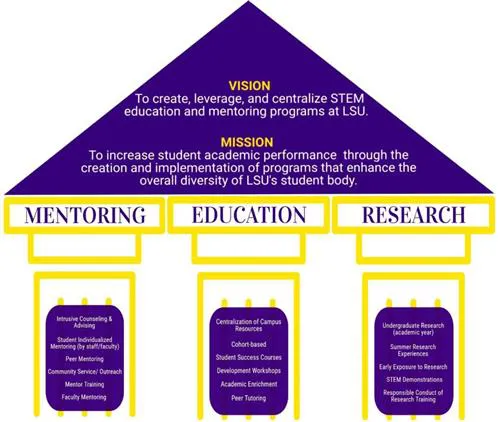
Table of contents

  1. Cover
  2. Title Page
  3. Part I
  4. Part II
  5. Index

Frequently asked questions

Yes, you can cancel anytime from the Subscription tab in your account settings on the Perlego website. Your subscription will stay active until the end of your current billing period. Learn how to cancel your subscription
No, books cannot be downloaded as external files, such as PDFs, for use outside of Perlego. However, you can download books within the Perlego app for offline reading on mobile or tablet. Learn how to download books offline
Perlego offers two plans: Essential and Complete
  • Essential is ideal for learners and professionals who enjoy exploring a wide range of subjects. Access the Essential Library with 800,000+ trusted titles and best-sellers across business, personal growth, and the humanities. Includes unlimited reading time and Standard Read Aloud voice.
  • Complete: Perfect for advanced learners and researchers needing full, unrestricted access. Unlock 1.4M+ books across hundreds of subjects, including academic and specialized titles. The Complete Plan also includes advanced features like Premium Read Aloud and Research Assistant.
Both plans are available with monthly, semester, or annual billing cycles.
We are an online textbook subscription service, where you can get access to an entire online library for less than the price of a single book per month. With over 1 million books across 990+ topics, we’ve got you covered! Learn about our mission
Look out for the read-aloud symbol on your next book to see if you can listen to it. The read-aloud tool reads text aloud for you, highlighting the text as it is being read. You can pause it, speed it up and slow it down. Learn more about Read Aloud
Yes! You can use the Perlego app on both iOS and Android devices to read anytime, anywhere — even offline. Perfect for commutes or when you’re on the go.
Please note we cannot support devices running on iOS 13 and Android 7 or earlier. Learn more about using the app
Yes, you can access Broadening Participation in STEM by Zayika Wilson-Kennedy, Goldie S. Byrd, Eugene Kennedy, Henry T. Frierson, Zayika Wilson-Kennedy,Goldie S. Byrd,Eugene Kennedy,Henry T. Frierson in PDF and/or ePUB format, as well as other popular books in Education & Educational Policy. We have over one million books available in our catalogue for you to explore.