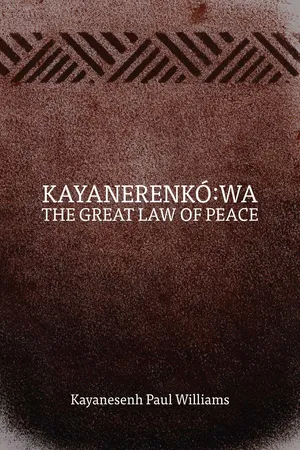
Kayanerenkó:wa
eBook - ePub

Kayanerenkó:wa

The Great Law of Peace

  1. English
  2. ePUB (mobile friendly)
  3. Available on iOS & Android
eBook - ePub

Kayanerenkó:wa

The Great Law of Peace

About this book

Several centuries ago, the five nations that would become the Haudenosaunee—Mohawk, Oneida, Onondaga, Cayuga, and Seneca—were locked in generations-long cycles of bloodshed. When they established Kayanerenkó: wa, the Great Law of Peace, they not only resolved intractable conflicts, but also shaped a system of law and government that would maintain peace for generations to come.

This law remains in place today in Haudenosaunee communities: an Indigenous legal system, distinctive, complex, and principled. It is not only a survivor, but a viable alternative to Euro-American systems of law. With its emphasis on lasting relationships, respect for the natural world, building consensus, and on making and maintaining peace, it stands in contrast to legal systems based on property, resource exploitation, and majority rule.

Although Kayanerenkó: wa has been studied by anthropologists, linguists, and historians, it has not been the subject of legal scholarship. There are few texts to which judges, lawyers, researchers, or academics may refer for any understanding of specific Indigenous legal systems. Following the United Nations Declaration on the Rights of Indigenous Peoples, and a growing emphasis on reconciliation, Indigenous legal systems are increasingly relevant to the evolution of law and society.

In Kayanerenkó: wa: The Great Law of Peace Kayanesenh Paul Williams, counsel to Indigenous nations for forty years, with a law practice based in the Grand River Territory of the Six Nations, brings the sum of his experience and expertise to this analysis of Kayanerenkó: wa as a living, principled legal system. In doing so, he puts a powerful tool in the hands of Indigenous and settler communities.

Frequently asked questions

Yes, you can cancel anytime from the Subscription tab in your account settings on the Perlego website. Your subscription will stay active until the end of your current billing period. Learn how to cancel your subscription.
No, books cannot be downloaded as external files, such as PDFs, for use outside of Perlego. However, you can download books within the Perlego app for offline reading on mobile or tablet. Learn more here.
Perlego offers two plans: Essential and Complete
  • Essential is ideal for learners and professionals who enjoy exploring a wide range of subjects. Access the Essential Library with 800,000+ trusted titles and best-sellers across business, personal growth, and the humanities. Includes unlimited reading time and Standard Read Aloud voice.
  • Complete: Perfect for advanced learners and researchers needing full, unrestricted access. Unlock 1.4M+ books across hundreds of subjects, including academic and specialized titles. The Complete Plan also includes advanced features like Premium Read Aloud and Research Assistant.
Both plans are available with monthly, semester, or annual billing cycles.
We are an online textbook subscription service, where you can get access to an entire online library for less than the price of a single book per month. With over 1 million books across 1000+ topics, we’ve got you covered! Learn more here.
Look out for the read-aloud symbol on your next book to see if you can listen to it. The read-aloud tool reads text aloud for you, highlighting the text as it is being read. You can pause it, speed it up and slow it down. Learn more here.
Yes! You can use the Perlego app on both iOS or Android devices to read anytime, anywhere — even offline. Perfect for commutes or when you’re on the go.
Please note we cannot support devices running on iOS 13 and Android 7 or earlier. Learn more about using the app.
Yes, you can access Kayanerenkó:wa by Kayanesenh Paul Williams in PDF and/or ePUB format, as well as other popular books in Derecho & Historia de Norteamérica. We have over one million books available in our catalogue for you to explore.

Table of contents

  1. Contents
  2. About Names
  3. Ohe’n:ton Karihwatékwen: Words Before All Else
  4. Introduction
  5. PART I
  6. Creation
  7. PART II
  8. Principles, Not Details
  9. PART III
  10. Patterns and Principles in the Narrative
  11. PART IV
  12. Overview
  13. Bibliography
  14. Endnotes
  15. Index