This groundbreaking survey explains why war remains predominant in today's world by showing how the spread of nationalism and capitalism has brought about modern warfare. It argues that the key explanation for modern conflict, which is characterized by violent conflicts between nation-states, civil war, and wars over resources, rests in the dialectical relationship between nation-states and capitalist modes of production, where nations have finite boundaries that capitalism seek to transcend in search of increased profits. Discussing issues such as globalization, global capitalism, North and Latin American continental policies, the nature of democracy, decolonization, and technology and military industrial complexes, this unique work challenges common approaches to international relations and peace studies.
This innovative, accessible work provides new insights into the causes and nature of modern war that will appeal to any student concerned with peace and violent conflict within the various fields of international relations, political economy, peace studies, and more.
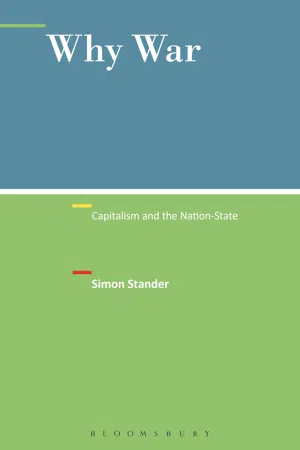
- 304 pages
- English
- ePUB (mobile friendly)
- Available on iOS & Android
eBook - ePub
About this book
Information
1
Introduction
This book asks the question why war in our time, and, by implication, why not peace? It takes the question from the classic text by Freud, Warum Krieg, which was written as a public answer to Einstein’s public question to Freud as war threatened Europe early in 1933. Freud responded to Einstein by saying that he did not hold up much hope that war would be eradicated. Einstein took the position that intellectuals would have some scope for achieving pacifist ends through moral arguments. He fully realized that political leaders or governments owed their power to the use of force or to the election by the masses. He argued that in both cases there was an absence of the best intellectual minds from decision making at the highest levels. This was not an uncommon position. George Orwell, writing a few years later in his essay The Lion and the Unicorn, expressed absolute horror at the poor political leadership in the world, especially in Britain, whose senior politicians and civil servants he vehemently attacked. Einstein, born in Germany, educated in Switzerland and a resident of the USA, placed himself outside nationalist loyalties. ‘As one immune from nationalist bias, I see a simple way of dealing with the superficial aspect of the problem.’ It was easy enough, he said, to set up an international body to settle conflict. He also realized that international conflict was only part of the problem. He referred to civil wars, religious wars and the persecution of minorities. He concluded that Freud might have some understanding of the problem and that he might like to convey this to the rest of the world in the hope of blazing a trail for ‘new and fruitful modes of action’.
However, at the end of his statement to Einstein, Freud put his trust in civilization and in the hope of eros defeating thanatos. Freud’s view is not the same as one that sees a simple Manichean struggle between good and evil as a common feature of the human condition. While eros may appear as a mass ‘love’ for mankind and self, thanatos may appear as a mass ‘death wish’ for mankind as a whole as well as for one’s self – the struggle between the two appears within each individual, within each group and within each clan; this struggle is regarded as a permanent, more or less immutable, feature of the life of the individual and of society in general. Only civilization, therefore, can channel eros into constructive directions and minimize thanatos in society and within the individual.1 In some ways the individual may be taken as a Hobbesian, in the sense that society needs to be constructed on a largely authoritarian basis in order to control the drive to destruction, though he should also be seen as an individualist, in that he must, through psychoanalytic guidance, learn to control his or her instincts aimed at personal or wider destruction.
Freud’s views on civilization are not explained in Why War but are argued in his much earlier work, Civilization and Its Discontents, originally published in 1908 (Freud, 2002).2 Here he does recognize the advances made by modern industrial processes, but he accepts that the dominant civilization is capitalist based, and we must expect greed, private property and the drive for profit to underpin it. Freud does not suggest that this can be reformed or changed. He accepts the world as it is. It is up to the individual, generally speaking, to find ways of adapting, sublimation being one route to the avoidance of the inevitable neurosis that accompanies living in an imperfect world. He is concerned with the nature of the discontent of the individual despite the advances that have been made as a result of economic growth and development. He was no optimist.3 When Einstein asked him his views on what might be done to avoid war, he concluded more or less pessimistically that war was probably inevitable, though he did suggest that civilization might save the human race from another war on a massive scale.4 In other words, Freud shirked outright pessimism, though it is clear he held out no real hope that a peaceful world might become the norm. Eros would be in constant dialectical struggle with thanatos, even though dialectics was not a term he used, nor, on the other hand, did he seem to believe that love would conquer all.
When Freud wrote this, the downside of so-called (Western) civilization had been the cause for serious pessimistic comment for nearly 200 years. Jean-Jacques Rousseau, despite his location within the supposedly optimistic Enlightenment, probably started the trend towards serious long-lasting negative comment in respect of the society that had wrought the civilization of eighteenth-century Western Europe. While answering the question has the progress of sciences and arts done more to corrupt morals or improve man, he was driven to the conclusion that ‘all the various branches of natural science were motivated by vice: astronomy by superstition, mathematics by greed, mechanics by ambition, physics by idle curiosity’ (Blanning, 2008, p. 515). Since then Western civilization has been the subject of regular critical scrutiny in general terms and as many of the specific elements that are supposed to constitute civilization come under regular attack: medicine, pharmacy, science, farming methods, urbanization, forms of energy, political systems, economic theory, market economics, globalization, arms manufacture. Simply putting one’s faith in modern civilization which has seen the twentieth century as probably the most violent in the history of mankind is certainly problematic unless one puts faith in the potential power of reformism; currently civilization means, in effect, what is wrought by the dominance of capitalism and the nation-state; the system is not yet at its apogee as the world hopes for China, India, Russia and Brazil to keep the system in a state of expansion for the next century or more.
In the literature on the causes of war it is possible to find a whole range of factors that exist in the explanation for wars and violent conflict: megalomania, ambition, glory, dynastic interest, greed, markets, raw materials, energy sources, lebensraum, racial domination, ethnic cleansing, strategic acquisition of land or ports or rivers or labour, territorial or oceanic buffers against invasion, irredentism, identity, religious differences, culture clashes and so on. Each one sounds convincing in itself, and lumped together we appear to have an explanation when applied to specific circumstances. However, the most central explanation for modern war arises directly from the historical experiences spreading from Europe from the seventeenth and eighteenth centuries onwards.
Europe is the seat of the modern nation-state and is simultaneously the seat of capitalism as it has progressed through its various formations. In short, it is in the exploration of the dialectical relationship between capital and nation-state that we find the answer to why modern war. The nation-states of Europe with its extension, the USA, having invented modern wars and exported them to the rest of the world, seek now to tame the forces of the nation-states it has created across the whole globe while appearing to want to export peace through spreading the so-called democracy and capitalism to the turbulent world it has created, often in the name of development and human rights. Unfortunately, contrary to ideologically driven opinion, democracy and capitalism are in a permanent state of conflict, as we shall see in Chapter 6, and, also, despite what some commentators may claim, the nation-state is far from dead.
Starting around the end of the fifteenth century (as most history Textbooks would have the modern world begin) the main force behind war stems from the formation and working of nation-states in Europe. Nation-building and the conflicts and alliances between nation-states are the stuff of history textbooks, and whatever might be thought in terms of the neglect of social history or gender history or whatever, the fact remains that from the point of war and domination and state-organized violence across borders, the nation-state is at the core as is capitalism. The modern nation-state, which we explore in more depth in Chapter 3, organizes violence in the interests of the capitalist ‘state’ and the process results in the export of violence to the rest of world and in modern wars; violent conflicts, wherever they are found, have been and are the most terrifying of all the exports from Europe in the last few centuries.
At this stage, brief conceptual distinctions need to be made in relation to nation, ‘state’, nation-state, people and country. Nation, nation-state, capitalist ‘state’, ‘state’, country, people, nationalism all need careful definition, but all are elusive. The nation-state is the country with defined boundaries inside of which are the people which have a majority that considers itself, or is led to believe, bound together by language, religion, blood and history to a greater or lesser extent and possibly tolerant of ‘minorities’ in some circumstances and historical moments. In Chapter 4 we see in more detail why the concept of nationalism is more ideology than reality. The ‘state’ is the ruling formation that holds power via an elite or a class and so controls virtually all aspects of the economy, polity and society to a greater or lesser extent.5 The capitalist ‘state’ is that form of power which is dominated overwhelmingly by capitalist forces such as concern for private property, economic expansion within and beyond political frontiers, dependence on market forces in the interest of distribution of resources but ensuring that surpluses produced under this system are allocated in the interests, very generally, of the capitalist class and capitalist system. Nationalism is the popular expression of the interest of the nation-state as fostered by the ‘state’ which means, in effect, in the interest of those elements, elites, castes or classes that wield power; this power includes the diversion of expenditure to protect labour power as well as ensuring the maintenance of a reserve army of labour. The term ‘country’, for example France, Britain, USA or Germany, incorporates all the above in a mish-mash of the individual’s uncritical appreciation (or antagonism or indifference) to the place of one’s citizenship. However, the danger of anthropomorphizing a nation or ‘country’ leads to obscuring the real motives for the pursuit of war and associated action on the part of the forces that drive action.6 For instance, we use misleadingly such expressions as Britain believed such and such, the USA intended such and such, France did such and such. When in 2011 Cameron, the then prime minister, used the UK veto in the proposals made by the European Union to save the Euro, Britain (as such) was not doing anything. Cameron was using the power of the ‘state’ to protect the short-term financial interests of the City of London to protect those that gave his political party 50 per cent of its income in order to stay in power and to continue to wield power in favour of a finance capitalism based in the UK but with global reach.
Closely associated with nation-building based on territory, frontiers and a range of artificial or genuine unifying factors is the contradictory economic process of capitalism. Capitalism, too, though supra-territorial in essence, is the main contributory factor that has led inexorably to the export of war and, though within capitalism there are countervailing forces, we shall see in Chapter 4 how capitalism continues to promote modern war outside Europe, through arms exports, the establishment and hardening of nation-statehood worldwide, furthering capitalist-imperialist interests, settling capitalist-imperialist interest, resource wars and the spread of cultural and ideological ‘norms’ set by the capitalist-imperialist nations and their imitators and late-comers.
In order to understand capitalism and the capitalist system it is important to consider its highly fractionalized nature and the way in which these fractions struggle for dominance.7 This is developed to some extent in Chapter 4, but for the moment it is important to simply label some of the fractions – rapine-capitalists, primitive capitalists, commercial, banking, finan...
Table of contents
- Cover
- Halftitle Page
- Title Page
- Dedication Page
- Contents
- Preface
- 1. Introduction
- 2. Why War: Approaching a Method
- 3. Nationalism and Nation-States
- 4. Capitalism
- 5. The Americas
- 6. Democracy, the ‘State’, War and Human Rights
- 7. Military–Industrial Complexes
- 8. Resource Wars
- 9. End of Empires, Decolonization and War
- 10. Conclusions
- Notes
- Bibliography
- Index
- Imprint
Trusted by 375,005 students
Access to over 1.5 million titles for a fair monthly price.
Study more efficiently using our study tools.
Frequently asked questions
Yes, you can cancel anytime from the Subscription tab in your account settings on the Perlego website. Your subscription will stay active until the end of your current billing period. Learn how to cancel your subscription
No, books cannot be downloaded as external files, such as PDFs, for use outside of Perlego. However, you can download books within the Perlego app for offline reading on mobile or tablet. Learn how to download books offline
Perlego offers two plans: Essential and Complete
- Essential is ideal for learners and professionals who enjoy exploring a wide range of subjects. Access the Essential Library with 800,000+ trusted titles and best-sellers across business, personal growth, and the humanities. Includes unlimited reading time and Standard Read Aloud voice.
- Complete: Perfect for advanced learners and researchers needing full, unrestricted access. Unlock 1.5M+ books across hundreds of subjects, including academic and specialized titles. The Complete Plan also includes advanced features like Premium Read Aloud and Research Assistant.
We are an online textbook subscription service, where you can get access to an entire online library for less than the price of a single book per month. With over 1.5 million books across 990+ topics, we’ve got you covered! Learn about our mission
Look out for the read-aloud symbol on your next book to see if you can listen to it. The read-aloud tool reads text aloud for you, highlighting the text as it is being read. You can pause it, speed it up and slow it down. Learn more about Read Aloud
Yes! You can use the Perlego app on both iOS and Android devices to read anytime, anywhere — even offline. Perfect for commutes or when you’re on the go.
Please note we cannot support devices running on iOS 13 and Android 7 or earlier. Learn more about using the app
Please note we cannot support devices running on iOS 13 and Android 7 or earlier. Learn more about using the app
Yes, you can access Why War by Simon Stander in PDF and/or ePUB format, as well as other popular books in Politics & International Relations & Essays in Politics & International Relations. We have over 1.5 million books available in our catalogue for you to explore.