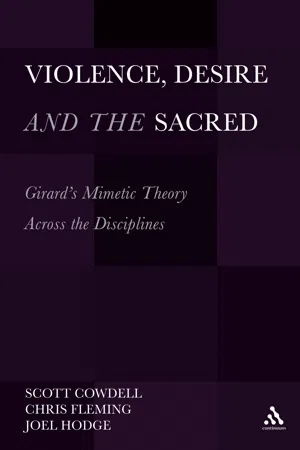
eBook - ePub
Violence, Desire, and the Sacred, Volume 1
Girard's Mimetic Theory Across the Disciplines
- 312 pages
- English
- ePUB (mobile friendly)
- Available on iOS & Android
eBook - ePub
Violence, Desire, and the Sacred, Volume 1
Girard's Mimetic Theory Across the Disciplines
About this book
Violence, Desire and the Sacred presents the most up-to-date inter-disciplinary work being developed with the ground-breaking insights of René Girard's mimetic theory. The collection showcases the work of outstanding scholars in mimetic theory and how they are applying and developing Girard's insights in a variety of fields. Girard's mimetic insight has provided a fruitful way for different disciplines, such as literature, anthropology, theology, religion studies, cultural studies, and philosophy, to engage on common anthropological ground, with a shared understanding of the human person. The aim of this edited collection is to present this interdisciplinary work and to illustrate how Girard's insights provide fertile ground for bringing together disparate disciplines in a shared purpose. As academic work on Girard's insights is growing, this collection would meet the need to show the critical, interdisciplinary applications of these insights.
Information
Part One
Finding Our Bearings
1
René Girard, Modernity, and Apocalypse
Scott Cowdell
The year 2009 marked the sesquicentenary of one of humanity’s greatest intellectual achievements, the theory of evolution by natural selection. Darwinian molecular biology is now foundational for everything we know about life’s development, illuminating so much complexity by an essentially simple mechanism. Similar attempts to unify the human sciences—from grand positivistic aspirations in nineteenth-century cultural anthropology (fictionalized by George Eliot in the character of her scholar-parson Edward Casaubon, who collapsed under the weight of his search for “the key to all mythologies”) through to today’s sceptical postmoderns (who question not only the likelihood but also the morality of encompassing cultural diversity in a single theory)—have met with less success. And of course the possibility of a Christian intellectual synthesis holding faith and reason together has scarcely been conceivable since the late Middle Ages, when faith and reason went their separate ways in the West and the modern saeculum began to emerge.
But, wonder of wonders, an audacious claim to do just this has been in place for 35 years now, and is beginning to win intellectual as well as spiritual converts among scholars, theologians, and clergy. In 2005, the French-American thinker, René Girard, in his ninth decade, was acclaimed by Michel Serres on his election to L’Académie française as the “new Darwin of the human sciences.”1 The postmodern academy—deeply wedded to the dogma of culture’s irreducible pluralism—remains largely unimpressed, also despising any attempted rehabilitation for the Queen of the Sciences. Girard, with a dash of Gallic insouciance, shrugs off these detractors, referring to their small intellectual ambitions as “the comprehensive unionization of failure”2—and of course his theory gives a good account of such academic rivalry, and of the arrogant individualist’s refusal of personal conversion that appreciation of his theory demands. Besides, his agenda is bigger than the intellectual, or, indeed, the theological: Girard believes that, having uncovered the origin of culture and explicated the emergence of secular modernity, he has now revealed the apocalyptic acceleration of history toward a tragic denouement. Hence, from his study at Stanford, this scholar’s scholar emerges as planetary prophet.
Desire, rivalry, violence, scapegoating
Girard’s account of modernity is one of a deepening crisis, with less and less to stop it. What sort of crisis, and from whence does it come? The first of three planks in Girard’s theory has to do with human desire. Through his early literary studies, Girard discovered what Shakespeare called “borrowed desire” or “desire by another’s eye.” Today’s romantically minded individual claims originality and autonomy, but Shakespeare knew better, as did his Renaissance contemporary, Cervantes. Girard prefers the ancient word “mimesis” over simple “imitation,” because it is the desire of the other that we emulate. So, for example, the young lovers in A Midsummer Night’s Dream all fall in and out of love according to the desires of others, with Puck’s love juice serving as a literary device for their mimetic desire,3 while Don Quixote lives in the desire of his chivalric model, Amadis of Gaul.4 Unfocused desire finds an object thanks to a model, who, in circumstances of close proximity, can become a rival—for the girl, the job, or the accolade. Girard realized that all great modern literature shares this insight, explicating Flaubert, Stendhal, Proust, and Dostoyevsky—also giving honorable mention to the writers of Seinfeld.5
All this is fairly straightforward, though at this stage many either fail to see themselves in this account or else bridle at it. To proceed with Girard, the need for conversion, from the romantic lie to what he calls “novelistic truth,”6 emerges. This is not necessarily Christian conversion, though the Gospels stand centrally in Girard’s vision. Proust never really became a Christian, though after recognizing the snobbisme that had controlled his life and imagination in the ultramimetic salon life of nineteenth-century Paris, he withdrew to his appartement on the Boulevard Haussmann, devoting the last 12 years of his life to crafting his great penitential exposé, À la recherche du temps perdu, which translates as “in search of lost time.”7 Girard strengthens the intellectual credentials for his case by offering his own encompassing account of Freudian psychology, with no need to invoke phantoms such as the unconscious, and the Oedipus complex. From the father as only the first of many rivals, to the coquettish narcissist whose desire for herself awakens men’s desire while in turn depending on it, to the psychology of sadomasochism, gambling, and other self-destructive behaviors as obsessively pursuing the being of one’s model of desire, Girard simplifies Freud.8 He also develops something Freud glimpses but does not know what to do with, making it the second plank of his theory. Here I refer to the founding murder.
Girard concluded from reading Euripides’ The Bacchae that the escalation of rivalry into violence finds a standard outlet in antiquity.9 He devoted the 1960s to studying classical literature and mythology, also to sociology and anthropology, testing this hypothesis. The result in 1972 was his best-known work, Violence and the Sacred, revealing the single victim mechanism at the origin of human life, culture, and religion.10 A premodern crowd was a dangerous thing, with envy becoming mimetically contagious until the original object of desire is forgotten and an undifferentiated mass of rivalrous doubles coalesces, escalating toward violence. He postulates that, on the cusp of humanity’s evolutionary emergence, mimesis appeared as a potentially good thing, but so quickly did it lead to rivalry and violence that no community could really take root—until something happened, which Girard believes is coded into the founding myths and rituals of all ancient cultures. And that is the sudden zeroing-in of crowd violence on a scapegoat, who creates unity around a new desire. Perhaps someone threw the first stone, and mimesis did the rest. Differentiation returns as one is separated from the undifferentiated throng. This slain victim thus becomes the first symbol, from which Girard the French structuralist sources the binary oppositions underpinning all languages and cultures.
The stability of human life together issuing from this founding murder is an unexpected miracle, and it is protected in three ways.11 First, prohibitions ensure that rivalry is not allowed to return, hence the elaborate gift-giving customs and incest taboos of ancient peoples. Second, rituals offer at least a limited hint of the primal crisis and reclaim the order which emerged from it, perhaps by sacrificing an animal, with the sacrificial origins of institutions like kingship revealed in the mock sacrifice of many initiation rituals. Third, myths grow up whereby the founding murder is coded into tales of man-beasts, for instance, with errant gods returning to the sky or disappearing into lakes, providing a sanitized sacred narrative of cultural origins. Thereafter, with these stabilizing elements in place, the essentially positive nature of our mimetic desire allows the buildingup of various human institutions, languages, and religions. Humans learn linguistic and practical skills by mimesis, and the essential plasticity of mimetic desire, beyond the fixed repertoires of animal instinct, allows cultural diversity to expand from just a few basic elements. On the basis of this simplicity yet comprehensiveness, Girard claims that his account of human culture is scientific.
Following the guiding insight, if not all the specific detail of Émile Durkheim’s sociology,12 Girard recognizes that premodern civilizations form cultural-social-religious wholes, demonstrating what he labels “deviated transcendence” or the “false sacred.” The religious awe and wonder attaching to these human totalities, which Rudolf Otto identified as a unique and irreducible experience, is explained more straightforwardly by Girard in terms of The Scapegoat’s dual nature.13 He notes that scapegoats are always guilty in antiquity, when for instance Oedipus was condemned for incest and parricide—extreme accusations so characteristic of an angry mob.14 Yet victims are regularly rehabilitated because the pacifying and unifying impact of their scapegoating is so extraordinary; hence the birth of gods and heroes. The wife of Caesar in Shakespeare’s Julius Caesar believed that “great Rome shall suck reviving blood” from the slaying of its founder.15 This peace won ultimately through violence is necessary for the survival of premodern societies, which lack a rule of law and the accompanying threat of force sufficient for restraining violent escalation. The breakdown of this comprehensive order sets humanity on the path to modernity, and that breakdown—according to the third and most controversial plank of le système Girard—begins with the Bible.
The deculturing, secularizing gospel
With the mimetic desire drawing Eve and then Adam into rivalry with God, and Abel’s primal murder prior to founding the first city, the scripture exposes humanity’s fall away from the innocence of prehuman life. The tenth commandment of the Decalogue warns against coveting and rivalry, which undergird the escalation named by earlier commandments toward murder via theft, adultery, and slander.16 An Egyptian version of the Joseph saga blames Joseph for his troubles, in consistent mythical fashion, while Genesis insists on his innocence, with the repentant brothers who scapegoated Joseph refusing to scapegoat another brother in the case of Benjamin.17 The sacrifice of Abraham’s son Isaac is averted, and while the Israelites are ordered to massacre the Canaanites, they are immediately told not to intermarry with them, so that even in such texts of terror there is evidence of violence being averted. Two-thirds of the Psalms center on the innocent victim’s lament, claiming God’s help against an encircling lynch mob.18 And Job the innocent scapegoat by and large resists the false sacred represented by his wife, his three friends, and even by that awesome voice of a harsh status quo who speaks from the whirlwind, clinging instead to the real sacred, to Israel’s faithful God, in his stubborn retort, “I know that my redeemer lives.”19 Isaiah’s Servant Songs register the leveling, undifferentiating effects of mimetic crises, with every valley lifted up and every hill made low, and the rough places plain, while the suffering servant is sacrificed.20
The Gospels represent the completion of this revelation, with the innocent one sacrificed to the angry, boundary-preserving false sacred of temple and empire—to the mob, and to the satanic show that could not tolerate exposure. Jesus’ death need not be understood as appeasing an offended heavenly Father but, rather, in terms of a loving God beginning to liberate our world when the time was right. The resurrection of Jesus begins a new creation beyond the violent sacred, offering human life new foundations. Satan, the advocate for the prosecution—the Bible’s shorthand for this whole process of violent escalation and appeasement—is now put on notice by the Holy Spirit, the Paraclete, our “advocate for the defense.”21 Previously, violent mimetic crises were resolved by a collective murder, which the Gospels call “Satan driving out Satan.” Now a new instability enters the picture, because targeting an innocent victim no longer works so well. Myths and rituals begin to give up their innocent dead, while incidents of violent escalation become harder to repress. Hence, th...
Table of contents
- Cover
- Half-Title
- Title
- Dedication
- Contents
- Foreword
- Contributors
- Introduction
- Part 1 Finding Our Bearings
- Part 2 Biblical Studies
- Part 3 Theology
- Part 4 Literary Studies
- Part 5 History and Political Thought
- Part 6 Developments and Critiques
- Glossary of Key Girardian Terms
- Some Further Reading
- Index
- eCopyright
Trusted by 375,005 students
Access to over 1.5 million titles for a fair monthly price.
Study more efficiently using our study tools.
Frequently asked questions
Yes, you can cancel anytime from the Subscription tab in your account settings on the Perlego website. Your subscription will stay active until the end of your current billing period. Learn how to cancel your subscription
No, books cannot be downloaded as external files, such as PDFs, for use outside of Perlego. However, you can download books within the Perlego app for offline reading on mobile or tablet. Learn how to download books offline
Perlego offers two plans: Essential and Complete
- Essential is ideal for learners and professionals who enjoy exploring a wide range of subjects. Access the Essential Library with 800,000+ trusted titles and best-sellers across business, personal growth, and the humanities. Includes unlimited reading time and Standard Read Aloud voice.
- Complete: Perfect for advanced learners and researchers needing full, unrestricted access. Unlock 1.5M+ books across hundreds of subjects, including academic and specialized titles. The Complete Plan also includes advanced features like Premium Read Aloud and Research Assistant.
We are an online textbook subscription service, where you can get access to an entire online library for less than the price of a single book per month. With over 1.5 million books across 990+ topics, we’ve got you covered! Learn about our mission
Look out for the read-aloud symbol on your next book to see if you can listen to it. The read-aloud tool reads text aloud for you, highlighting the text as it is being read. You can pause it, speed it up and slow it down. Learn more about Read Aloud
Yes! You can use the Perlego app on both iOS and Android devices to read anytime, anywhere — even offline. Perfect for commutes or when you’re on the go.
Please note we cannot support devices running on iOS 13 and Android 7 or earlier. Learn more about using the app
Please note we cannot support devices running on iOS 13 and Android 7 or earlier. Learn more about using the app
Yes, you can access Violence, Desire, and the Sacred, Volume 1 by Scott Cowdell, Chris Fleming, Joel Hodge, Scott Cowdell,Chris Fleming,Joel Hodge in PDF and/or ePUB format, as well as other popular books in Theology & Religion & Christian Denominations. We have over 1.5 million books available in our catalogue for you to explore.