- 320 pages
- English
- ePUB (mobile friendly)
- Available on iOS & Android
eBook - ePub
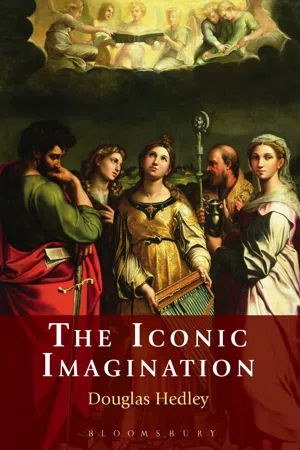
The Iconic Imagination
About this book
Is it merely an accident of English etymology that 'imagination' is cognate with 'image'? Despite the iconoclasm shared to a greater or lesser extent by all Abrahamic faiths, theism tends to assert a link between beauty, goodness and truth, all of which are viewed as Divine attributes. Douglas Hedley argues that religious ideas can be presented in a sensory form, especially in aesthetic works. Drawing explicitly on a Platonic metaphysics of the image as a bearer of transcendence, The Iconic Imagination shows the singular capacity and power of images to represent the transcendent in the traditions of Christianity, Judaism, Hinduism and Islam. In opposition to cold abstraction and narrow asceticism, Hedley shows that the image furnishes a vision of the eternal through the visible and temporal.
Information
1
Images, Representation and Imagination
In Bildern besteht der ganze Schatz menschlicher Erkenntnis und Glueckseligkeit.1
When we think with images, either in art or in religion, we are genuinely thinking. That’s to say, we are coming more and more fully to ‘inhabit’ our humanity.2
In recent years, art historians have joined forces with philosophers to criticize the Platonic paradigm of the image. Panofsky, Wind or Gombrich viewed Platonism, especially Neoplatonism, as providing the meaning behind the images of great European art. The image, so the argument goes, became a signpost for transcendence; the image was dematerialized, even desexualized, and a means of disguising, for example, Michelangelo’s homosexuality. In response to the highly literary Iconography of the Panofsky school, there has been return to the image, an iconic or pictorial turn. Here is a move to restore the image to its proper dignity and autonomy, rather than as a staging post to an immaterial idea. In this chapter, we will defend the Panofsky-Hegel-Plato view that the image is, indeed, best seen as the expression of spirit. Moreover, the rejection of transcendence will eviscerate rather than restore the image. Yet the appeal of crude materialism is often reinforced by what one might call ‘Freshman’ Platonism. This chapter will conclude with some observations about the image in Plotinus in order to distinguish his subtle theorizing about the image from crude stereotypes of the Platonist. This Alexandrian Hellenist was fascinated by the language pictures of the Egyptians, their hieroglyphs. He valued these as expressions of a non-discursive awareness that transcends habitual concepts. In this way, Plotinus was as sensitive to the problems of a misleading externalizing of ocular metaphors as many late twentieth century French avant-garde thinkers, albeit for different reasons. He was less concerned with reification as a mode of commodification than the requirement of the soul to become what it knows. He employs the beautiful image of people walking in a desert and taking on the colour of the sunlit dust surrounding them. Once we appreciate the value and role of images in Plotinus, it is easier to understand his powerful critique of both rationalism and reductionism.
What is an image? The word can refer to mental images or pictorial objects – e.g. the mythological image of Narcissus, or the ancestral imago of the imperious Roman aristocrat. What of the Veronica: the archetypal image of Christ, fabric which, according to legend, bears the image of Christ’s face and thus a vera icona, one not made by human hands? One might consider the expressive power of architecture – the Parthenon or the Taj Mahal. Horace’s renowned ‘ut pictura poesis’ defines poetry as the re-presentation of images.3 The poet’s employment of the mind’s eye is compared with the painter’s imitation of nature. Certainly, the imagistic depiction in words is a key tool in the poetic device of ekphrasis: the vivid description of a particular object, like the Homeric Achilles’ shield or the Urn in Keat’s ode. Furthermore, one might consider the tradition of images as having a didactic quality for the unlettered: the biblia pauperum. Our historical being is shaped by images in myriad ways.
The emotional and motivational force of such images to mobilize tribes, nations and empires is incontestable. Images constitute a strident counterblast to the mechanical explanations of human history. Constantine’s dream of the cross and the voice exclaiming ‘In this sign you will conquer’, or the Archeropoeitos image of Kamoulia from Cappodocia, which was used on the banners of the Byzantine army. One might think of the Venerable Bede’s report of the conversion of England and especially St Augustine of Canterbury’s encounter with Ethelbert, King of Kent (552–616): ‘With them Augustine went with carrying a silver cross and an image of our Lord and saviour painted on a picture.’4 Or why should images generate such fury and violence: from the great Byzantine icon controversies of the eighth and ninth centuries, the iconoclasms of the Reformation, destruction of monuments and images in the English Civil war or the French Revolution up to – in more recent times – the destruction of the Buddhas of Bamiyan and the attack on the Twin Towers; the toppling of the Soviet statues? Pitiless acts of cruelty are often justified in terms of an archaic prohibition of sacred images (e.g. images of the prophet). The sacred and savage power of images, like the head of Medusa, is often invoked in modern political conflicts. It is often remarked that our era is a period of an unprecedented flood of images – the technology of the printing press, prints, photography and film. Walter Benjamin considered film to be the great art of the modern age. In the digital and internet age, with the rapid decline of print media there are questions about the erosion of critical judgement. Guy Dubord in his La Société du spectacle analysed the spectatorial nature of capitalist society and the prodigious influence of Foucault’s exploration of the ‘panoptic’ surveillance structures of early modern civilization in his analysis of the proposed Panopticon of Jeremy Bentham.
Lying behind such intense recent debates concerning images is Weber’s idea of disenchantment, where he states that the stahlhartes Gehäuse (steel- hard-structure) of the technological efficiency of modern society crushes the sense of enchantment enjoyed by our ancestors. This Weberian notion of disenchantment is often linked to Benjamin’s highly influential idea of ‘aura’ and its loss through the mechanical reproduction of art itself in his The Work of Art. This ‘aura’ is the un-reproducible originality and authenticity of a work of art such as a painting. The photograph, so the argument goes, with its facility for exact and easy duplication loses the unique ‘aura’ of the painting.5 The influence of Weber and Benjamin can be seen clearly in the work of the German art historian Hans Belting and his three-fold chronology of theology, art history, anthropology in his celebrated and much discussed opus magnum, Bild und Kult, one of the most influential recent books in medieval and Byzantine history.6 The basic dichotomy is cult and art. The ancient paradigm of the magical presence: the cult object that would be kissed, venerated and clouded in incense. We then have a move to art as the consciously reflexive illusionism of the Renaissance: the move from cult to art.7 There is a stress upon genealogy here and Belting views the medieval as the era of the image as opposed to the subsequent era of art. Art history, like theology, tends to separate images from the body. Hence his Bild anthropology is conceived in opposition to both the theological paradigm of the magical cult objects and the rarified objects of ‘art’.
The image has played a prominent role in much recent philosophy. Wittgenstein can say: ‘A picture held us captive. And we could not get outside it, for it lay in our language and language seemed to repeat itself to us inexorably.’8 Heidegger ominously associated modern technology with the world-picture (Welt-Bild), the final product of an intellectual narrative that begins Plato’s substitution of the problem of Being with onto-theology and develops through the mathesis of the Galilean-Cartesian approach to nature.
Iconic Turn vs Linguistic Turn?
‘Les poetes sont des hommes qui refuse d’utiliser le langage.’9
Much of twentieth-century thought was shaped by the idea that inherited philosophical problems could be resolved or even dissolved by linguistic reflection. For Derrida ‘il n’y a pas de hors-texte’ (‘there is nothing outside the text or...
Table of contents
- Dedication
- Title
- Contents
- Acknowledgements
- Prologue
- 1 Images, Representation and Imagination
- 2 Human Nature and the Imago Dei
- 3 The Anagogic Image
- 4 Freedom and the Narrative Image
- 5 Symbol, Participation and Divine Ideas
- 6 Idolatry and Iconoclasm
- 7 Mythology and Theogony
- 8 Imagination and Revelation
- Epilogue
- Bibliography
- Index of Subjects
- Index of Names
- Copyright
Trusted by 375,005 students
Access to over 1.5 million titles for a fair monthly price.
Study more efficiently using our study tools.
Frequently asked questions
Yes, you can cancel anytime from the Subscription tab in your account settings on the Perlego website. Your subscription will stay active until the end of your current billing period. Learn how to cancel your subscription
No, books cannot be downloaded as external files, such as PDFs, for use outside of Perlego. However, you can download books within the Perlego app for offline reading on mobile or tablet. Learn how to download books offline
Perlego offers two plans: Essential and Complete
- Essential is ideal for learners and professionals who enjoy exploring a wide range of subjects. Access the Essential Library with 800,000+ trusted titles and best-sellers across business, personal growth, and the humanities. Includes unlimited reading time and Standard Read Aloud voice.
- Complete: Perfect for advanced learners and researchers needing full, unrestricted access. Unlock 1.5M+ books across hundreds of subjects, including academic and specialized titles. The Complete Plan also includes advanced features like Premium Read Aloud and Research Assistant.
We are an online textbook subscription service, where you can get access to an entire online library for less than the price of a single book per month. With over 1.5 million books across 990+ topics, we’ve got you covered! Learn about our mission
Look out for the read-aloud symbol on your next book to see if you can listen to it. The read-aloud tool reads text aloud for you, highlighting the text as it is being read. You can pause it, speed it up and slow it down. Learn more about Read Aloud
Yes! You can use the Perlego app on both iOS and Android devices to read anytime, anywhere — even offline. Perfect for commutes or when you’re on the go.
Please note we cannot support devices running on iOS 13 and Android 7 or earlier. Learn more about using the app
Please note we cannot support devices running on iOS 13 and Android 7 or earlier. Learn more about using the app
Yes, you can access The Iconic Imagination by Douglas Hedley in PDF and/or ePUB format, as well as other popular books in Theology & Religion & Aesthetics in Philosophy. We have over 1.5 million books available in our catalogue for you to explore.