Rocket States crosses the disciplines of Cold War Studies, American Literature, American Studies and Cultural Studies. The particular attraction of this study lies in the combination of its range-close textual and visual analysis of the correlations between land and weaponry, set firmly within its political and cultural contexts-with its unique analytical approach. The book offers a synthesis between history, theories of technology, theories of space, popular culture, literary study and military science. It illuminates a variety of literary texts from key writers and thinkers such as Pynchon, Stephen King, Norman Mailer, and Tom Wolfe, while also invoking figures like Nikola Tesla, James Webb, Batman and Ronald Reagan. Organised topographically, according to how missile technology manifests itself differently in particular locations, Rocket States's geographical targets are Colorado, Kansas, Cape Canaveral and New York, variously titled 'Excavation', 'Preservation', 'Evacuation' and 'Transmission'. It advances through these states roughly chronologically, beginning in the late 1940s and early 1950s and coming to an end in the first part of the 21st century.
Collignon's argument is concerned with identifying the recurring figures and fantasies of the Cold War: the dome or parabola as sheltering techno-form; the fictions of total security adapting to constantly changing targeting strategies; gadget love; closed, freezing worlds. As such, Rocket States analyses by what processes the Cold War is frequently literalised in its weapons installations and how these facilities, in turn, shape dreams of containment, survival, escape and techno-supremacy.
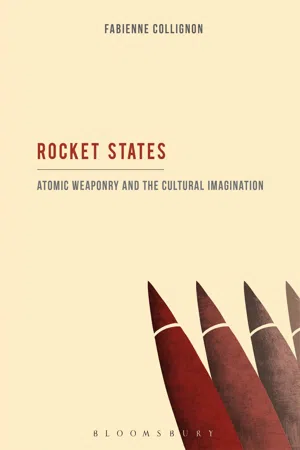
- 192 pages
- English
- ePUB (mobile friendly)
- Available on iOS & Android
eBook - ePub
Rocket States: Atomic Weaponry and the Cultural Imagination
About this book
Information
1
Excavation: Colorado
The grounds of the bomb
Thomas Pynchon’s Gravity’s Rainbow is about the rocket and rocket state formation, technologies of dream-like and catastrophic dimensions whose (de)realizations reconfigure the world:
But a rocket has suddenly struck. A terrific blast quite close beyond the village: the entire fabric of the air, the time, is changed – the casement window blown inward, rebounding with a wood squeak to slam again as all the house still shudders.1
A book so concerned with reversals, films running backwards – ‘faired skin back to sheet steel back to pigs to white incandescence to ore, to Earth’2 – Gravity’s Rainbow deals with the impact of the missile, which it also considers in terms of ‘phases’ that occur before detonation. ‘Phase’ refers to conditioned reflexes, for example, installed in subjects recruited, willingly or unwillingly, as ‘colonial outpost[s]’ functioning in the service of the ‘metropolitan brain’3; the processes of excavation that this chapter considers are therefore also indicative of the order of emptiness installed through programmed commands in slaves that nonetheless think themselves masters. Prior to ‘angelic visits’ – and bearing in mind the missile’s apparent reversal of the ‘normal order of the stimuli’ – the rocket state coming into existence, even though it announces itself through a ‘terrific blast’, emerges as much out of the earth than out of the sky: it is ore that makes possible the ‘new cosmic bombs’ continuing, and expanding, ‘structures favouring death’.4 To reveal the ‘angel’ therefore means to return to the ground, to a moment before its explosive arrival by effectuating a backward movement, as it were, to consider a mineral: the ore and core of the nuclear weapon mined, among other places, in the state of Colorado.
In 1997, Peter Bacon Hales published a book on ‘America’s atomic spaces’, a military creation that in time consolidates into a ‘new type of cultural environment, penetrating work, leisure . . ., language, and belief, and present even today as a significant, if surreptitious, strain of American culture’.5 He proceeds to investigate the Manhattan Project’s three principal sites, a holy trinity indicating an emergent technological sublimity assembled in Oak Ridge, Tennessee; Los Alamos, New Mexico; and Hanford, Washington. Of these, it is only Los Alamos or, more specifically, White Sands Missile Range – where the plutonium device, in a test codenamed Trinity, is first detonated on 16 July 1945 – that spectacularly erupts into visibility through the blinding light of the bomb. Here, in ‘Atomland-on-Mars’, as William L. Laurence, prophet of the nuclear age, notes,
the vast energy locked within the heart of the atoms of matter was released for the first time in a burst of flame such as had never before been seen on this planet, illuminating earth and sky, for a brief span that seemed eternal, with the light of many super-suns. With the flash came a delayed roll of mighty thunder, heard, just as the flash was seen, for hundreds of miles. The roar echoed and reverberated from the distant hills and the Sierra Oscuro range nearby, sounding as though it came from supramundane sources as well as from the bowels of the earth.6
The implosion is all spectacle, shooting upwards in rainbow dyes; both visible and aural manifestations appear at once to emanate from extraterrestrial as well as earthly origins, whose compression, in the bomb, releases an energy whose glare is reflected on the surface of the moon. Laurence’s account, which suits the occasion in its hyperbolic rhetoric, marks the beginning of an empire of the super-sun, a messianic arrival but also sexualized outburst resulting in the ‘cry of a newborn world’.7 The metaphors really get mixed up – as if an indication of the mutations to come – in descriptions of the bomb’s constitution, approximated through polarized chains of words, phallic/vulvic, dark/light, terrestrial/‘supramundane’: it is at the interface of these expressions that the bomb materializes as an entity that is defined, above all, through (nuclear) fusion. The missing link, in the listing above, concerns the opposition between the visible and the unseen, the irradiations that occur at cell level and happen quietly on the inside, but also in relation to the secrets around which the bomb is formed and which it spreads out across the ‘newborn’ world. This order is distinctly that of the nuclear device, whose existence has, since the inception of the ‘atomic age’, concurrently been associated with monumentality and invisibility. Latour’s discussion on the lack of a frontier separating matter from spirit in relation to technological projects consequently also – or, perhaps, above all – applies to the bomb that, though momentarily a concrete object, explodes formlessness: the blankness of ground zero and the ‘spirit’ of radioactivity. The secrets of this total war-state – the state of emergency whose pure violence expands the degree zero of the law – leave their marks on the imagination besieged and traumatized by the Cold War and its in/visible workings of power.
In Underworld, Don DeLillo writes that ‘[t]here is the secret of the bomb and there are secrets that the bomb inspires’:
the genius of the bomb is printed not only in its physics of particles and rays but in the occasion it creates for new secrets. For every atmospheric blast, every glimpse we get of the barred force of nature, that weird peeled eyeball exploding over the desert – for every one of these . . . a hundred plots go underground, to spawn and skein.8
Before it arises out of the pre-dawn darkness, the bomb exists as shadow technology developed in a military bureaucracy that hides itself in nondescript, colourless edifices and through generic designations, like the Manhattan Engineer District (MED), implying the edges of an island when the project in effect exceeds all limits. MED, a giant cartel which, after World War II, shifts responsibilities to the Atomic Energy Commission (AEC), established by way of the Atomic Energy Act of 1946, adapts landscapes to a single purpose: the creation of a weapon whose damage begins before its detonation. Hales demonstrates that destruction is already to be found in the assigned worthlessness of pockets of land, deeds of property wiped out by District superpowers. As such, even though the bomb’s epicentre is located in ‘albino’9 topography in New Mexico, the production facilities and assemblage plants, as well as the consequences of manufacture and blast are dispersed throughout the nation, extending the Jornada del Muerto past its New Mexican basin: the journey and triumph of the dead claim the remainder of the world of the living.
In the introduction to At Work in the Fields of the Bomb, Jonathan Schell comments on how Robert Del Tredici, a photographer travelling across a geography of war, ‘penetrate[s] . . . the “amazing invisibility” of the bomb’ by directing ‘our special attention’ to the preparations for total death, machinery that is approached through ‘oblique observation’, x-ray vision that traverses ‘ordinary’10 sights. Del Tredici’s photographs – comprising eerily silent, still perspectives of rocket displays devoid of any signs of life; ‘classic landscapes’11 masking suffering – do not record sublime explosions and pay no heed to the weapon’s ‘romantic grandeur’.12 What is evident instead is a sense of absence, the haunting emptiness of a techno-culture whose nucleus is occupied by the absent presence of the atom bomb. To look at this device, then, according to a mode of visuality that focuses on the processes of production and on the people involved in such developments is to notice a vacuum that lies concealed in details, in the ordinariness of towns whose life force is drained by surrounding plants: ‘super carrots’,13 superbombs.
If, as Del Tredici so precisely captures, even unused atomic weapons radiate death, then the correlations between the bomb and (horror) fiction are not simply restricted to stories of apocalypse, zero-hour detonations mutilating and mutating human/animal ontology or spawning rampant, outsized plant life. After the blast, so Pynchon writes in Gravity’s Rainbow, the sound of the rocket arrives too late: it is a ‘ghost in the sky’ calling to ‘ghosts newly made’14; even prior to launch, however, the nuclear device is spectral, disappearing into code words and bleached space. The ‘amazing invisibility’ associated with its creation and continuing ‘proliferation’ – quotation marks for a word with botanical and biological origins, raising the spirit of an autonomous technology, thereby abdicating responsibility – characterizes both the bomb’s beginning and its end points. The ‘variable ontology’15 of the nuclear weapon, concurrently matter and spirit or text, refers not only to Latour’s work, but also to Derrida’s, concerned with the discourse formations of a ‘fable’, that is, all-out nuclear war, impacting on the collective imagination in terms of the recurring pathologies of the Cold War: a closed world of supreme control and total paranoia, whose metaphors/fantasies are so pervasive that texts can speak of nothing else. In his article for the ‘nuclear criticism’ issue of Diacritics, Derrida claims that nuclear war has become the ‘absolute referent, the horizon and the condition of all the others’, to the point that texts invariably refer back – ‘in order to assimilate that unassimilable wholly other’ – to that horizon.16 The nuclear symbolic, which Derrida talks of in terms of an ‘absolute’ trace that is ‘remainderless’ and yet ‘ineffaceable’,17 functions as the structuring force of writing, fantasizing about total self-destruction; even texts that manoeuvre around the subject, the degree zero of a war that leaves nothing in its wake, are haunted by this perspective that ‘things are in the unmaking’.18
A case in point is Adam Piette’s analysis of Lolita in his study on the ‘literary Cold War’, concerned with the ‘direct link between private fantasies and the military-industrial complex running the world’.19 Piette investigates the occupation of subjects’ interiority, underground manoeuvres that find material expression in buried ‘defence’ mechanisms executing the Cold War. Titanic machinery carries out death wishes, but so does the ‘long game of deterrence and nuclear logic’20 that drifts, radioactively, into the constitution of a nation and its citizens alike. ‘The aim of the book,’ Piette writes, ‘is to sketch out the secret, obsessive and paranoid story of the mind under the compulsions of the Cold War, to graph the triangulated nuclear anxieties of the citizen in the postwar security state.’21 Applied to Lolita, this approach yields a reading that matches up Humbert Humbert’s sexual plotting with Cold War secrecies; the assimilation of projects is initiated in the Arctic, where Distant Early Warning (DEW) lines of fantasy defence and hush-hush uranium mining instruct Humbert in techniques of camouflage. The subsequent findings relate to the identification of nuclear systems of aggression readily incorporated by Humbert, ‘death-ray’ exterminator, ‘lethally dosing Lolita with killer gamma rays’.22 In a text mined like this, managed so as to reveal the deadly energies at work in Lolita and directed against the girl child, a level of radioactive damage gradually becomes clear; it initially hides in words, references to landscapes absorbed into the Cold War effort, which Piette traces across Nabokov’s work – the Cold War forms Lolita’s heart of darkness or core of radiant light.
Confronted with internalized killer strategies, it is, then, necessary to adopt peripheral vision – Del Tredici’s ‘oblique observation’ that penetrates ordinary sights; Piette’s readings of Cold War coded, encoded, discourses – combined with the requirement to become an insider so as to negotiate textual underworlds. As such, what is to come is a paranoid investigation of Stephen King’s The Shining (book and movie) in radioactive light, organizing Jack Torrance’s stay and decay at the Overlook Hotel according to the effects of ‘archive fevers’: nuclear, demonic, fake-paternal. The novel is published in 1977, at a time when the nuclear referent looks to have been displaced into much more unspecified environmental catastrophes – industrial waste, as opposed to the terror of the superweapon, forming cosmologies of refuse; daily garbage pushing into ‘every available space’23 – yet Stephen King, after all, is a ‘child of [his] times’. War baby grown up on Strontium-90, King defines his existence as a horror writer according to an ‘unheard-off occurrence’ that recalls the ending of Gravity’s Rainbow (as well as the opening stages of It, a novel about ‘Corpse-lights’)24:
For me, the terror – the real terror, as opposed to whatever demons and bogeys which might have been living in my own mind – began on an afternoon in October 1957. I had just turned ten. And, as was only fitting, I ...
Table of contents
- Cover-Page
- Half-Title
- Title
- Contents
- List of Illustrations
- Acknowledgements
- Introduction: Ignition
- 1 Excavation: Colorado
- 2 Preservation: Kansas
- 3 Evacuation: Cape Canaveral
- 4 Transmission: New York
- Mobilization: Un/Endings
- Notes
- Works Cited and Consulted
- Index
- Copyright
Trusted by 375,005 students
Access to over 1.5 million titles for a fair monthly price.
Study more efficiently using our study tools.
Frequently asked questions
Yes, you can cancel anytime from the Subscription tab in your account settings on the Perlego website. Your subscription will stay active until the end of your current billing period. Learn how to cancel your subscription
No, books cannot be downloaded as external files, such as PDFs, for use outside of Perlego. However, you can download books within the Perlego app for offline reading on mobile or tablet. Learn how to download books offline
Perlego offers two plans: Essential and Complete
- Essential is ideal for learners and professionals who enjoy exploring a wide range of subjects. Access the Essential Library with 800,000+ trusted titles and best-sellers across business, personal growth, and the humanities. Includes unlimited reading time and Standard Read Aloud voice.
- Complete: Perfect for advanced learners and researchers needing full, unrestricted access. Unlock 1.5M+ books across hundreds of subjects, including academic and specialized titles. The Complete Plan also includes advanced features like Premium Read Aloud and Research Assistant.
We are an online textbook subscription service, where you can get access to an entire online library for less than the price of a single book per month. With over 1.5 million books across 990+ topics, we’ve got you covered! Learn about our mission
Look out for the read-aloud symbol on your next book to see if you can listen to it. The read-aloud tool reads text aloud for you, highlighting the text as it is being read. You can pause it, speed it up and slow it down. Learn more about Read Aloud
Yes! You can use the Perlego app on both iOS and Android devices to read anytime, anywhere — even offline. Perfect for commutes or when you’re on the go.
Please note we cannot support devices running on iOS 13 and Android 7 or earlier. Learn more about using the app
Please note we cannot support devices running on iOS 13 and Android 7 or earlier. Learn more about using the app
Yes, you can access Rocket States: Atomic Weaponry and the Cultural Imagination by Fabienne Collignon in PDF and/or ePUB format, as well as other popular books in Literature & 20th Century History. We have over 1.5 million books available in our catalogue for you to explore.