The military success achieved by the Duke of Wellington casts a long shadow over the history of the British army in the French Revolutionary and Napoleonic wars. The popular account of Britain's military record in the great struggle against Napoleonic France is chiefly one of glorious victories, with Britain cast as the saviour of Europe from the Corsican 'monster'. Most British historians have focused on retelling stories of British success, notably Wellington's, in Spain, Portugal and during the Hundred Days campaign and tend to pay little attention to British military defeats.
But is the focus on Wellington's successes really an appropriate way to understand the performance of the British army in a conflict which lasted over twenty years? And what about the army’s poor record in the Low Countries, where it suffered defeats and sustained crippling losses during the same period? In this perceptive and highly readable study Andrew Limm answers these questions and provides a more balanced account of the British contribution to the downfall of Napoleon.
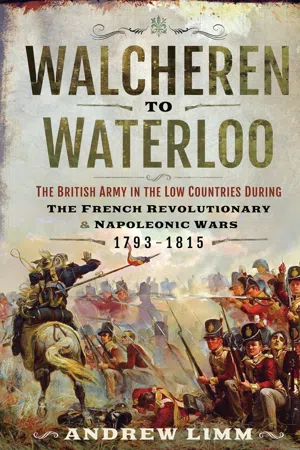
eBook - ePub
Walcheren to Waterloo
The British Army in the Low Countries during French Revolutionary and Napoleonic Wars 1793–1815
- 256 pages
- English
- ePUB (mobile friendly)
- Available on iOS & Android
eBook - ePub
Walcheren to Waterloo
The British Army in the Low Countries during French Revolutionary and Napoleonic Wars 1793–1815
About this book
Information
Subtopic
19th Century HistoryIndex
HistoryChapter 1
The British Army and the Dunkirk Campaign, 1793
The Ministers and the Military
Unlike the Royal Navy, which was administered and directed in wartime by the Cabinet, the First Lords of the Admiralty and the officials in the Admiralty office, the army did not possess a clear chain of command. The symbolic and ceremonial head of the British army was His Majesty King George III. Despite being refused the chance to gain active military experience during the Seven Years War (1756–63) the king nurtured a keen interest in political and military affairs and was the commanding officer of both the Foot Guards and the Household Cavalry. Over the course of the Napoleonic period, the king played a key role in the management of promotions and his powers of patronage allowed him to maintain an influence over appointments.1 That all major military and strategic decisions needed royal approval also meant that the king was always well informed about the war effort and this enabled him to influence wider political and military aspects.2
Directly answerable to the king and to Parliament was the C-in-C who was chiefly responsible for the upkeep and organisation of the regular forces, both at home and abroad. The C-in-C was supported in these tasks at the Horse Guards by the Adjutant (AG) and Quartermaster Generals (QMG) – the former was tasked with the upkeep of the army whilst the latter was responsible for its movements and supply. The Royal Artillery and Engineers benefitted from being administered separately by the Ordnance Department, headed by the Master General who was also responsible for the procurement of military equipment and ammunition.3 The C-in-C also relied on a number of other administrative officials and organisations, such as the medical officials of the Army Medical Board and the military representatives at the Treasury. But, although influential in military administrative affairs, the C-in-C had relatively little influence over British strategy and the planning of military expeditions. Instead, the key persons who were responsible for the direction of British strategy and the deployment of the army were the senior politicians based at Whitehall, in particular the Prime Minister and the Secretaries of State for War and Foreign Affairs.4
During the early years of the French wars the incumbents of these key positions were William Pitt the Younger, Sir Henry Dundas (later Lord Melville), and Sir William Grenville. Pitt had risen to power in 1783, thanks largely to the support of the king, who deeply disliked the opposition Whigs and their leader Charles Fox. From 1783 to 1801 Pitt, Dundas and Grenville formed the key triumvirate in British political and strategic circles alongside the king.5 The king continued to play a formative role in British politics and the conduct of the war during the period 1793 to 1810, a period which witnessed a range of governmental changes as British military fortunes went from bad to worse in Europe. Despite the political turmoil, however, the key British government posts largely remained in the hands of a small group of ministers, many of whom were Pitt’s friends and protégés.6 Indeed, as Jennifer Mori has suggested, during the 1790s Dundas and Grenville were more akin to being Pitt’s political ‘creatures’ than his friends.7 Over the course of the following decades, the king’s grip over British politics gradually waned, due to a combination of the deterioration of the king’s mental health and an increase in the power of the executive, with its growing emphasis on Cabinet politics.8 Thus the British war effort in the years 1793 to 1815 was managed and maintained by a small number of people. It must be remembered that the creation of a dedicated civil service and the development of professionally trained government officials was still some way in the future.9 In the political realm, it was not unusual for a senior minister to hold a number of different and complex governmental posts at the same time. For example, Henry Dundas, Britain’s first Secretary for War in the period 1793 to 1801, was also Home Secretary and the President of the Board of Control.10
The British Army on the Eve of War
Our army was lax in its discipline, entirely without system, and very weak in numbers. Each Colonel of a regiment managed it according to his own notions, or neglected it altogether. There was no uniformity of drill or movement; professional pride was rare; professional knowledge still more so.11
This statement, written by Henry Bunbury, highlights some of the British army’s significant weaknesses at the start of the French Revolutionary Wars. Dejected after its defeat in America, the army had returned to Britain with little to show for its endeavours. Despite some battlefield success, particularly in the early years of the war, the increased scope and scale of the conflict after 1778 had stretched British military and naval resources to breaking point.12 Although other factors played a part in British defeat in 1783, poor strategic and military planning were major factors, particularly in the humiliating defeats suffered by the British at Saratoga in 1777 and Yorktown in 1781.13 Furthermore the lack of popular support for the war in Britain hindered recruitment levels and necessitated the use of German mercenaries in British service. Naval recruitment had also proved difficult during the early years of the American war and only gained in popularity after the French declared war on Great Britain in 1778.14
The crushing military and naval defeat of British forces by the combined American and French armies at Yorktown in 1781 was a strategic hammer blow for the British war effort and hastened calls for an armistice, which was negotiated at Paris in 1783.15 The reputation of the British army, which had been high since the Seven Years War, had been turned upside down and the force which returned from America needed drastic reform. War weary and financially exhausted, however, the British government was in no position to undertake costly reform and the politicians eschewed the need for change and demobilised the bulk of the army.16
Demobilisation was rapid as the army shrank in size from its wartime strength of over 90,000 officers and men to well below 50,000 in a year.17 The remaining regiments were redeployed across the globe to guard what remained of the British Empire, leaving a skeleton force in the British Isles. The British army at home continued to be reduced, save for a brief period around the time of the Nootka Sound crisis in 1790 and by 1792 there were barely 13,092 officers and men fit for service out of a total garrison of 15,919. The British army as a whole, including the garrisons in the Caribbean, Canada, Australia, India, Gibraltar and the Bahamas, officially numbered 43,717, of whom 36,557 were listed as ‘effectives’.18 These numbers were in keeping with the strength of the British army in the period 1775 to 1777.19
The meagre size of the army in Great Britain was necessitated by both cultural and financial factors. The British public had long been averse to the existence of a large standing army because of the perceived threat that this would pose to British liberty; sentiments which could be traced back to the English Civil Wars’ and to the aftermath of the Glorious Revolution of 1688.20 The general public was also opposed to the creation of barracks, fearing that these would enable the government to gather troops together in order to impose their will on the populace. This latter concern had little merit since in the absence of purpose-built accommodation and an official police force, soldiers were both billeted with civilians and employed to maintain order, factors which increased existing tensions.21
The lack of a nationwide system of barracks, combined with the need for British troops to be dispersed across the country in small groups to keep the peace, greatly hindered the effective training of the troops. Unlike the French and Prussians, who regularly staged large peacetime training camps, it was usually only in times of war that the British were able to gather large numbers in camps.22 The multiplicity of roles which the army was expected to perform, combined with the need to spread the forces across the globe, militated against the development of standard drills and training methods for the infantry and cavalry.
The lack of training opportunities not only hindered the drilling of the troops, but also hampered the development of higher command skills amongst the officer corps. With few opportunities to train in camp, veteran officers had to rely on what they had previously experienced, which generally meant the skills cultivated in America during the War of Independence. A major problem with this approach, however, was that the skills that had proved useful in American conditions were not necessarily good preparation for European war.23 Few British officers had experience of European warfare or indeed knew what it was like to command large forces on a European battlefield.
The forces involved in the War of Independence were pitifully small by European standards. For example, Cornwallis’s army in the campaigns in the Carolinas and Virginia in 1780–1 was no bigger than around 8,000 men at the peak of the fighting. On many occasions such as the Battle of Green Spring Farm, during the Yorktown campaign in 1781, the number of British troops involved did not exceed 2,500.24 In contrast, York was expected to command around 35,000 troops in 1793, 5,000 more than the entire British military presence in the American Colonies in 1776.25
The small-scale nature of the armies in America meant that the majority of the officer corps of the British army, save those of Dundas’s generation, went to war in 1793 with as J.A. Houlding notes ‘Little or no experience of manoeuvring in brigade, let alone in the lines and columns adopted on campaign’ and the majority were forced to ‘learn their business on the spot’.26 Lack of training in large formations, combined with the small-scale character of the war in America, meant that the British officer corps in 1793 was largely bereft of generals who had the necessary skills to command large formations on campaign. This continued to hinder the improvement of the British army throughout the conflict and, as Wellington later noted of his colleagues, ‘I have often said that if there were eight to ten thousand men in Hyde Park, it is not every general that would know how to get them out again …’.27
The continued rotation of battalions to and from different parts of the British Isles and the globe was also disruptive, with different types of drill favoured in different climes. The movement of officers also hindered training techniques, especially if a regiment received a change of commanding officer. It was customary for colonels to train their men according to their own methods. The result was chaotic with regiments being drilled in a variety of different ways.28 Although there was some form of official guidance, in the form of the King’s Regulations of 1728, 1764 and 1778, these had not been made compulsory.29 It took until 1792 for a standardised drill manual for the infantry to be introduced, in the form of Colonel Sir David Dundas’s Principles of Militarily Movements, Chiefly Applied to Infantry.30 Although York has been accredited as a keen supporter of Colonel Dundas’s drills, Dundas’s Principles had first been published in 1788 when he was QMG in Ireland. Dundas’s drills were known at the Horse Guards before York assumed office and had caught the attention of Lord Jeffrey Amherst when he was C-in-C and it was Amherst who had made Principles the basis of the 1792 regulations.
The adoption of a standard system of drill in the British army was long overdue, especially given that the Europeans had experimented with standard drills for many years. The army of the Dutch Republic, for example, had created a set of standard drills during the Eighty Years War (1568–1648). In Prussia the first official regulations for the training of the infantry emerged as early as 1714. These were updated at regular intervals during the years that followed.31 The French also experimented with a variety of drills during these years and gradually standardised them. Even the Americans, during the War of Independence, showed a desire to create greater uniformity of drill than their British opponents. George Washington famously enlisted a Prussian drill master, Baron von Steuben, to train the Continental Army in European methods.32
Although the adoption of a standardised system of drill was a necessary step for the British army, Principles was far from innovative because Dundas’s tactical ideas were chiefly based on the dated training methods of Frederick the Great.33 Unlike some of his contemporaries, who had made names for themselves fighting colonial wars in North America and the West Indies, Dundas was a European soldier who had served under the Duke of Cumberland in the Low Countries and Germany during the Seven Years War. It was during this conflict that Dundas had developed a keen appreciation of the rigorous and methodical drills used by the Prussians.
Crucially, Dundas was not interested in assessing the recent tactical developments which had been undertaken by the army in North Amer...
Table of contents
- Cover
- Title
- Copyright
- Contents
- Acknowledgements
- Abbreviations
- Maps
- Introduction
- 1. The British Army and the Dunkirk Campaign, 1793
- 2. British Defeat in the Netherlands, 1794–5 and the Duke of York’s Reforms
- 3. The Expedition to the Helder, 1799
- 4. The Expedition to the Scheldt, 1809
- 5. The British Army and the Debacle at Bergen-Op-Zoom, 1813–14
- Conclusion
- Notes
- Bibliography
- Plate section
Trusted by 375,005 students
Access to over 1.5 million titles for a fair monthly price.
Study more efficiently using our study tools.
Frequently asked questions
Yes, you can cancel anytime from the Subscription tab in your account settings on the Perlego website. Your subscription will stay active until the end of your current billing period. Learn how to cancel your subscription
No, books cannot be downloaded as external files, such as PDFs, for use outside of Perlego. However, you can download books within the Perlego app for offline reading on mobile or tablet. Learn how to download books offline
Perlego offers two plans: Essential and Complete
- Essential is ideal for learners and professionals who enjoy exploring a wide range of subjects. Access the Essential Library with 800,000+ trusted titles and best-sellers across business, personal growth, and the humanities. Includes unlimited reading time and Standard Read Aloud voice.
- Complete: Perfect for advanced learners and researchers needing full, unrestricted access. Unlock 1.5M+ books across hundreds of subjects, including academic and specialized titles. The Complete Plan also includes advanced features like Premium Read Aloud and Research Assistant.
We are an online textbook subscription service, where you can get access to an entire online library for less than the price of a single book per month. With over 1.5 million books across 990+ topics, we’ve got you covered! Learn about our mission
Look out for the read-aloud symbol on your next book to see if you can listen to it. The read-aloud tool reads text aloud for you, highlighting the text as it is being read. You can pause it, speed it up and slow it down. Learn more about Read Aloud
Yes! You can use the Perlego app on both iOS and Android devices to read anytime, anywhere — even offline. Perfect for commutes or when you’re on the go.
Please note we cannot support devices running on iOS 13 and Android 7 or earlier. Learn more about using the app
Please note we cannot support devices running on iOS 13 and Android 7 or earlier. Learn more about using the app
Yes, you can access Walcheren to Waterloo by Andrew Limm in PDF and/or ePUB format, as well as other popular books in History & 19th Century History. We have over 1.5 million books available in our catalogue for you to explore.