Prohibition, with all its crime, corruption, and cultural upheaval, ran its course after thirteen years in most of the rest of the country—but not in Memphis, where it lasted thirty years. Patrick O'Daniel takes a fresh look at those responsible for the rise and fall of Prohibition, its effect on Memphis, and the impact events in the city made on the rest of the state and country.
Prohibition remains perhaps the most important issue to affect Memphis after the Civil War. It affected politics, religion, crime, the economy, and health, along with race and class. In Memphis, bootlegging bore a particular character shaped by its urban environment and the rural background of the city's inhabitants. Religious fundamentalists and the Ku Klux Klan supported Prohibition, while the rebellious youth of the Jazz Age fought against it. Poor and working-class people took the brunt of Prohibition, while the wealthy skirted the law. Like the War on Drugs today, African Americans, immigrants, and poor whites made easy targets for law enforcement due to their lack of resources and effective legal counsel.
Based on news reports and documents, O'Daniel's lively account distills long-forgotten gangsters, criminal organizations, and crusaders whose actions shaped the character of Memphis well into the twentieth century.
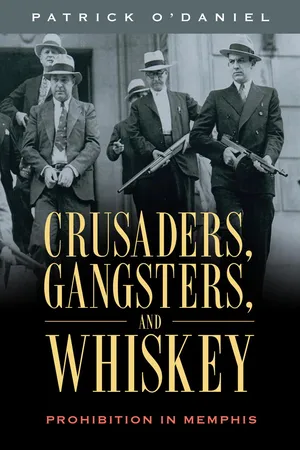
- 306 pages
- English
- ePUB (mobile friendly)
- Available on iOS & Android
eBook - ePub
About this book
Information
Publisher
University Press of MississippiYear
2018Print ISBN
9781496834539
9781496820044
eBook ISBN
9781496820051
1
RISE OF THE WHITE RIBBONS
Temperate temperance is best. Intemperate temperance injures the cause of temperance, while temperate temperance helps it in its fight against intemperate intemperance. Fanatics will never learn that, though it be written in letters of gold across the sky.
—Mark Twain, 1896
Edward Ward Carmack was about to become a martyr. Of course, he had no idea this was about to happen; it was just the end of another typical day at the office where he worked as the editor of the Nashville newspaper The Tennessean. He finished up, locked his door, and began to walk home along the crowded streets on an otherwise pleasant afternoon on November 9, 1908.
The tall, red-haired Carmack had begun his law career in Columbia, Tennessee, and served as a member of the lower house of the state legislature in Nashville in 1885. He found an outlet for his political opinions as editor of the Columbia Herald, the Nashville American in 1888, and the Memphis Daily Commercial in 1892. Carmack’s caustic personality and no-holds-barred approach caused many hard feelings, including those of W. A. Collier, editor of the rival Memphis newspaper the Appeal-Avalanche.1
Carmack’s stand on the issue of silver cemented his reputation as a firebrand. He joined the crusade to increase the money supply through silver coinage to offset the panic and depression. In 1896, he resigned from the recently merged Commercial Appeal because three of the five owners of the newspaper swayed the local Democratic Party to nominate pro-goldstandard Josiah Patterson to US Congress for a fourth term. Tennessee’s so-called Silver Democrats withdrew from the party and nominated Carmack. After a long battle, Carmack eventually won but made an enemy of Patterson’s son Malcolm, who became governor. Carmack served two terms in the US House of Representatives and began a term as a US Senator in 1901.2

Fig. 1.1. Edward Ward Carmack. Courtesy of the Library of Congress.
Carmack challenged Malcom Patterson in his 1908 re-election campaign, so the Democrats took the unusual step of holding a gubernatorial primary. Prohibition became the deciding factor, and each candidate stood firmly entrenched on his side of the issue: Carmack represented the rural Prohibitionists and Patterson represented the urban opposition. Patterson won the nomination and the election, while Prohibitionist candidates won the state legislature. Carmack remained editor of The Tennessean, where he continued his attacks on Patterson and his advisor Col. Duncan Cooper.
Cooper had hired Carmack as editor of the Nashville American in 1888, but the two became political opponents after Cooper sided with Patterson. Carmack, true to form, used his newspaper to attack Cooper’s integrity and influence over the governor. He then accused Patterson of fraud and Cooper of secretly orchestrating an alliance with former governor John Isaac Cox to sway the election. The blatant attack on his honor infuriated Cooper and made him a bitter enemy.
On the afternoon of November 9, 1908, Carmack lit a cigar and left his office headed north on Seventh Street with the evening paper under his arm. He stopped in front of the Polk Apartment House to speak to friends Charles and Catherine Eastman. He had just tipped his hat to the lady when he noticed Duncan Cooper and his twenty-seven-year-old son Robin across the street. Cooper yelled, “You’re trying to hide behind a woman, you coward!” Carmack stepped away from Mrs. Eastman, and Robin Cooper stepped in front of his father. Robin Cooper and Carmack both drew revolvers as Mrs. Eastman screamed, “For God’s sake, don’t shoot!”3
Both men opened fire. One bullet struck Robin Cooper in the shoulder and another missed. Two bullets struck Carmack in the chest. The third bullet from Robin Cooper’s pistol hit Carmack in the back of the neck and exited through the mouth as he spun around from the impacts of the first two shots. Cooper staggered to the ground wounded, and Carmack fell into the gutter. Dr. McPheeters Glasgow rushed to the scene, examined Carmack, and pronounced him dead. Colonel Cooper rushed his wounded son to Dr. R. G. Fort’s office to call for an ambulance.4
Police arrested the Coopers on charges of second-degree murder and former sheriff John Sharpe with aiding and abetting. The Coopers claimed they met Carmack by chance while walking to the state capitol in response to a telephone call from Governor Patterson. Vengeful Carmack supporters insisted the Coopers were guilty of premeditated murder. The Memphis News Scimitar accused Patterson of complicity and suggested he had promised Cooper a pardon in advance.5
The jury acquitted John Sharpe in March 1909 but, after much debate, found both Coopers guilty. The judge sentenced each to twenty years in the state penitentiary. Duncan Cooper appealed, but the state supreme court upheld the decision. Patterson, however, issued a pardon within the hour. He maintained that the elder Cooper, who never drew his pistol during the fight, did not receive a fair trial.6
A second jury acquitted Robin Cooper on November 15, 1910, despite the uproar from temperance supporters who wanted him imprisoned. He won his freedom, as well as many enemies. He made the news again on August 19, 1919, when unknown assailants beat him to death and left his body in his car.7
Carmack supporters held memorial services across the state the Sunday after his death. Seven thousand people crowded into Ryman Auditorium in Nashville to sing hymns, listen to speeches, and solemnly resolve in Carmack’s memory to “drive the liquor power from the State of Tennessee.” Mourners claimed the liquor interests assassinated their champion and his death was a call to arms. Charles D. Johns conveyed the meaning of Carmack’s death in his book, Tennessee’s Pond of Liquor and Pool of Blood:
There is not a day that passed since the blood of the peerless Carmack, made flow by an assassin’s bullet, dampened the ground on that now hallowed spot on Seventh Avenue, Nashville, Tennessee, that many interested and grieving strangers do not visit the scene of the lamented senator’s last moments on Earth, where he was shot down almost without warning in the prime of his manhood and in the midst of his usefulness to his state and country as a leader and statesman…. Do you not feel the presence of his great spirit as you stand there and recall the whole affair? Do you not experience the peculiar sensation of being on sacred ground when you remember the greatness of the man whose life ebbed away there on that spot, while the pistols of his assassins were yet smoking … ?8
Carmack’s violent death caused outrage across Tennessee and the country. Prohibitionists labeled the shooting an assassination and framed Carmack as a slain martyr. Public opinion in Tennessee, incited by temperance propaganda, shifted in favor of Prohibition.
The temperance movement in the United States originally aimed to curb excessive alcohol consumption, but after decades of unresponsiveness from the government and the public, members shifted their focus to building enough support to force a legal ban on all alcohol consumption. Temperance workers had a genuine cause for concern. In 1830, the average fifteen-year-old boy consumed nearly seven gallons of alcohol a year, three times the average of modern Americans. Adults drank far more. Alcohol played a role in missed work, on-the-job injuries, workmanship, higher crime rates, and domestic violence. Women suffered the most since they had few legal rights and depended on drinking fathers and husbands for support.9
The rising indignation of wives and mothers across the country gave rise to the Woman’s Christian Temperance Union (WCTU) in 1874 in Cleveland, Ohio. Members chose the white ribbon bow to symbolize purity and took pledges of abstinence from alcohol, and later tobacco and narcotics. The WCTU, under Annie Turner Wittenmyer, opened chapters across the country with the slogan “Agitate—Educate—Legislate.”10

Fig. 1.2. Wayne B. Wheeler. Courtesy of the Library of Congress.
The WCTU became a formidable force, especially after its members allied with Susan B. Anthony, Elizabeth Cady Stanton, and other women battling for women’s suffrage. The organization, later led by Frances Willard, lobbied to restrict alcohol sales, created antialcohol programs for children and campaigned for state legislation against alcohol. Under pressure from the WCTU, North Dakota, South Dakota, Iowa, and Rhode Island adopted Prohibition laws, and Kansas legislators wrote Prohibition into their constitution in 1880. Georgia passed statewide Prohibition in 1907, followed by Oklahoma in 1907, Mississippi in 1908, North Carolina in 1908, Tennessee in 1909, and West Virginia in 1912. The WCTU claimed significant successes, but its goal of a nationwide ban remained just out of reach.
The campaign for a Prohibition amendment to the United States Constitution gained momentum with the formation of the Anti-Saloon League (ASL) in 1893. Under the shrewd and ruthless leadership of Wayne Wheeler, the ASL became the country’s most successful single-issue lobbying organization intent on destroying the saloon’s influence on society and politics. An ASL member wrote, “A Prohibitionary law puts the saloon where it can’t fight back. It removes the saloon from politics by removing it from existence.”11
The ASL harnessed both morality and patriotism for its cause. ASL propaganda took advantage of the rising anti-German fervor and framed beer brewers as German sympathizers. Thinking ahead, Prohibitionists supported the income tax amendment in 1913 to cover revenue expected to be lost when the breweries closed. Most politicians dared not defy the ASL as the proposed Eighteenth Amendment to the US Constitution, the ban on alcohol consumption, stood on the verge of ratification by both houses of Congress.12
In Tennessee, the battle over alcohol began with the founding of the state in 1796. The first laws limited amounts sold, limited sales to African Americans, and outlawed drunkenness. More laws followed as the temperance movement begun by Quakers and Congregationists spread from the Northeast into Tennessee in the 1820s. Legislation following the Civil War introduced high taxes and local option laws and outlawed the sale of alcohol near schools and churches. The effort by the Tennessee Temperance Alliance nearly succeeded in enacting a Prohibition amendment to the state constitution in 1887.13
Prohibitionists despised Memphis’s saloons, with their stand-up bars with big mirrors, polished mahogany, brass rails, and spittoons. The city had over 150 such places by 1899, for a population of just over one hundred thousand. Even groceries sold ten-cent cups of whiskey from a barrel kept behind the store counter or in a back room.14
Saloons played a big part in the business life of the city in the nineteenth century, and many of the city’s elite invested in the liquor trade. For example, Robert R. Church Sr. became the South’s first African American millionaire after coming to Memphis during the Civil War. He invested in real estate and founded the Solvent Savings Bank and Trust in 1906; however, his first business successes came from running some of the busiest saloons and brothels on Beale Street.15
Elizabeth Fisher Johnson established Tennessee’s first WCTU chapter in Memphis in 1876 and collected six thousand abstinence pledges. Membership flagged because of the yellow fever epidemic in 1878 until Frances Willard’s visit to the city in 1881. In 1882, Johnson joined forces with a newly formed Nashville chapter to create a statewide organization. The Tennessee WCTU then became the most powerful component of the Tennessee Temperance Alliance, an organization of Methodist, Baptist, and Presbyterian churches that rallied support for a Prohibition amendment to the state constitution in 1887.16

Fig. 1.3. Frances Willard of the Woman’s Christian Temperance Union. Courtesy of the Library of Congress.
Lide Meriwether, wife of Memphis civil engineer Niles Meriwether, became president of the seventy-five-member Memphis WCTU after Johnson died in April 1883. Meriwether had joined only four months earlier and had never spoken in public until attending a WCTU convention in Arkansas. To her surprise, she became a powerful speaker and leader. She created an effective propaganda tool by organizing children into “Bands of Hope” in Memphis and other communities in Tennessee to carry the message about the “evils of strong drink.” With her encouragement, African American women formed chapters and later organized the Sojourner Truth of Tennessee State Union at the state convention on September 21, 1886.17
Prohibition divided African Americans as deeply as whites in Tennessee during the 1887 campaign. Those who supported Prohibition organized within churches and colleges, especially Fisk University, Roger Williams University, and Tennessee Central College. Many black Tennesseans heeded the appeals of Fisk University founder Gen. Clinton Fisk and Frederick Douglass to join the cause. Many in Memphis, however, proved harder to sway. “Prohibition is a slave law, as it puts some in bondage and leaves others to do as they please,” wrote an editorialist from the African American newspaper The Watchman. Another black Memphian said, “I fought the rebels for my freedom, and I’ll fight again before I will let the Prohibitionists take away my rights.”18
The Memphis WCTU continued to meet and even opened a lunch room for shop girls in 1887, but interest began to fade by 1900. Ada Wallace Unruh, president of the Oregon chapter of the WCTU, spoke at the Court Street Presbyterian Church in Memphis in 1898 to an enthusiastic crowd. She returned to the city two years later and spoke at the Central Baptist Church. The meager reception left Unruh disappointed. She said it was the smallest audience she had addressed in her twenty years of temperance work.19
In 1902, Rev. John Royal Harris, state ASL superintendent, announced in Memphis, “We have arrived at last!” The Tennessee branch of the ASL revitalized the antiliquor movement by recruiting members of both political parties to force passage of increasingly stricter laws. Pro-ASL legislators began by outlawing alcohol sales within four miles of any school in rural Tennessee. They next enacted bans on alcohol sales in towns with populations less than two thousand people in 1887 and on the state capitol grounds in 1901.20 The 1903 Adams Act extended the four-m...
Table of contents
- Cover
- Title Page
- Copyright
- Dedication
- Contents
- Acknowledgments
- Abbreviations
- Introduction
- 1. Rise of the White Ribbons
- 2. Fall of the Saloons
- 3. Rogues’ Gallery
- 4. Conspiracy
- 5. Tyree Taylor
- 6. Big Fish, Little Fish
- 7. No Campaigns
- 8. Equality before the Law
- 9. Loopholes
- 10. Ku Klux Klan
- 11. Flaming Youth and Police Characters
- 12. Roadhouses and Pig Stands
- 13. Liquor and Other Vices
- 14. King of President’s Island
- 15. John Belluomini
- 16. Fall of the Liquor Barons
- 17. Repeal of the Eighteenth Amendment
- 18. Prohibition after Repeal
- 19. Last Bootleggers
- 20. Sin against High Heaven
- Conclusion
- Notes
- Bibliography
- Index
Trusted by 375,005 students
Access to over 1.5 million titles for a fair monthly price.
Study more efficiently using our study tools.
Frequently asked questions
Yes, you can cancel anytime from the Subscription tab in your account settings on the Perlego website. Your subscription will stay active until the end of your current billing period. Learn how to cancel your subscription
No, books cannot be downloaded as external files, such as PDFs, for use outside of Perlego. However, you can download books within the Perlego app for offline reading on mobile or tablet. Learn how to download books offline
Perlego offers two plans: Essential and Complete
- Essential is ideal for learners and professionals who enjoy exploring a wide range of subjects. Access the Essential Library with 800,000+ trusted titles and best-sellers across business, personal growth, and the humanities. Includes unlimited reading time and Standard Read Aloud voice.
- Complete: Perfect for advanced learners and researchers needing full, unrestricted access. Unlock 1.5M+ books across hundreds of subjects, including academic and specialized titles. The Complete Plan also includes advanced features like Premium Read Aloud and Research Assistant.
We are an online textbook subscription service, where you can get access to an entire online library for less than the price of a single book per month. With over 1.5 million books across 990+ topics, we’ve got you covered! Learn about our mission
Look out for the read-aloud symbol on your next book to see if you can listen to it. The read-aloud tool reads text aloud for you, highlighting the text as it is being read. You can pause it, speed it up and slow it down. Learn more about Read Aloud
Yes! You can use the Perlego app on both iOS and Android devices to read anytime, anywhere — even offline. Perfect for commutes or when you’re on the go.
Please note we cannot support devices running on iOS 13 and Android 7 or earlier. Learn more about using the app
Please note we cannot support devices running on iOS 13 and Android 7 or earlier. Learn more about using the app
Yes, you can access Crusaders, Gangsters, and Whiskey by Patrick O’Daniel in PDF and/or ePUB format, as well as other popular books in History & North American History. We have over 1.5 million books available in our catalogue for you to explore.