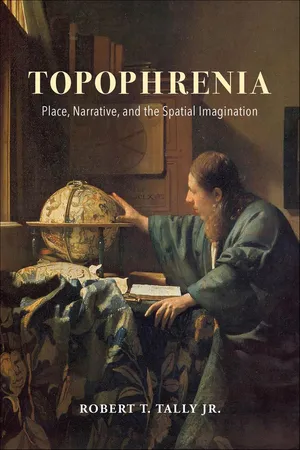
What is our place in the world, and how do we inhabit, understand, and represent this place to others? Topophrenia gathers essays by Robert Tally that explore the relationship between space, place, and mapping, on the one hand, and literary criticism, history, and theory on the other. The book provides an introduction to spatial literary studies, exploring in detail the theory and practice of geocriticism, literary cartography, and the spatial humanities more generally. The spatial anxiety of disorientation and the need to know one's location, even if only subconsciously, is a deeply felt and shared human experience. Building on Yi Fu Tuan's "topophilia" (or love of place), Tally instead considers the notion of "topophrenia" as a simultaneous sense of place-consciousness coupled with a feeling of disorder, anxiety, and "dis-ease." He argues that no effective geography could be complete without also incorporating an awareness of the lonely, loathsome, or frightening spaces that condition our understanding of that space. Tally considers the tension between the objective ordering of a space and the subjective ways in which narrative worlds are constructed. Narrative maps present a way of understanding that seems realistic but is completely figurative. So how can these maps be used to not only understand the real world but also to put up an alternative vision of what that world might otherwise be? From Tolkien to Cervantes, Borges to More, Topophrenia provides a clear and compelling explanation of how geocriticism, the spatial humanities, and literary cartography help us to narrate, represent, and understand our place in a constantly changing world.
eBook - ePub
Topophrenia
Place, Narrative, and the Spatial Imagination
- 196 pages
- English
- ePUB (mobile friendly)
- Available on iOS & Android
eBook - ePub
About this book
Information
PART I
PLACE IN GEOCRITICAL THEORY AND PRACTICE
1Topophrenia
PLACE SEEMS SO simple—commonplace, in fact—yet the concept lies at the heart not only of some rather complicated geographic theory and practice but also, arguably, of the arts, humanities, and sciences as a whole. The idea of place is crucial to spatial literary studies, unsurprisingly, and as such it deserves further attention. The fact that place can be taken for granted at times is already a sign of its conceptual ubiquity inasmuch as everything is situated in space and in or with respect to a place, but the distinctiveness of this or that place, the relationship of a place to other places and spaces, and the effects of place on persons, events, or narratives occurring or situated in a certain place are certainly worthy of further inquiry. With respect to literature in particular, place is always exerting its influence or making itself known in the text, and narratives frequently display their fundamental spatiotemporality according to the ways in which places, as well as moments in time, are represented. As such, place can be thought of as a sort of unit in literary cartography, which, like actual mapmaking, must register various types of place at the same time as it tries to account for them. Mapping makes visible places, and, in what might seem to be a circular logic, being mapped is what in many respects establishes a place as a place. Any study of literary cartography has to take into consideration, or take for granted, the problematics of place.
The Problematics of Place
In his magisterial study Space and Place: The Perspective of Experience, Yi-Fu Tuan carefully sets forth the conditions under which what we think of as a place emerges from the almost inchoate or chaotic proliferation of relations associated with space. He identifies a powerfully spatiotemporal dynamic in which a place becomes distinctive and thus knowable, and this dynamic creates meaning for and gives shape to all human experience of the world. For Tuan, a discrete or recognizable portion of otherwise undifferentiated space becomes a place when it occasions a pause, a resting of the eye or the stimulation of some other sense, at which point that now discrete spot becomes imbued with value and meaning. It thus enters the province of literary art, subject to interpretation, as well as to affective appreciation and significance. As Tuan puts it, among the ways that place can be defined,
place is whatever stable object catches our attention. As we look at a panoramic scene our eyes pause at points of interest. Each pause is time enough to create an image of place that looms momentarily in our view. The pause may be of such short duration and the interest so fleeting that we may not be fully aware of having focused on any particular object; we believe we have simply been looking at the general scene. Nonetheless these pauses have occurred. It is not possible to look at a scene in general; our eyes keep searching for points of rest. We may be deliberately searching for a landmark, or a feature on the horizon may be so prominent that it compels attention. . . .
Many places, profoundly significant to particular individuals and groups, have little visual prominence. They are known viscerally, as it were, and not through the discerning eye or mind. A function of literary art is to give visibility to intimate experiences, including those of place. The Grand Tetons of landscape do not require the services of literature; they advertise themselves by sheer size. Literary art can illuminate the inconspicuous fields of human care such as a Midwestern town, a Mississippi county, a big-city neighborhood, or an Appalachian hollow.1
Place, then, by definition is associated with a certain way of seeing that might well be called “critical,” even “literary critical,” inasmuch as interpretation, evaluation, and analysis of its meaning, functioning, and effects are presupposed the moment a given portion of space becomes recognizable as a place. If in Tuan’s view place is understood in terms of a pause, a moment of rest, then space is associated with movement. Place can then be understood as a relatively fixed, stable, and thus familiar or at least recognizable point, whereas space partakes of the mobile, dynamic, or unfamiliar. Space is likewise associated with the freedom, but also the peril, that comes from being away from home or being on the move. “From the security and stability of place, we are aware of the openness, freedom, and threat of space, and vice-versa.”2 In this somewhat phenomenological conception, the individual subject establishes a place through his or her experience and perception while simultaneously being subject to a place and to the space, abstract or diffuse, against which it is defined. Place is therefore profoundly subjective, but it is also a form of subjection.
A place is not quite the same as a territory, whose tortuous history of shifting relations of power and knowledge is illuminated in Stuart Elden’s brilliant genealogy The Birth of Territory, but a place must also be understood as an astonishingly dense ensemble of crystallized social relations.3 These relations might be disclosed in the everyday experiences, attitudes, or memories of those individuals or groups who inhabit, visit, or even just know of such places, which in turn may represent a complicated skein of intersecting historical events, narratives, traumas, and so on. Schematically, we may identify a given place, a “you are here,” from which to orient ourselves in relation to other places, but the “here” in question is never merely a location in space, such as would be approximated in the abstract by a set of coordinates on a Cartesian grid or even by a street address. Obviously, there is far more to a place than its mere localizability, but the very idea of localizing, of determining a locus, is essential to producing a place, not to mention experiencing and interpreting it.
In his Place: A Short Introduction, Tim Cresswell acknowledges both the simplicity and the complexity of the concept while exploring the many ways in which place or places have been understood by various spatial theorists and critics. One distinction is the difference between an abstract understanding of a given locus and the richer but messier apprehension of the place as experienced or lived. Cresswell illustrates the point by observing that the geographically definitive or specific marker “40.46 degrees North, 73.58 degrees West” does not mean much to most people, but the referent of these coordinates, New York City (or, more precisely, Midtown Manhattan), conjures up a host of images for persons familiar with the area and even for persons who may only know the place from its reputation or from images in books and movies. Pressing further into the analysis of the place, one discovers narratives without limit, social history, cultural traditions, political conflicts, artistic forms, and on and on.4 Hence, the exact location itself is not necessarily meaningful, at least not to all, but a given place, recognized as such, contains a plenum of meaning so vast as to be nearly overwhelming for an interpreter.
To know a place is really to know only a little about the place, since it would be impossible to achieve anything remotely approaching a complete representation of it. This has been almost comically proven by Georges Perec in his Attempt at Exhausting a Place in Paris, in which the writer tries to take note of every person and incident visible to him at a bustling intersection of Place Saint-Sulpice over the course of three days.5 (Needless to say, perhaps, but even by limiting his inquiry to a single intersection in Paris over a single weekend, Perec can offer little more than an infinitesimal amount of detail, considering the impossibly vast array of potential data to be registered.) This is also why, in Bertrand Westphal’s Geocriticism, the insoluble problem of the corpus haunts any effort to perform a comprehensive, geocentric interpretation, as I will discuss further in the next chapter.6 With a nearly infinite number of potential impressions of a particular place at our disposal, at what point does the geocritic feel comfortable that the body of work has achieved some level or threshold of adequate representation? Who is to say where the line would be drawn? Where does one even begin? How does one ever decide where to end?
One approach, certainly, involves a reliance on the subjective experience of space and place that Tuan discusses. In many respects, this remains egocentric, as opposed to Westphal’s geocentric methodology, which attempts to avoid bias through a multifocal process in which the place, not the writer or writers representing the place, is central to the investigation at all times. However, the somewhat egocentric approach that focuses on a single observer’s subjective experience allows a reader to explore the place as perceived or as experienced, without necessarily straining to achieve a quasi-scientific categorical knowledge of the place.7 The admittedly artificial limits on a corpus or on the object under scrutiny need not be debilitating, and these limits can often prove quite constructive. Focusing on a single author or single text, for instance, can enable a range of creative interpretations that may be productive of others. Hence, a geocritical exploration might well take as its starting point a particular text and its relation to a place, whose almost unavoidable polysemy and heteroglossia will ensure that any reading of the text, place, and relations among them will exceed simple personal or autobiographical experience, as if even that were entirely possible to pin down. The problem of place, in this sense, becomes a larger problematic: it is a grand assemblage of problems to be grappled with by the reader and writer. This subjective limit then opens up a plus ultra for subsequent, if not endless, exploration.
A key element of such geocritical explorations has been the affective geography made visible through a given subject’s own experience with and in places. In an earlier study, Tuan had coined an evocative term, topophilia, in order to represent succinctly “all of the human being’s affective ties to the material environment.” As Tuan explains, these ties “differ greatly in intensity, subtlety, and mode of expression. The response to environment may be primarily aesthetic: it may then vary from the fleeting pleasure one gets from a view to the equally fleeting but far more intense sense of beauty that is suddenly revealed. The response may be tactile, a delight in the feel of air, water, earth. More permanent and less easy to express are feelings that one has toward a place because it is home, a locus of memories, and the means of gaining a livelihood.”8 In Tuan’s joyous phenomenology, places are endowed with deeply personal and subjective meanings. They are invested with profoundly affective or emotional content for the subject that perceives, moves about, and in the broadest sense inhabits those spaces that have become demarcated and identified as places. Topophilia, or the love of place, seems an appropriate concept for one who so revels in the sensuous geographies of place, to use Paul Rodaway’s suggestive formulation.9
Here I might also mention the suggestive notion of nonplace, analyzed by Marc Augé in his influential study, Non-Places: Introduction to an Anthropology of Supermodernity. Augé focused attention on transitory sites, such as airports, hotels, highways, and supermarkets, which in a sense are not so much places—that is, locations imbued with meaning, dense with historical and social reference, the result of creative human endeavor, and so forth—as nonplaces, uniform, homogeneous zones of transit in which humans increasingly spend their lives.10 Siobhan Carroll has referred to these sorts of sites as atopias, spaces “antithetical to habitable place,” and she adds to the list of man-made atopias such as those mentioned by Augé a number of “natural atopias,” such as the North Pole, the middle of the ocean, the desert, or outer space, although she also notes how cyberspace is frequently imagined as a somewhat positive, man-made atopia. Carroll concludes that, whether these atopias are viewed as spaces that either liberate or threaten the individual subject, they have become increasingly useful in “orientating ourselves to the sublime space of the planet and the human networks that span its surface.”11
Recently, Dylan Trigg has called into question the binary distinction between place and nonplace distinction. Drawing on Maurice Merleau-Ponty’s Phenomenology of Perception, Trigg argues that “the bodily experience of place operates on several layers” and that this multidimensionality “renders our experience of place ambiguous.”12 Moreover, the phenomenological value of the concept of the nonplace is somewhat compromised by the recognition of the affective complexities and ambiguities associated with the subjective, and especially intersubjective, experience of these apparent nonplaces, as Trigg shows how hospital waiting rooms or beds, as wel...
Table of contents
- Cover
- Title Page
- Copyright
- Dedication
- Contents
- Acknowledgments
- Introduction: The Cartographic Imperative
- Part I: Place in Geocritical Theory and Practice
- Part II: Spatial Representation in Narrative
- Part III: Fantasy and the Spatial Imagination
- Conclusion: A Map of the Pyrenees
- Bibliography
- Index
- About the Author
Trusted by 375,005 students
Access to over 1.5 million titles for a fair monthly price.
Study more efficiently using our study tools.
Frequently asked questions
Yes, you can cancel anytime from the Subscription tab in your account settings on the Perlego website. Your subscription will stay active until the end of your current billing period. Learn how to cancel your subscription
No, books cannot be downloaded as external files, such as PDFs, for use outside of Perlego. However, you can download books within the Perlego app for offline reading on mobile or tablet. Learn how to download books offline
Perlego offers two plans: Essential and Complete
- Essential is ideal for learners and professionals who enjoy exploring a wide range of subjects. Access the Essential Library with 800,000+ trusted titles and best-sellers across business, personal growth, and the humanities. Includes unlimited reading time and Standard Read Aloud voice.
- Complete: Perfect for advanced learners and researchers needing full, unrestricted access. Unlock 1.5M+ books across hundreds of subjects, including academic and specialized titles. The Complete Plan also includes advanced features like Premium Read Aloud and Research Assistant.
We are an online textbook subscription service, where you can get access to an entire online library for less than the price of a single book per month. With over 1.5 million books across 990+ topics, we’ve got you covered! Learn about our mission
Look out for the read-aloud symbol on your next book to see if you can listen to it. The read-aloud tool reads text aloud for you, highlighting the text as it is being read. You can pause it, speed it up and slow it down. Learn more about Read Aloud
Yes! You can use the Perlego app on both iOS and Android devices to read anytime, anywhere — even offline. Perfect for commutes or when you’re on the go.
Please note we cannot support devices running on iOS 13 and Android 7 or earlier. Learn more about using the app
Please note we cannot support devices running on iOS 13 and Android 7 or earlier. Learn more about using the app
Yes, you can access Topophrenia by Robert T. Tally, Jr.,Robert T. Tally in PDF and/or ePUB format, as well as other popular books in Literature & Literary Criticism. We have over 1.5 million books available in our catalogue for you to explore.