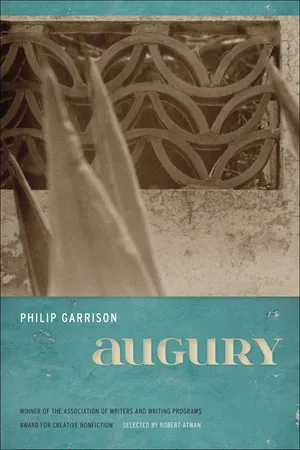
Set primarily in Mexico and the American Northwest, yet equally at home with Achilleus on the Trojan plains or with Walt Whitman in his New Jersey home, these fifteen essays pass back and forth across international boundaries as easily as they cross the more fluid lines separating past and present. Part biography, part history, Augury is also something of a writer's journal, a guide to Garrison's imaginative journeys.
eBook - ePub
Augury
About this book
Information
Print ISBN
9780820347479
9780820313122
ON THE CONQUEST

Even the briefest visit to Mexico leaves the visitor dizzy with contradictions. As we cross that subway landing in the national capital, the one they’ve built around a prehispanic pyramid, right in front of our eyes, past and present struggle for mastery. No corner of the country remains isolated enough to be free of polarities. I remember twenty-some years ago, eyeing the nightly news, in a tiny town, on a dim TV screen. It fascinated me how a specially designed government railroad car was struggling to transport a huge stone statue of Tláloc—Aztec divinity of rain—through five hundred miles of jungle, to where it could be displayed outside the national museum. Because of the weather, the journey seemed to be taking forever. Record cloud bursts were following Tláloc, day after day, down those steel rails, on his way to his new temple.
It probably owes to the Conquest, this giddy feel that, wherever we go in Mexico, contraries of time or culture keep on getting mixed. It was the Conquest, probably, with its diverse points of view, its floating loyalties and shifting alliances, that lent the country its first and fiercest multiplicity. Mexico, to this day, recapitulates the shock waves let loose in those few months, when the two halves of the world, making contact, released an energy something like the impact that sperm and ovum have on each other. And yet by now, even to recount the Conquest to ourselves, we have to simplify it: we have to consider it a trajectory that resulted from the collision of two world views, that of the Spaniard and that of the Aztec.
The two outlooks with which we begin, like the documents on which we base them, agree on very little—maybe only on the fact that the Spaniards were so few, and the Aztecs, so many. Bernal Díaz, a foot soldier with Cortés, remembers that “We numbered five hundred and eight, not counting a hundred shipmasters, pilots, and sailors.” Eleven ships and sixteen horses and mares, thirty-two crossbowmen and thirteen musketeers, a few bronze guns, four falconets, and a lot of powder and ball—for the Spanish king, it certainly didn’t represent much of an investment. But that modest show of force soon was bringing to Spain more wealth than Spain had ever seen.
As early as the seventh day of July, in 1519—a little more than two months before Moctezuma and Cortés are to meet—the latter writes a letter to Carlos V. Its concluding paragraphs mention that His Majesty will receive, by messenger, a wheel of gold weighing 238 pounds, carved with the figures of monsters. Other gifts are also on the way: two necklaces of gold and rare stones, two pairs of leggings (one gold leaf and yellow deerskin, the other of white deerskin and silver leaf), a green-feathered bird with feet and beak and eyes of gold, the heads of two wolves and two tigers, two cotton sheets embroidered with figures in black and white, six brush paintings and two women’s shirts. From our perspective, four centuries later, the splendor and variety of the gifts prefigure much of what the Aztec City of Tenochtitlán will offer. Cortés even includes six pounds of gold, that His Majesty may melt it, and see for himself its quality. The longer we ponder them, the more we begin to consider these first gifts as a kind of omen.
From the Aztec perspective, for many years before the Spaniards’ arrival, omens had wrenched the landscape. In the Codex Florentino, Bernardino de Sahagún’s Aztec informants tell of a flame shape that opened in the sky overhead: wide at the base and narrowing toward the top, like an ear of corn, it bled fire a drop at a time, as if the sky were wounded. When the people cried out, beating the palms of their hands against their mouths, they sounded like thousands of bells being shaken. All on its own, a temple burst into flames, wings of fire seeming to rush out the doors, to carry the walls off into the sky. Wind blew the lake into boiling, raging waves that lashed the walls of houses till they collapsed. Night after night, up and down the streets, people heard what sounded like a woman weeping, shouting to her children to flee the City, wondering where she should take them. At last fishermen netted a strange bird: it resembled a crane, except that it was the color of ashes and, in the crown of its head, bore a mirror which reflected, even at noon, the three stars to which the City burned incense every night.
It doesn’t matter who’s doing the talking. Whether we’re listening to Spaniard or Aztec, the voices that ring within our story touch off, in each other, a kind of counterpoint. The deepest assumptions of the conquered manage to throw into relief those of the conqueror. Each lends, to whatever the other describes, a dizzying dimensionality. Whether from depths of wretchedness, or from heights of exhilaration, each perspective views the Conquest the way it does because of its definition of what comprises human existence.
The essence of the Spaniard is a soul, a sliver of existence both immortal and immaterial. The soul is also simple, seamlessly unified, indivisible into further components. But the nature of the Aztec is double: each is not just himself or herself, but is also a nahualli. At the moment of birth, each Aztec gets associated with a specific bit of plant or animal life, or maybe with a few inches of dirt, or a glimpse of sky. Each of the gods, even, is bound to this kind of other: to an owl or to an eagle, say, to a coyote or a coati. Sorcerers, those who practice magic, simply have learned to control these alternate selves, these exterior souls: shoot a bat, and you’ll likely scar a witch. An arrow in a caiman leaves a curandero limping.
So Aztecs and their gods alike live subject to one rule: an element of otherness, an opposite number, balances each of them. As they watch the stars march across the sky, the Aztecs feel the year grind past with a mathematical regularity, a month at a time. They know that the very moment of the day on which the child is born fixes her future, predicts his potential. And yet, given all the balanced foreshadowing, given that the whole world’s a network of anticipations, the nahualli lends to human experience an incomplete, disconnected quality.
Even Quetzalcóatl, Lord of the Air, when fetching back from the underworld all that was left of human ancestors, had to ask his nahualli how to revive their splintered bones. (He heard a voice say to bleed on them, bleed on them.) Aztecs can’t conceive of existing alone, as only a self: the nahualli’s paw prints carry them all which directions; its root systems bind them to earth. Her nahualli can lend feathers to a woman, or sharp teeth; it frees her from the isolation of individuality. No wholeness can threaten the man whose nahualli roams the streets and paths of the Aztec Empire. Without nahuallis the earth would collapse into sameness.
The self and the nahualli amount to different versions of the same person: each is able to give the other advice, or to take the other’s directions. And yet, though people born at the same moment share the same nahualli, each individual amounts to a different interpretation of it. The nahualli does predispose the self in certain ways, just as tomorrow predisposes today; like the future and the present, nahualli and self amount to paraphrases of each other.
Behind nahualli and soul, after all, lie two different concepts of time. The Spaniard understands time as linear and progressive, as a series of moments possessing a plot—a sequence of events flowing in one direction, interconnected by cause and effect. The soul needs such a medium to survive, to refine itself. Time, for the Spaniard, will come to an end at the moment Christ returns to judge the souls of men and women. The Aztec, on the other hand, understands time as gliding, circular and endless, about the fixed axis of a ceremonial year. The individual human is not immortal, or only minimally so. Of far greater importance are the combinations, the endlessly recurring days on which humans can get born into relation with a fixed, preexisting number of nahuallis. This sense of time as repetition leaves the Aztecs forever watching for omens, for moments which prefigure moments yet to come. The Spaniards’ sense of time as change leaves them measuring evidence, calculating, guessing. The future, for the Aztec, not only is fixed, but also lies encoded in the natural world, in a kind of writing that people who are learned in such matters can decipher. For the Spaniard the future, at least in its particulars, remains largely indeterminate, depending as it does on human choice.

And yet the Spaniards seem, at times, to know their deeds are going to wind, forever after, through the imagination of Europe and the Americas. When the islands through which they are sailing start to yield signs of human life, to indicate that the jungle overgrowing the mainland hides cities, they begin with a special fervor to commend themselves to their God, and to the future. And yet, ironically, the landscape first gives them back reflections of lives exactly like their own, traces of the presence of Spanish explorers, wanderers. Cortés’s secretary, Lopéz de Gómara, reports that when they catch a huge shark off Cozumel, it carries in its belly three shoes, a cheese, a tin plate, and ten flitches of salt pork. They even begin to run across Spanish castaways. One is named Guerrero. Having lived among the natives so long by now that his face is tattooed, and both earlobes bored, he refuses to leave. On the other hand Aguilar, a prisoner only eight years, limps into camp clutching an oar, rags at his waist, scraps of an old book of prayers tied in a bundle at one shoulder. He begs to come along as interpreter.
The first natives the Spaniards encounter seem nothing special. They certainly give no sign that, within weeks, they’ll be collaborating with their conquerors to furnish the quasi-historical chronicle now unrolling before us. Indeed, the first natives take one look at the Spaniards and flee. Cortés and his men find only a temple full of fowls and idols, of toys and ornaments made of debased gold. Destroying the altar, pulling down the gods, Cortés cuts a limestone altar to the Virgin. These people live like filthy children, Bernal Diaz writes, or like gypsies. Each time the cannon fires, they shout, whistle, throw up straw and dust in the air, their faces painted, their limbs in quilted-cotton armor. Even though they’ve fled, the Spaniards suspect they’ll be back. In fact, their numbers are so great that, if each only lifts a handful of dust, they’ll bury this little band of adventurers. Cortés orders his men to dress the horses’ wounds in fat cut from dead Indians.
By now it’s begun to exhibit the resilience of a dialogue, the tale our sources are telling us. If, a moment ago, we heard the Spaniards’ report of the first contacts, by now the Aztec version of the same events begins to reply. The Aztec authors of the Crónica Mexicana describe how, day by day, Moctezuma senses generations worth of prophecy solidifying, becoming rumor: the empire has been invaded. To verify the existence of the strange beings the rumors describe, he sends out scouts. But they keep coming back with their ears and toes cut off. The Crónica mentions the scouts catching glimpses of strangers, light skinned with long beards, dressed in blue or red, black or green jackets, wearing large round hats shaped like griddles. These fellows’ hair reaches only to their ears. They’re fishing. Moctezuma knows it must be Quetzalcóatl returning, just as he said he would, to end the world by wreaking revenge on certain other gods, in particular on those who drove him from this land. So Moctezuma sends messengers with gifts: a serpent (or coatl) mask inlaid with turquoise, a breastplate of quetzal feathers, a collar of reeds woven around a gold disk, a shield of gold and mother-of-pearl. Surely any god would respond to such lavish homage.
But these gods don’t. Instead, when the messengers kiss the ground in front of his feet, and fasten to his body the gifts they’ve brought, the leader, the one in the red beard, wonders if these gifts are all they’ve brought. He asks if this is how the Aztecs greet their guests. Back in the City, before he’ll hear the news, Moctezuma orders the hearts ripped out of two captives. He has their blood sprinkled on the messengers. These men, after all, have looked at the gods’ faces. He sighs and shivers at the description of the cannon, how something like a ball of stone leaped from its entrails, shooting sparks, flinging fire and a smoke that smelled like rotten mud, and how the tree it aimed at shattered into splinters.
His messengers’ reports tighten around Moctezuma, rather the way our story is starting to restrict our own choices, the options for selection and sequence by means of which we’re composing it: the emperor is bound, whichever way he turns, by a plaiting together of contradiction, rumor, and discrepancy. As messengers, the next time, he sends out princes with gifts of gold. Now the gods smile with glee, fingering each object, snatching them from one another like monkeys, yakking away in their barbarous tongue, demanding more. The sorcerers he sends, on the final mission, never arrive. A stranger, someone they think is a drunk, waylays them. He talks and dresses as if he were from Chalco. Suddenly, his voice sounds as if he were standing far away. He tells them the City is doomed, that Moctezuma is a fool to struggle against fate. When the stranger disappears, they know it has to have been Tezcatlipoca, Lord of the Polished Judgment-Mirror. When they tell Moctezuma, he says it means the City will have to be punished. Now there’s nothing to do but wait.
As we turn our attention back to the Spaniards, all these shifts in perspective start to feel like a dialectical process, the self-propelled sensation of time passing. Even the Spaniards can sense it: Bernal Diaz notes how they feel that history itself is sweeping them down that causeway straight as a blade, wide as eight horses abreast, as they approach the great lakeside city. Four thousand courtiers touch earth with their right hand, kissing it, bowing, retreating. Then Moctezuma himself appears, in golden-soled sandals, preceded by princes sweeping the ground, averting their eyes, spreading rare cloths under the emperor’s step, holding Cortés back lest he try to embrace him. The imperial bodyguards carry lances of fire-hardened wood tipped with skate spines. Flint glued with the blood of bats edges their wooden swords. A smokeless, fragrant tree bark burns, heating the imperial apartment. Dancers and buffoons, and tiny humpbacked clowns, bent nearly double, provide entertainment. Moctezuma smokes a couple of tubes filled with herbs, and promptly falls asleep.
Birds with long green feathers fill the imperial palace, as well as others with red feathers, white, yellow, and blue. Women clean the nests, placing eggs under birds that are brooding, harvesting the feathers. In another house the Spaniards find stone idols, and beasts of prey eating the bodies of sacrifice victims. The Spaniards eye goose quills stuffed with gold dust. They flinch at poisonous snakes with tails that ring like bells.
In the market, merchants sell food: moles and lice, the voiceless, castrated dogs they fatten, a kind of scum they net from the lake. From the top of the pyramid honoring the Aztec waridol, voices bartering in the market leave a low hum on the air. Causeways and canoes, towers and flat-roof houses, the whole City floats. Weakened from disease and fever, Cortés studies the broad face and terrible eyes of the war-idol, the hearts of three men burning before it, the walls black with blood. He begs permission to leave an image of the Virgin there. Refused, he totters down 114 steps on abscessed legs. Everywhere he looks, men are playing games. Aztec warriors slash a tree, until it oozes white drops they roll into a ball—which they then proceed to drive back and forth, with blows from hip and thigh, the length of a great whitewashed court. Spanish soldiers gamble for gold shares with cards they’ve cut out of drum skins.
According to the Crónica, Moctezuma now orders golden necklaces hung from the necks of these gods, and wreaths of flowers put on their heads. He welcomes them to what is now their City. Their response is to put him under guard, and fire off one of their cannons. It makes a noise so huge that people run back and forth, as if they had eaten mind-numbing mushrooms. First the gods demand eggs and tortillas, chicken and drinking water and firewood and charcoal. Then they demand gold. They strip the feathers from pennants and shields, leaving only the golden frames, which they melt into ingots, along with necklaces and nose plugs, greaves and bracelets and crowns. Everything else they pile up and burn, the feathers and delicate leathers, the rare cloths and furs.
A few days later, when Moctezuma asks these gods for permission to hold the fiesta of Toxcatl, they grant it. But then, when dancers and song fill the Sacred Patio, a certain fear of the Aztec worshipers seems to overcome the gods. Anyhow they seal off the exits, attacking with swords and shields. To this day, in bark-paper paintings, the severed arms of the Aztec drummers still writhe, squirting blood, and lopped heads still roll. When dancers slashed in the abdomen try to flee, they tangle their feet in their own entrails.
Enraged, the City’s entire population surrounds the Patio, driving the attackers back into the palace where they’re lodged. Moctezuma appears on a rooftop, begging his people not to r...
Table of contents
- Cover Page
- Title Page
- Copyright Page
- Dedication
- Contents
- Foreword
- Acknowledgments
- Independence Day
- Adaptations
- Three Days in the Mexican Highlands
- The Republic of Boylston
- Tombs
- Burning What We Weave
- Borders
- Two Love Scenes in Homer
- American Miracles
- Where Pigs Can See the Wind
- Finding Our Lives
- Monument
- On the Conquest
- The Tour Guide
- Las Aventuras
Trusted by 375,005 students
Access to over 1.5 million titles for a fair monthly price.
Study more efficiently using our study tools.