- 184 pages
- English
- ePUB (mobile friendly)
- Available on iOS & Android
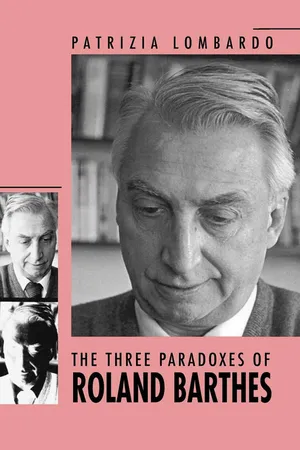
The Three Paradoxes of Roland Barthes
About this book
Revolution must of necessity borrow, from what it wants to destroy, the very image of what it wants to possess.—Roland Barthes
In the field of contemporary literary studies, Roland Barthes remains an inestimably influential figure—perhaps more influential in America than in his native France. The Three Paradoxes of Roland Barthes proposes a new method of viewing Barthes's critical enterprise. Patrizia Lombardo, who studied with Barthes, rejects an absolutist or developmental assessment of his career. Insisting that his world can best be understood in terms of the paradoxes he perceived in the very activity of writing, Lombardo similarly sees in Barthes the crucial ambiguity that determines the modern writer—an irresistible attraction for something new, different, breaking with the past, yet also an unavoidable scorn for the contemporary world. Lombardo demonstrates that her mentor's critical endeavor was not a linear progression of thought but was, as Barthes described his work, a romance, a "dance with a pen."
Frequently asked questions
- Essential is ideal for learners and professionals who enjoy exploring a wide range of subjects. Access the Essential Library with 800,000+ trusted titles and best-sellers across business, personal growth, and the humanities. Includes unlimited reading time and Standard Read Aloud voice.
- Complete: Perfect for advanced learners and researchers needing full, unrestricted access. Unlock 1.4M+ books across hundreds of subjects, including academic and specialized titles. The Complete Plan also includes advanced features like Premium Read Aloud and Research Assistant.
Please note we cannot support devices running on iOS 13 and Android 7 or earlier. Learn more about using the app.
Information
Table of contents
- Cover Page
- Title Page
- Copyright Page
- Contents
- Preface
- Acknowledgments
- 1. History and Form
- 2. Against Language
- 3. Essays in Fiction
- Conclusion: The Return of History
- Notes
- Bibliography
- Index