Cold War Dixie
eBook - ePub

Cold War Dixie

Militarization and Modernization in the American South

  1. 256 pages
  2. English
  3. ePUB (mobile friendly)
  4. Available on iOS & Android
eBook - ePub

Cold War Dixie

Militarization and Modernization in the American South

About this book

Focusing on the impact of the Savannah River Plant (SRP) on the communities it created, rejuvenated, or displaced, this book explores the parallel militarization and modernization of the Cold War-era South. The SRP, a scientific and industrial complex near Aiken, South Carolina, grew out of a 1950 partnership between the Atomic Energy Commission and the DuPont Corporation and was dedicated to producing materials for the hydrogen bomb. Kari Frederickson shows how the needs of the expanding national security state, in combination with the corporate culture of DuPont, transformed the economy, landscape, social relations, and politics of this corner of the South. In 1950, the area comprising the SRP and its surrounding communities was primarily poor, uneducated, rural, and staunchly Democratic; by the mid-1960s, it boasted the most PhDs per capita in the state and had become increasingly middle class, suburban, and Republican.

The SRP's story is notably dramatic; however, Frederickson argues, it is far from unique. The influx of new money, new workers, and new business practices stemming from Cold War-era federal initiatives helped drive the emergence of the Sunbelt. These factors also shaped local race relations. In the case of the SRP, DuPont's deeply conservative ethos blunted opportunities for social change, but it also helped contain the radical white backlash that was so prominent in places like the Mississippi Delta that received less Cold War investment.

Frequently asked questions

Yes, you can cancel anytime from the Subscription tab in your account settings on the Perlego website. Your subscription will stay active until the end of your current billing period. Learn how to cancel your subscription.
No, books cannot be downloaded as external files, such as PDFs, for use outside of Perlego. However, you can download books within the Perlego app for offline reading on mobile or tablet. Learn more here.
Perlego offers two plans: Essential and Complete
  • Essential is ideal for learners and professionals who enjoy exploring a wide range of subjects. Access the Essential Library with 800,000+ trusted titles and best-sellers across business, personal growth, and the humanities. Includes unlimited reading time and Standard Read Aloud voice.
  • Complete: Perfect for advanced learners and researchers needing full, unrestricted access. Unlock 1.4M+ books across hundreds of subjects, including academic and specialized titles. The Complete Plan also includes advanced features like Premium Read Aloud and Research Assistant.
Both plans are available with monthly, semester, or annual billing cycles.
We are an online textbook subscription service, where you can get access to an entire online library for less than the price of a single book per month. With over 1 million books across 1000+ topics, we’ve got you covered! Learn more here.
Look out for the read-aloud symbol on your next book to see if you can listen to it. The read-aloud tool reads text aloud for you, highlighting the text as it is being read. You can pause it, speed it up and slow it down. Learn more here.
Yes! You can use the Perlego app on both iOS or Android devices to read anytime, anywhere — even offline. Perfect for commutes or when you’re on the go.
Please note we cannot support devices running on iOS 13 and Android 7 or earlier. Learn more about using the app.
Yes, you can access Cold War Dixie by Kari Frederickson, Jane Dailey in PDF and/or ePUB format, as well as other popular books in History & North American History. We have over one million books available in our catalogue for you to explore.

NOTES

Abbreviations

ACC Minutes
Minutes, Aiken City Council, Aiken County Government Complex, Aiken, South Carolina
AED Records
E. I. Du Pont de Nemours and Company, Atomic Energy Division Records, Gregg-Graniteville Library, University of South Carolina at Aiken
ASR
Aiken Standard and Review
BRM
Burnet R. Maybank
BRM Papers
Burnet R. Maybank Papers, Special Collections, Marlene and Nathan Addlestone Library, College of Charleston, Charleston, South Carolina
CAN
Curtis A. Nelson
HLA
Harry L. Alston
HH
Harry Hammond
HOD
Harold O. DeWitt
HST Papers
Harry S. Truman Papers, Harry S. Truman Library, Independence, Missouri
JAT
Julius A. Thomas
JSB
John Shaw Billings
JSB/FWB Papers
John Shaw Billings and Frederika Wade Billings Papers, Manuscripts, South Caroliniana Library, University of South Carolina at Columbia
NCJ
Nelson C. Jackson
NUL-SRO
Papers of the National Urban League—Southern Regional Office, Library of Congress, Washington, D.C.
SHS
Samuel H. Swint
SHS Papers
Samuel H. Swint Papers, Gregg-Graniteville Library, University of South Carolina at Aiken
SRPP
E. I. Du Pont de Nemours and Company, Atomic Energy Division, Savannah River Plant Papers, Accession 1957, Hagley Museum and Library, Wilmington, Delaware
WDW
William D. Workman
WDW Papers
William D. Workman Papers, Modern Political Collections, South Caroliniana Library, University of South Carolina at Columbia

Introduction

1. Schulman, From Cotton Belt to Sunbelt, 141. For military spending and the South, see also Markusen et al., Rise of the Gunbelt; David L. Carlton, ā€œThe American South and the U.S. Defense Economy,ā€ in South, the Nation, and the World, ed. Carlton and Coclanis, 152–53; Hooks, ā€œGuns and Butter.ā€
2. For the impact of the Cold War on western development generally, see Hevly and Findlay, Atomic West; Lotchin, Fortress California; Nash, American West Transformed; Nash, Federal Landscape; McGirr, Suburban Warriors; Fernlund, Cold War American West.
3. See Findlay and Hevly, Atomic Frontier Days; Gerber, On the Home Front; Sanger, Working on the Bomb; Hunner, Inventing Los Alamos; Fishbine, Children of Usher; Litchman, Secrets; Shroyer, Secret Mesa; Charles W. Johnson and Jackson, City behind a Fence; Olwell, At Work in the Atomic City; Leland Johnson and Schaffer, Oak Ridge National Laboratory; Hales, Atomic Spaces; Fischer, Los Alamos Experience.
4. Schulman, From Cotton Belt to Sunbelt, 149. For examinations of southern military bases and their impact on their host communities, see Myers, Black, White, and Olive Drab; Lutz, Homefront; Phillips, ā€œBuilding a New South Metropolis.ā€
5. The historiography of the civil rights movement is large and ever-expanding. Key older works include Dittmer, Local People; Carson, In Struggle; Payne, I’ve Got the Light; Chafe, Civilities and Civil Rights. More recent works have expanded the parameters of the movement beyond the traditional 1954–65 framework, putting greater emphasis on activism during the New Deal and World War II eras. For civil rights activism in the 1930s and 1940s, see Sullivan, Days of Hope; Egerton, Speak Now against the Day; Frederickson, Dixiecrat Revolt; Brooks, Winning the Peace; Kruse and Tuck, Fog of War.
6. See Lassiter, Silent Majority; Kruse, White Flight.
7. Sullivan, Days of Hope; Egerton, Speak Now against the Day; Gilmore, Defying Dixie; Tyson, Radio Free Dixie; Woods, Black Struggle, Red Scare; Dudziak, Cold War Civil Rights.
8. Stewart, ā€œWhat Nature Suffers to Groe,ā€ 12.
9. Mart A. Stewart, ā€œSouthern Environmental History,ā€ in Companion, ed. Boles, 414–15.
10. The respective roles of race and class in the rebirth of the Republican Party in the South are topics of fierce scholarly debate. For those arguing for the primacy of race, see Carter, Politics of Rage; Carter,...
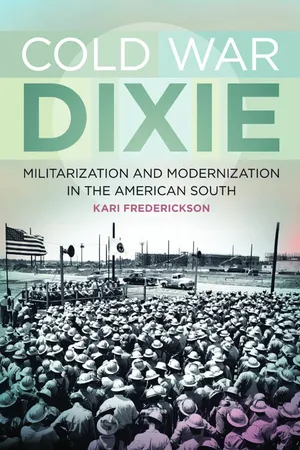
Table of contents

  1. Cover Page
  2. Title Page
  3. Copyright Page
  4. Dedication
  5. Contents
  6. List of Illustrations
  7. Acknowledgments
  8. Introduction
  9. One. ā€œThis Most Essential Taskā€: The Decision to Build the Super
  10. Two. A Varied Landscape: Geography and Culture in the Savannah River Valley
  11. Three. ā€œA Land Doomed and Damnedā€: The Costs of Militarization
  12. Four. ā€œBigger’n Any Lieā€: Building the Bomb Plant
  13. Five. Rejecting the Garrison State: National Priorities and Local Limitations
  14. Six. ā€œBetter Livingā€: Life in a Cold War Company Town
  15. Seven. Shifting Landscapes: Politics and Race in a Cold War Community
  16. Epilogue
  17. Notes
  18. Bibliography
  19. Index