![]()
CHAPTER ONE
“One-Half of 1%”
Geopolitics, Geoeconomics, and USAID
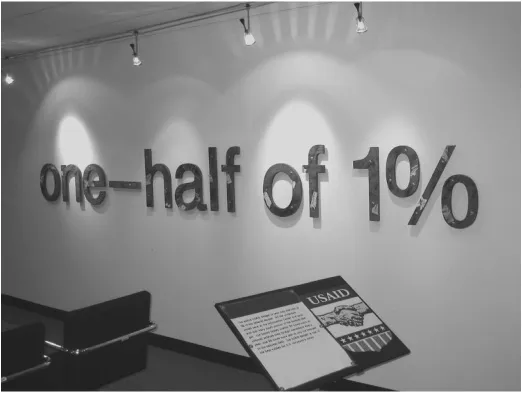
VISITORS TO THE PUBLIC INFORMATION CENTER of the U.S. Agency for International Development (USAID), in downtown Washington’s Ronald Reagan Building, are greeted by the words “one-half of 1%,” bolted to the lobby wall in letters fashioned out of wood from official aid shipment crates (see figure 1). The small sign in front of this somewhat strange message indicates that “one-half of 1%” represents USAID’s share of the federal budget, a rather paltry sum dwarfed by the amount of federal money budgeted annually for military expenditures and servicing the national debt. The return on this minuscule budgetary outlay, the sign states, “is one of the best values for [the] U.S. taxpayer’s dollar.” I first encountered this display in July 2006, when visiting the Public Information Center while doing research on USAID; it still adorned the lobby wall when I arrived for a second visit in August 2008. When I returned for a third time in July 2010, the wall featured instead a large poster detailing USAID emergency aid programs in Haiti following the devastating earthquake in that country several months prior. When I asked the receptionist whether the “one-half of 1%” lettering had been removed, she laughed and said no, it remained intact under the Haiti poster.
The relative permanence of this budget line at (more or less) one-half of 1 percent of federal government spending, and its announcement as the first message encountered on entering the information center, speaks to USAID’s position within the U.S. state and the agency’s confidence in its mandate, mission, and standing.1 The defensiveness with which the agency declares both its relatively minuscule budget and its broad impact, and the juxtaposition of these against one another, offers a glimpse into the deeper and more complex web of inter- and intrastate relations that have shaped USAID’s institutional and political evolution across a wide range of geographic locales and strategic activities. The agency itself is an important global actor in the political economy of development, and a critical geographical and historical examination of the agency highlights the uncertain and winding path of official development practices and discourses, strategic decision making within the state, and the sociopolitical and economic forces that align themselves with particular political, state, and hegemonic projects. This work focuses on the tangled web of relations, projects, and practices shaped by USAID and which in turn shape the agency. My analysis builds from two conceptual frameworks, one regarding the structure of the capitalist state, the other dealing with intertwined but distinct, sometimes complementary, sometimes competing “geostrategic discourses” of geopolitics and geoeconomics.
FIGURE 1. One-half of 1%. The phrase “one-half of 1%” is bolted to the lobby wall in USAID’s Public Information Center in Washington, D.C.’S Ronald Reagan Building. (Photo by author.)
It is important to note the active work geostrategic discourses perform, and the work of “geo-graphing” that goes into making and reproducing them in a world of ever-shifting contexts (Sparke 2005). Discourses do not, of course, drop from the sky fully formed, and they are useful and powerful to the extent that they circulate and shape how political, economic, and other social agents see and make the world and their place within it. As Lawson (2007, 40) summarizes in her examination of the making and remaking of development geographies, “Discourses are both socially produced and socially producing—bound up in intimate power relations with the institutions and societies that they describe.” Geopolitics and geoeconomics comprise two distinct but interrelated discourses guiding state strategies and policies, and they provide powerful frameworks for shaping how development-oriented actors such as USAID, as well as the objects of its development strategies and programs, view the world and act upon it.
Most crucial for my examination are the distinctions between and intersections of geopolitics and geoeconomics as forms of geostrategic discourse and how these shape state- and scale-making practices. The demarcation and strategic positioning of territorial states within an international state system girded by capitalist economic relations has long formed the corpus of geopolitics. Geopolitical logic has served as the basis not only for statecraft, military strategy, and development intervention (Slater 1993) but also for popular geographical imaginations and views of world order; a deconstructive analysis of this logic grounds the contemporary subfield of critical geopolitics (for overviews and representative discussions, see Dalby 2008; Ingram and Dodds 2009; Ó Tuathail 1996). The term geoeconomics, on the other hand, stems initially from the work of security consultant Edward Luttwak (1990), who coined it in response to an emergent post–Cold War order in which, he argued, national economic position in a brutally efficient world economy would trump military strength as the primary ordering mechanism for the state system. As a set of discursive constructs and a platform for devising political and economic strategies and policy, geoeconomics concentrates on “building international partnerships that advance ‘harmonization,’ ‘efficiency,’ ‘economic leverage’ and ‘growth’ against the supposed threats of political ‘radicalism,’ ‘anachronism’ and ‘anarchy’” (Sparke and Lawson 2007, 316). Although Luttwak’s usage of the term continues to circulate in official policy, pundit, and defense circles (see Barnett 2004, 2006, 2009), the underlying concept now not only functions to inform the exclusive and narrow realm of national and global security strategy formation, especially where making “better” U.S. policy is concerned, but also serves as a broad descriptor of a distinct vision of international relations, social and spatial order, and political economic connectivity.
My emphasis on geostrategic discourses, and especially on geopolitics and geoeconomics, follows from a growing body of critical work that interrogates how discourses produce, reproduce, and frame connections, processes, and flows between places and across scales and how such framings circulate and shape strategic decision making, not just by powerful actors and institutions but also by those challenging dominant power relations and working toward oppositional and alternative projects (Cowen and Smith 2009; Gregory 2004; Power 2003; Roberts, Secor, and Sparke 2003; Sparke 2005; Sparke and Lawson 2007). In addition, Matthew Sparke’s (2007b, 338) work detailing geographers’ responsibility to engage in critical analysis of how geographical relationships and understandings are made “by multiple, often unnoticed space-making processes and space-framing assumptions” also underlies the approach I take (see also Jackson, Ward, and Russell 2008; Massey 2004; Sparke 2007a).
Despite USAID’s importance as a global development actor and a major component of U.S. foreign policy strategies since the early Cold War era, geographers have not carried out a sustained and focused examination of the organization’s inner workings and external relations. The agency is one of the most deeply internationalized institutions within the U.S. state, with staff stationed at field sites and embassies around the world and in Washington and a mandate to promote economic and political development in developing states in line with U.S. foreign policy objectives. The agency therefore provides a window into geostrategic thinking and action from within the heart of the American state. The tensions, compromises, and contradictions driving the development and deployment of geostrategic discourses are written into the very structure and character of USAID. This likewise demonstrates the constrained evolution of mainstream postwar development theory and practice and the creation and reproduction of the Third World/Global South as a geographic space in need of development intervention.
Attention to how USAID works from, reproduces, and is limited by its geostrategic assumptions and framings, and what this has meant for theorizations and practices of development more broadly, is crucial in the context of global interdependence and crisis. On one hand, USAID views recent global economic, financial, and food crises as evidence of the need for further development intervention, largely under the geoeconomic rubric of neoliberal globalization and geopolitical considerations linked to the “global war on terror” framing underdevelopment as a breeding ground for state failure, international crime, and terrorism. On the other hand, the lack of development progress and the geoeconomic push for further global integration and openness has meant prolonged crisis and reform within USAID itself, as it works to reposition itself alongside other U.S. state institutions with a stake in development aid and programming and within the expanding nexus of civil society and private channels of development and humanitarian assistance that make up the “global aid architecture.”
A critical geographical analysis of geostrategic discourses thus comprises an effort to understand how this architecture is structured and structuring and how powerful, even hegemonic, forms of discourse shape and are shaped by the institutions composing it. The path of geopolitical and geoeconomic discourses as they relate to development assistance and institutions such as USAID, however, should not be understood as a crude chronological progression from the geopolitics of Cold War developmentalism to the geoeconomic rhetoric of “borderlessness” that marks contemporary neoliberal globalization. Indeed, as Neil Smith (2003, 457) demonstrates in his analysis of twentieth-century American imperialism, “the transition to a ‘geo-economic globalism’ was not initiated at the end of the American [twentieth] Century but marks the crucial break with territorial expansionism at its beginning.” The considerable historical and geographical overlap between these two broad geostrategic discourses and the imperial practices they inform and underwrite stands as much more prevalent than any temporal or spatial disconnect between them. While the remainder of this work illustrates that the temporary dominance of one discourse and associated institutional configurations over the other can be periodized to some degree, the historical trajectory remains rooted in a complex intertwining and in the institutional materiality of USAID and the American state.
In pursuing my examination in this way, I intend, as Cowen and Smith (2009, 24–25, emphasis in original) do, to “trace the emergence of a political-geographic logic of economy, security and power somewhat at variance with that proposed by geopolitics,” and which “recasts rather than simply replaces geopolitical calculation.” Most importantly, Cowen and Smith (2009, 25) emphasize consideration of the “geopolitical social” and “geoeconomic social,” or the ways in which the ordered logic of strategic discourses and their attendant practices and institutions are central to both the creation and defense of a clearly bounded national territory, and “the making of national social order.” In their view, the geopolitical social has dissolved and been reconfigured in favor of a new geoeconomic social and spatial logic, such that geopolitics is “dead but dominant” as a mode of explanation and sociospatial ordering; I will return to this point in the concluding chapter, but for now the (attempted) totalizing, ordering logics that animate geopolitics and geoeconomics deserve further attention (Cowen and Smith 2009, 23).
As discursive formations and platforms for articulating and enacting political economic strategies, geoeconomics differs from but meshes with geopolitics. Each emphasizes specific but related aspects of the many geographic, social, political, and economic relationships that form between places, across scales, and through extensive formal and informal networks and institutions. While geoeconomics itself is a relatively new term, the recognition that a deterritorializing logic of economic connection exists alongside and, at turns, intertwines with and contradicts a territorializing logic of political control and closure is not confined to Luttwak and his critics (see Arrighi 1994; Glassman 2005a; Harvey 2003) and can be studied across multiple historical and institutional contexts. Agnew (1994, 2005a, 2005b) and Agnew and Corbridge (1995), for example, provide a theorization of territoriality and sovereignty that highlights the historical development of state sovereignty on the basis of territorial control as well as the specific conditions of American hegemony in the context of globalization and what they term the global geopolitical economy. While I return to the question of American hegemony and imperialism more fully in later chapters, it suffices to note here that the state, or at least the legitimate exercise of state power, and the scalar and spatial foundations of the state and statecraft are shifting terms of debate and analysis in contemporary geopolitical practice. This is in large part due to the incompleteness and contingency of territorial control and the inability of discursive framings linking globalization, state power, and political economic change to keep pace with the social and geographical realities of these processes.
Roberts, Secor, and Sparke (2003) have argued that the period just prior to and following the terrorist attacks of September 11, 2001, are defined by the emergence of “neoliberal geopolitics.” They use this term to refer to a system of discourse and practice in which an overriding geopolitical concern with security, couched especially in terms of the global war on terror and enacted through new forms of managing global-local connectivity, has coalesced (steadily but uneasily) with a geoeconomic emphasis on unfettered flows of trade and investment in a liberalized world market system. Mitchell (2010, 289), meanwhile, emphasizes the geostrategic power of enframing language, noting that the “imaginative geopolitical scripting of the neoliberal era … has moved from a Cold War conceptualization of security attained through effective spatial containment, to an idea of security won through effective spatial administration.” Again, however, the problem of temporal and geographical reductionism must be avoided, as these discourses of security do not simply supplant one another over time or space in a linear fashion. To return once more to Cowen and Smith (2009, 24), we must be careful not to frame geopolitics and geoeconomics as entirely distinct from one another in their historical evolution or in their spatial and geographical exercise; they thus argue that the emphasis on geostrategic discourses in Sparke’s work, and in much critical geopolitics, “begs rather than answers the question of the historically and geographically specific life of geopolitics as practice and discourse.”
Examining the discursive making of worlds through the production, reproduction, and deployment of geostrategic discourses is therefore necessary but insufficient for adequately capturing how USAID operates with respect specifically to the political economy of development. The tensions between coeval but competing geostrategic understandings of the world, and how they are integral to the making and remaking of USAID’s institutional structure, strategic decision making, and political and economic position, are the primary focus of this work, which attempts to reconcile the multiple threads outlined above with respect to geopolitical and geoeconomic discourse and practice. To accomplish this, I also employ a second framework, which places state institutions and their chosen strategies within the larger nexus of a global capitalist political economy, without treating particular institutional actors’ decision making in a deterministic manner or assuming all strategies or decisions are made according to either endogenous institutional interests or exogenous rules and interests dictated from the towering heights of economic control. This is important so as not to lose sight of development as understood and practiced by USAID, and indeed by the global development industry that includes state agencies like USAID as well as international and intergovernmental bodies, NGOS, private charities, and capitalist firms working simultaneously across several scales and in a multitude of sites. Using this framework, which stems from a Marxian political economy perspective on the contemporary state, and especially the “strategic relational approach” as outlined by Jessop (1990, 2000, 2001a, 2001b, 2002a, 2002b, 2008), I examine USAID in its “triple identity”: as one particularly important site among many within the U.S. state for articulating relations with and within the Global South, the global aid architecture, and the United States itself; as a product of strategies used by social forces intertwined with the agencies and functions of the state; and finally as a generator of strategies, albeit in constrained and sometimes contradictory ways (Glassman 1999; Glassman and Samatar 1997).
This approach has the benefit of focusing analysis on the strategic selectivity of political economic actors, which Jessop (2002a, 40) defines as the “ways in which the state considered as a social ensemble has a specific, differential impact on the ability of various political forces to pursue particular interests and strategies in specific spatio-temporal contexts through their access to and/or control over given state capacities.” The strength and ability to exercise these capacities are neither inherent nor completely endogenous to the state or its institutional components, as they “always depend for their effectiveness on links to forces and powers that exist and operate beyond the state’s formal boundaries” (Jessop 2002a, 40). In other words, I examine the production, reproduction, and use of geostrategic discourses within and through USAID not just by focusing on the content of the discourses themselves and how they frame the geography of development intervention but also by concentrating on how the agency selects strategies and policies from the options ostensibly available to it. As I demonstrate in subsequent chapters, USAID has been prone to shifting political and economic winds since its establishment in 1961, and the meaning and practice of development interventions the agency has undertaken have changed accordingly. This has not been a simple one-way causal relationship, however, and this approach to understanding state institutions also ensures that the analysis of USAID remains reflexive, highlighting the dynamic, mutually constitutive relationship between geostrategic discourses and the institutions using them. The overlaps and tensions between geopolitics and geoeconomics stand not only as abstract framings and conceptions of global relations and the conundrums of development relative to world order but also as the ideological and material underpinnings of USAID’s strategic selectivity. The actual exercise of this strategic selectivity, in turn, has shaped how these discourses operate and relate both to one another and to development more generally. The agency’s relationship with and use of geopolitics and geoeconomics in forming and enacting its development and aid strategies indicates the link between effective spatial administration and effective institutional administration across the multiple components and social forces that make up and animate the state.
The argument that follows addresses historical and political economic shifts between specific geostrategic approaches to development as practiced by and articulated through USAID and how such shifts relate to the institutional relationships that make the agency what it is. By this, I mean the institutionalized understandings of development broadly writ, and of the agency’s own operation and mandate, that hold sway in and around USAID. The exact terms and articulation of this relationship are not pregiven by the agency’s mere existence as an instrument for the global projection of American power. As an internationally oriented state institution with ...