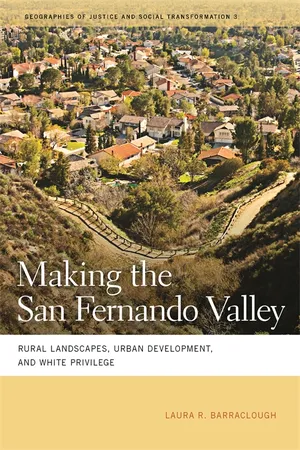
Making the San Fernando Valley
eBook - PDF

Making the San Fernando Valley

Rural Landscapes, Urban Development, and White Privilege

  1. 316 pages
  2. English
  3. PDF
  4. Available on iOS & Android
eBook - PDF

Making the San Fernando Valley

Rural Landscapes, Urban Development, and White Privilege

About this book

In the first book-length scholarly study of the San Fernando Valley—home to one-third of the population of Los Angeles—Laura R. Barraclough combines ambitious historical sweep with an on-theground investigation of contemporary life in this iconic western suburb. She is particularly intrigued by the Valley's many rural elements, such as dirt roads, tack-and-feed stores, horse-keeping districts, citrus groves, and movie ranches. Far from natural or undeveloped spaces, these rural characteristics are, she shows, the result of deliberate urbanplanning decisions that have shaped the Valley over the course of more than a hundred years.

The Valley's entwined history of urban development and rural preservation has real ramifications today for patterns of racial and class inequality and especially for the evolving meaning of whiteness. Immersing herself in meetings of homeowners' associations, equestrian organizations, and redistricting committees, Barraclough uncovers the racial biases embedded in rhetoric about "open space" and "western heritage." The Valley's urban cowboys enjoy exclusive, semirural landscapes alongside the opportunities afforded by one of the world's largest cities. Despite this enviable position, they have at their disposal powerful articulations of both white victimization and, with little contradiction, color-blind politics.

Frequently asked questions

Yes, you can cancel anytime from the Subscription tab in your account settings on the Perlego website. Your subscription will stay active until the end of your current billing period. Learn how to cancel your subscription.
At the moment all of our mobile-responsive ePub books are available to download via the app. Most of our PDFs are also available to download and we're working on making the final remaining ones downloadable now. Learn more here.
Perlego offers two plans: Essential and Complete
  • Essential is ideal for learners and professionals who enjoy exploring a wide range of subjects. Access the Essential Library with 800,000+ trusted titles and best-sellers across business, personal growth, and the humanities. Includes unlimited reading time and Standard Read Aloud voice.
  • Complete: Perfect for advanced learners and researchers needing full, unrestricted access. Unlock 1.4M+ books across hundreds of subjects, including academic and specialized titles. The Complete Plan also includes advanced features like Premium Read Aloud and Research Assistant.
Both plans are available with monthly, semester, or annual billing cycles.
We are an online textbook subscription service, where you can get access to an entire online library for less than the price of a single book per month. With over 1 million books across 1000+ topics, we’ve got you covered! Learn more here.
Look out for the read-aloud symbol on your next book to see if you can listen to it. The read-aloud tool reads text aloud for you, highlighting the text as it is being read. You can pause it, speed it up and slow it down. Learn more here.
Yes! You can use the Perlego app on both iOS or Android devices to read anytime, anywhere — even offline. Perfect for commutes or when you’re on the go.
Please note we cannot support devices running on iOS 13 and Android 7 or earlier. Learn more about using the app.
Yes, you can access Making the San Fernando Valley by Laura Barraclough, Andrew Herod, Melissa Wright, Nik Heynen in PDF and/or ePUB format, as well as other popular books in Politics & International Relations & City Planning & Urban Development. We have over one million books available in our catalogue for you to explore.

Table of contents

  1. Contents
  2. List of Illustrations
  3. Acknowledgments
  4. Introduction
  5. PART ONE: Creating the Foundations of Rural Whiteness, 1900–1960
  6. PART TWO: Consolidating Rural Whiteness, 1960–2000
  7. PART THREE: Rural Whiteness in the Twenty-first Century
  8. Conclusion
  9. Notes
  10. Bibliography
  11. Index