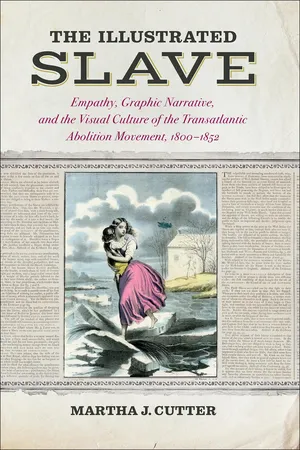
The Illustrated Slave
eBook - ePub

The Illustrated Slave

Empathy, Graphic Narrative, and the Visual Culture of the Transatlantic Abolition Movement, 1800–1852

  1. 312 pages
  2. English
  3. ePUB (mobile friendly)
  4. Available on iOS & Android
eBook - ePub

The Illustrated Slave

Empathy, Graphic Narrative, and the Visual Culture of the Transatlantic Abolition Movement, 1800–1852

About this book

From the 1787 Wedgwood antislavery medallion featuring the image of an enchained and pleading black body to Quentin Tarantino's Django Unchained (2012) and Steve McQueen's Twelve Years a Slave (2013), slavery as a system of torture and bondage has fascinated the optical imagination of the transatlantic world. Scholars have examined various aspects of the visual culture that was slavery, including its painting, sculpture, pamphlet campaigns, and artwork. Yet an important piece of this visual culture has gone unexamined: the popular and frequently reprinted antislavery illustrated books published prior to Harriet Beecher Stowe's Uncle Tom's Cabin (1852) that were utilized extensively by the antislavery movement in the first half of the nineteenth century.

The Illustrated Slave analyzes some of the more innovative works in the archive of antislavery illustrated books published from 1800 to 1852 alongside other visual materials that depict enslavement. Martha J. Cutter argues that some illustrated narratives attempt to shift a viewing reader away from pity and spectatorship into a mode of empathy and interrelationship with the enslaved. She also contends that some illustrated books characterize the enslaved as obtaining a degree of control over narrative and lived experiences, even if these figurations entail a sense that the story of slavery is beyond representation itself. Through exploration of famous works such as Uncle Tom's Cabin, as well as unfamiliar ones by Amelia Opie, Henry Bibb, and Henry Box Brown, she delineates a mode of radical empathy that attempts to destroy divisions between the enslaved individual and the free white subject and between the viewer and the viewed.

Frequently asked questions

Yes, you can cancel anytime from the Subscription tab in your account settings on the Perlego website. Your subscription will stay active until the end of your current billing period. Learn how to cancel your subscription.
No, books cannot be downloaded as external files, such as PDFs, for use outside of Perlego. However, you can download books within the Perlego app for offline reading on mobile or tablet. Learn more here.
Perlego offers two plans: Essential and Complete
  • Essential is ideal for learners and professionals who enjoy exploring a wide range of subjects. Access the Essential Library with 800,000+ trusted titles and best-sellers across business, personal growth, and the humanities. Includes unlimited reading time and Standard Read Aloud voice.
  • Complete: Perfect for advanced learners and researchers needing full, unrestricted access. Unlock 1.4M+ books across hundreds of subjects, including academic and specialized titles. The Complete Plan also includes advanced features like Premium Read Aloud and Research Assistant.
Both plans are available with monthly, semester, or annual billing cycles.
We are an online textbook subscription service, where you can get access to an entire online library for less than the price of a single book per month. With over 1 million books across 1000+ topics, we’ve got you covered! Learn more here.
Look out for the read-aloud symbol on your next book to see if you can listen to it. The read-aloud tool reads text aloud for you, highlighting the text as it is being read. You can pause it, speed it up and slow it down. Learn more here.
Yes! You can use the Perlego app on both iOS or Android devices to read anytime, anywhere — even offline. Perfect for commutes or when you’re on the go.
Please note we cannot support devices running on iOS 13 and Android 7 or earlier. Learn more about using the app.
Yes, you can access The Illustrated Slave by Martha J. Cutter in PDF and/or ePUB format, as well as other popular books in Social Sciences & North American History. We have over one million books available in our catalogue for you to explore.

Table of contents

  1. Cover
  2. Title Page
  3. Copyright Page
  4. Contents
  5. Acknowledgments
  6. Preface
  7. Introduction: Visualizing Slavery and Slave Torture
  8. Chapter One: Precursors: Picturing the Story of Slavery in Broadsides, Pamphlets, and Early Illustrated Graphic Works about Slavery, 1793–1812
  9. Chapter Two: ā€œThese Loathsome Pictures Shall Be Publishedā€: Reconfigurations of the Optical Regime of Transatlantic Slavery in Amelia Opie’s The Black Man’s Lament (1826) and George Bourne’s Picture of Slavery in the United States of America (1834)
  10. Chapter Three: Entering and Exiting the Sensorium of Slave Torture: A Narrative of the Adventures and Escape of Moses Roper, from American Slavery (1837, 1838) and the Visual Culture of the Slave’s Body in the Transatlantic Abolition Movement
  11. Chapter Four: Structuring a New Abolitionist Reading of Masculinity and Femininity: The Graphic Narrative Systems of Lydia Maria Child’s Joanna (1838) and Henry Bibb’s Narrative of the Life and Adventures of Henry Bibb, an American Slave, Written by Himself (1849)
  12. Chapter Five: After Tom: Illustrated Books, Panoramas, and the Staging of the African American Enslaved Body in Uncle Tom’s Cabin (1852) and the Performance Work of Henry Box Brown (1849–1875)
  13. Epilogue: The End of Empathy, or Slavery Revisited via Twentieth- and Twenty-First-Century Artworks
  14. Appendix: Hierarchical and Parallel Empathy
  15. Notes
  16. Bibliography
  17. Index