The Dinner Party
eBook - ePub

The Dinner Party

Judy Chicago and the Power of Popular Feminism, 1970-2007

  1. 360 pages
  2. English
  3. ePUB (mobile friendly)
  4. Available on iOS & Android
eBook - ePub

The Dinner Party

Judy Chicago and the Power of Popular Feminism, 1970-2007

About this book

Judy Chicago's monumental art installation The Dinner Party was an immediate sensation when it debuted in 1979, and today it is considered the most popular work of art to emerge from the second-wave feminist movement. Jane F. Gerhard examines the piece's popularity to understand how ideas about feminism migrated from activist and intellectual circles into the American mainstream in the last three decades of the twentieth century.

More than most social movements, feminism was transmitted and understood through culture—art installations, Ms. Magazine, All in the Family, and thousands of other cultural artifacts. But the phenomenon of cultural feminism came under extraordinary criticism in the late 1970s and 1980s Gerhard analyzes these divisions over whether cultural feminism was sufficiently activist in light of the shifting line separating liberalism from radicalism in post-1970s America. She concludes with a chapter on the 1990s, when The Dinner Party emerged as a target in political struggles over public funding for the arts, even as academic feminists denounced the piece for its alleged essentialism.

The path that The Dinner Party traveled—from inception (1973) to completion (1979) to tour (1979-1989) to the permanent collection of the Brooklyn Museum (2007)—sheds light on the history of American feminism since 1970 and on the ways popular feminism in particular can illuminate important trends and transformations in the broader culture.

Frequently asked questions

Yes, you can cancel anytime from the Subscription tab in your account settings on the Perlego website. Your subscription will stay active until the end of your current billing period. Learn how to cancel your subscription.
At the moment all of our mobile-responsive ePub books are available to download via the app. Most of our PDFs are also available to download and we're working on making the final remaining ones downloadable now. Learn more here.
Perlego offers two plans: Essential and Complete
  • Essential is ideal for learners and professionals who enjoy exploring a wide range of subjects. Access the Essential Library with 800,000+ trusted titles and best-sellers across business, personal growth, and the humanities. Includes unlimited reading time and Standard Read Aloud voice.
  • Complete: Perfect for advanced learners and researchers needing full, unrestricted access. Unlock 1.4M+ books across hundreds of subjects, including academic and specialized titles. The Complete Plan also includes advanced features like Premium Read Aloud and Research Assistant.
Both plans are available with monthly, semester, or annual billing cycles.
We are an online textbook subscription service, where you can get access to an entire online library for less than the price of a single book per month. With over 1 million books across 1000+ topics, we’ve got you covered! Learn more here.
Look out for the read-aloud symbol on your next book to see if you can listen to it. The read-aloud tool reads text aloud for you, highlighting the text as it is being read. You can pause it, speed it up and slow it down. Learn more here.
Yes! You can use the Perlego app on both iOS or Android devices to read anytime, anywhere — even offline. Perfect for commutes or when you’re on the go.
Please note we cannot support devices running on iOS 13 and Android 7 or earlier. Learn more about using the app.
Yes, you can access The Dinner Party by Jane Gerhard, Claire Potter, Renee Romano in PDF and/or ePUB format, as well as other popular books in History & 21st Century History. We have over one million books available in our catalogue for you to explore.

Notes

INTRODUCTION

1. Susan Hill, interview with author, July 2011.
2. See Gail Levin, Becoming Judy Chicago: A Biography of the Artist (New York: Harmony Books, 2007); Laura Meyer, “A Studio of Their Own: The Legacy of the Fresno Feminist Experiment,” in Laura Meyer, ed., with essays by Laura Meyer and Faith Wilding, A Studio of Their Own: The Legacy of the Fresno Feminist Experiment, (Fresno: Press at the California State University, Fresno, 2009); Edward Lucie-Smith, Judy Chicago: An American Vision (New York: Watson-Guptill Publications, 2000).
3. Judy Chicago, Through the Flower: My Struggle as a Woman Artist (New York: Penguin, 1975), 55.
4. Lisa Gail Collins and Margo Natalie Crawford, eds., New Thoughts on the Black Arts Movement (New Brunswick, N.J.: Rutgers University, 2006); Scott Kurashige, The Shifting Grounds of Race: Black and Japanese Americans in the Making of Multicultural Los Angeles (Princeton, N.J.: Princeton University Press, 2010); Laura Pulido, Black, Brown, Yellow, and Left: Radical Activism in Los Angeles (Berkeley: University of California Press, 2006).
5. This compressed biography is based on Levin, Becoming Judy Chicago, and Judy Chicago, Through the Flower.
6. Michael Kammen, Visual Shock: A History of Art Controversies in American Culture (New York: Vintage Press, 2006), 181.
7. Ibid., 183.
8. Susan Sontag, “Against Interpretation,” in Against Interpretation and Other Essays (New York: Basic Books, 1966), 268; Lucy Lippard, A Different War: Vietnam in Art (Bellingham, Wash.: Whatcom Museum of History and Art, and Seattle, Wash.: Real Comet Press, 1990).
9. Levin, Becoming Judy Chicago, 117.
10. Michael Kammen, Visual Shock: A History of Art Controversies in American Culture (New York: Vintage Press, 2006), 181.
11. Kellie Jones, “Black West, Thoughts on Art in Los Angeles,” in Lisa Gail Collins and Margo Natalie Crawford, eds., New Thoughts on the Black Arts Movement (New Brunswick, N.J.: Rutgers University, 2006), 43–74.
12. Vivien Green Fryd, “Suzanne Lacy’s Three Weeks in May: Feminist Activist Performance Art as “Expanded Public Pedagogy,” NWSA Journal 19, no. 1 (spring 2007): 23–38.
13. Gallery 32 and Its Circle, organized by Carolyn Peter, director and curator of the Laband Art Gallery, and Damon Willick, assistant professor of modern and contemporary art history, Loyola Marymount University, 2008.
14. “A Date with Judy: Dialogue with Judy Chicago, Suzanne Lacy and Faith Wilding,” unpublished article for Images and Issues, 1980—letter dated December 26, 1980, 6.
15. Ibid., 4.
16. Lisa Gail Collins, “The Art of Transformation: Parallels in the Black Arts and Feminist Art Movements,” in Lisa Gail Collins and Margo Natalie Crawford, eds., New Thoughts on the Black Arts Movement (New Brunswick, N.J.: Rutgers University, 2006), 273–96.
17. My approach to the consumer market is informed by Elizabeth Chin, Purchasing Power: Black Kids and American Consumer Culture (Minneapolis: University of Minnesota Press, 2001); Thomas Frank, The Conquest of Cool: Business Culture, Counterculture, and the Rise of Hip Consumerism (Chicago: University of Chicago Press, 1997); Marilyn Halter, Shopping for Identity: The Marketing of Ethnicity (New York: Schocken Books 2000); John Seabrook, Nobrow: The Culture of Marketing, the Marketing of Culture (New York: Vintage Press, 2000).
18. Feminist engagement with popular culture is extensive. Here are a few that have informed my approach: Kim Akass and Janet McCabe, eds., Reading “The L Word” (London: I. B. Tauris, 2006); Alice Echols, Hot Stuff: Disco and the Remaking of American Culture (New York: Norton, 2010); Barbara Ehrenreich, Elizabeth Hess, Gloria Jacobs, Remaking Love: The Feminization of Sex (Garden City, N.J.: Anchor Press, 1987); Sarah Gamble, ed., Feminism and Postfeminism (New York: Routledge, 1998); Laura Grindstaff, The Money Shot: Trash, Class and the Making of TV Talk Shows (Chicago: University of Chicago Press, 2002); Molly Haskell, From Reverence to Rape: The Treatment of Women in the Movies (Chicago: University of Chicago Press, 3rd ed., 1987); Astrid Henry, Not My Mother’s Sister: Generational Conflict and Third-Wave Feminism (Bloomington: Indiana University Press, 2004); Mandy Merck, Naomi Segal, Elizabeth Wright, Coming Out of Feminism? (London: Blackwell Press 1998); Susan Jeffords, The Remasculinization of America: Gender and the Vietnam War (Bloomington: Indiana University, 1989); Merri Lisa Johnson, ed., Third Wave Feminism and Television: Jane Puts It in a Box (London: I. B. Tauris, 2007); Tania Modleski, Feminism without Women: Culture and Criticism in a “Postfeminist” Age (New York: Routledge, 1991)...
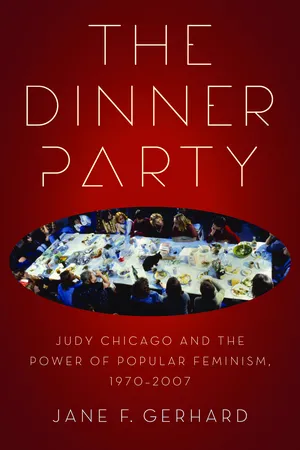
Table of contents

  1. Cover Page
  2. Title Page
  3. Copyright Page
  4. Contents
  5. Acknowledgments
  6. Introduction Toward a Cultural History of The Dinner Party
  7. One Making Feminist Artists: The Feminist Art Programs of Fresno and CalArts, 1970–1972
  8. Two Making Feminist Art: Womanhouse and the Feminist Art Movement, 1972–1974
  9. Three The Studio as a Feminist Space: Practicing Feminism at The Dinner Party, 1975–1979
  10. Four Joining Forces: Making Art and History at The Dinner Party, 1975–1979
  11. Five Going Public: The Dinner Party in San Francisco, 1979
  12. Six The Tour That Very Nearly Wasn’t: The Dinner Party’s Alternative Showings, 1980–1983
  13. Seven Debating Feminist Art: The Dinner Party in Published and Unpublished Commentary, 1979–1989
  14. Eight From Controversy to Canonization: The Dinner Party in the Culture Wars, 1990–2007
  15. Epilogue A Prehistory of Postfeminism
  16. Notes
  17. Index