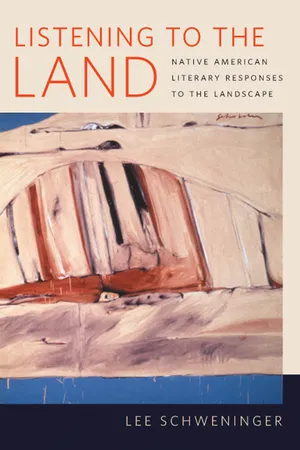
Listening to the Land
eBook - PDF

Listening to the Land

Native American Literary Responses to the Landscape

  1. 256 pages
  2. English
  3. PDF
  4. Available on iOS & Android
eBook - PDF

Listening to the Land

Native American Literary Responses to the Landscape

About this book

For better or worse, representations abound of Native Americans as a people with an innate and special connection to the earth. This study looks at the challenges faced by Native American writers who confront stereotypical representations as they assert their own ethical relationship with the earth. Lee Schweninger considers a range of genres (memoirs, novels, stories, essays) by Native writers from various parts of the United States. Contextualizing these works within the origins, evolution, and perpetuation of the "green" labels imposed on American Indians, Schweninger shows how writers often find themselves denying some land ethic stereotypes while seeming to embrace others.

Taken together, the time periods covered in Listening to the Land span more than a hundred years, from Luther Standing Bear's description of his late-nineteenth-century life on the prairie to Linda Hogan's account of a 1999 Makah hunt of a gray whale. Two-thirds of the writers Schweninger considers, however, are well-known voices from the second half of the twentieth century, including N. Scott Momaday, Louise Erdrich, Vine Deloria Jr., Gerald Vizenor, and Louis Owens.

Few ecocritical studies have focused on indigenous environmental attitudes, in comparison to related work done by historians and anthropologists. Listening to the Land will narrow this gap in the scholarship; moreover, it will add individual Native American perspectives to an understanding of what, to these writers, is a genuine Native American philosophy regarding the land.

Frequently asked questions

Yes, you can cancel anytime from the Subscription tab in your account settings on the Perlego website. Your subscription will stay active until the end of your current billing period. Learn how to cancel your subscription.
At the moment all of our mobile-responsive ePub books are available to download via the app. Most of our PDFs are also available to download and we're working on making the final remaining ones downloadable now. Learn more here.
Perlego offers two plans: Essential and Complete
  • Essential is ideal for learners and professionals who enjoy exploring a wide range of subjects. Access the Essential Library with 800,000+ trusted titles and best-sellers across business, personal growth, and the humanities. Includes unlimited reading time and Standard Read Aloud voice.
  • Complete: Perfect for advanced learners and researchers needing full, unrestricted access. Unlock 1.4M+ books across hundreds of subjects, including academic and specialized titles. The Complete Plan also includes advanced features like Premium Read Aloud and Research Assistant.
Both plans are available with monthly, semester, or annual billing cycles.
We are an online textbook subscription service, where you can get access to an entire online library for less than the price of a single book per month. With over 1 million books across 1000+ topics, we’ve got you covered! Learn more here.
Look out for the read-aloud symbol on your next book to see if you can listen to it. The read-aloud tool reads text aloud for you, highlighting the text as it is being read. You can pause it, speed it up and slow it down. Learn more here.
Yes! You can use the Perlego app on both iOS or Android devices to read anytime, anywhere — even offline. Perfect for commutes or when you’re on the go.
Please note we cannot support devices running on iOS 13 and Android 7 or earlier. Learn more about using the app.
Yes, you can access Listening to the Land by Lee Schweninger in PDF and/or ePUB format, as well as other popular books in Literature & North American Literary Criticism. We have over one million books available in our catalogue for you to explore.

Table of contents

  1. Contents
  2. Acknowledgments
  3. Introduction: An Ethical Regard for the Land
  4. One. The Land Ethic Stereotype: American Indian Wisdom
  5. Two. Where the Buffalo Roam: Iconoclasts and Romantics
  6. Three. Between the People and the Land: Luther Standing Bear, Mother Earth, and Assimilation
  7. Four. Talking Back: John Joseph Mathews and Talking to the Moon
  8. Five. “She Gives Me a Metaphor”: Survival and Louise Erdrich’s The Blue Jay’s Dance
  9. Six. Cultural Identity, Storytelling, Place: Revision and Return in Louis Owens’s Wolfsong
  10. Seven. “From the Land Itself”: Momaday’s Language, Landscape, and Land Ethic
  11. Eight. Living with the Land: Deloria, Landscape, and Religion
  12. Nine. Liberation and the Land: The Environmental Ethos of Gerald Vizenor
  13. Ten. “Changed by the Wild”: Linda Hogan’s Spirit of Renewal
  14. Eleven. Killing the Whale: Sightings and the Makah Hunt
  15. Works Cited
  16. Index