While Louis W. Sullivan was a student at Morehouse College, Morehouse president Benjamin Mays said something to the student body that stuck with him for the rest of his life. "The tragedy of life is not failing to reach our goals," Mays said. "It is not having goals to reach."
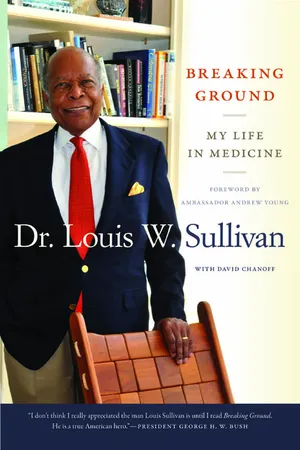
In Breaking Ground, Sullivan recounts his extraordinary life beginning with his childhood in Jim Crow south Georgia and continuing through his trailblazing endeavors training to become a physician in an almost entirely white environment in the Northeast, founding and then leading the Morehouse School of Medicine in Atlanta, and serving as secretary of Health and Human Services in President George H. W. Bush's administration. Throughout this extraordinary life Sullivan has passionately championed both improved health care and increased access to medical professions for the poor and people of color.
At five years old, Louis Sullivan declared to his mother that he wanted to be a doctor. Given the harsh segregation in Blakely, Georgia, and its lack of adequate schools for African Americans at the time, his parents sent Louis and his brother, Walter, to Savannah and later Atlanta, where greater educational opportunities existed for blacks.
After attending Booker T. Washington High School and Morehouse College, Sullivan went to medical school at Boston University—he was the sole African American student in his class. He eventually became the chief of hematology there until Hugh Gloster, the president of Morehouse College, presented him with an opportunity he couldn't refuse: Would Sullivan be the founding dean of Morehouse's new medical school? He agreed and went on to create a state-of-the-art institution dedicated to helping poor and minority students become doctors. During this period he established long-lasting relationships with George H. W. and Barbara Bush that would eventually result in his becoming the secretary of Health and Human Services in 1989.
Sullivan details his experiences in Washington dealing with the burgeoning AIDS crisis, PETA activists, and antismoking efforts, along with his efforts to push through comprehensive health care reform decades before the Affordable Care Act. Along the way his interactions with a cast of politicos, including Thurgood Marshall, Jack Kemp, Clarence Thomas, Jesse Helms, and the Bushes, capture vividly a particular moment in recent history.
Sullivan's life—from Morehouse to the White House and his ongoing work with medical students in South Africa—is the embodiment of the hopes and progress that the civil rights movement fought to achieve. His story should inspire future generations—of all backgrounds—to aspire to great things.
- 288 pages
- English
- ePUB (mobile friendly)
- Available on iOS & Android
eBook - ePub
About this book
Information
Publisher
University of Georgia PressYear
2014Print ISBN
9780820349381
9780820346632
eBook ISBN
9780820346939
Topic
MedicineSubtopic
Medicine BiographiesTable of contents
- Cover Page
- Title Page
- Copyright Page
- Dedication
- Contents
- Foreword
- Chapter 1. Blakely, Georgia
- Chapter 2. Morehouse College
- Chapter 3. Medical Student
- Chapter 4. The Kamikaze School of Medicine
- Chapter 5. Professor
- Chapter 6. An Offer
- Chapter 7. Founding Dean
- Chapter 8. Morehouse School of Medicine
- Chapter 9. President Bush Calls
- Chapter 10. Mr. Secretary
- Chapter 11. Reforming Health Care
- Chapter 12. Morehouse, a Model Black Institution
- Chapter 13. Missing Persons
- Epilogue
- Acknowledgments
- Index
Trusted by 375,005 students
Access to over 1.5 million titles for a fair monthly price.
Study more efficiently using our study tools.
Frequently asked questions
Yes, you can cancel anytime from the Subscription tab in your account settings on the Perlego website. Your subscription will stay active until the end of your current billing period. Learn how to cancel your subscription
No, books cannot be downloaded as external files, such as PDFs, for use outside of Perlego. However, you can download books within the Perlego app for offline reading on mobile or tablet. Learn how to download books offline
Perlego offers two plans: Essential and Complete
- Essential is ideal for learners and professionals who enjoy exploring a wide range of subjects. Access the Essential Library with 800,000+ trusted titles and best-sellers across business, personal growth, and the humanities. Includes unlimited reading time and Standard Read Aloud voice.
- Complete: Perfect for advanced learners and researchers needing full, unrestricted access. Unlock 1.5M+ books across hundreds of subjects, including academic and specialized titles. The Complete Plan also includes advanced features like Premium Read Aloud and Research Assistant.
We are an online textbook subscription service, where you can get access to an entire online library for less than the price of a single book per month. With over 1.5 million books across 990+ topics, we’ve got you covered! Learn about our mission
Look out for the read-aloud symbol on your next book to see if you can listen to it. The read-aloud tool reads text aloud for you, highlighting the text as it is being read. You can pause it, speed it up and slow it down. Learn more about Read Aloud
Yes! You can use the Perlego app on both iOS and Android devices to read anytime, anywhere — even offline. Perfect for commutes or when you’re on the go.
Please note we cannot support devices running on iOS 13 and Android 7 or earlier. Learn more about using the app
Please note we cannot support devices running on iOS 13 and Android 7 or earlier. Learn more about using the app
Yes, you can access Breaking Ground by Louis Sullivan, David Chanoff in PDF and/or ePUB format, as well as other popular books in Medicine & Medicine Biographies. We have over 1.5 million books available in our catalogue for you to explore.