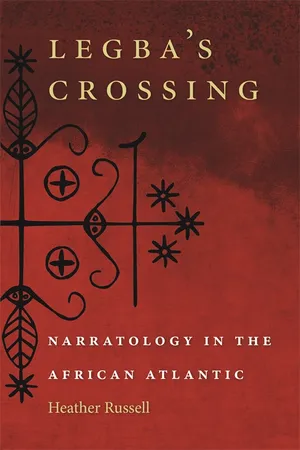
In Haiti, Papa Legba is the spirit whose permission must be sought to communicate with the spirit world. He stands at and for the crossroads of language, interpretation, and form and is considered to be like the voice of a god. In Legba's Crossing, Heather Russell examines how writers from the United States and the anglophone Caribbean challenge conventional Western narratives through innovative use, disruption, and reconfiguration of form.
Russell's in-depth analysis of the work of James Weldon Johnson, Audre Lorde, Michelle Cliff, Earl Lovelace, and John Edgar Wideman is framed in light of the West African aesthetic principle of àshe, a quality ascribed to art that transcends the prescribed boundaries of form. Àshe is linked to the characteristics of improvisation and flexibility that are central to jazz and other art forms. Russell argues that African Atlantic writers self-consciously and self-reflexively manipulate dominant forms that prescribe a certain trajectory of, for example, enlightenment, civilization, or progress. She connects this seemingly postmodern meta-analysis to much older West African philosophy and its African Atlantic iterations, which she calls "the Legba Principle."