![]()
This Compost
ECOLOGICAL IMPERATIVES
IN AMERICAN POETRY
Jed Rasula
![]()
Contents
Preface
Acknowledgments
Introduction
Gilgamesh
The library
Generation
The tropics, & the trope
Cinders
Vomito cogito
That origin which is act … that riddle which is awe
The archaic and the old lore
Indian skin
On the extremest verge
The rim, the sediment
Necropoetics
Muses’ archetext
A skin of mouths
The vessel
Nigredo
From Saturn to Demeter
Milk light
The floor of the upside down
The starry horizon
The frozen being
Emanation
Memoranda and signatures
Proprioception
Vertigo
Characters
Language obeyed
Pestilence
De rerum natura: epic’s lyric absolute
Ghosts of inner ecology
Origin
Detritus pathways
Scruples & superstition
Psychosm
Superfluity
The empty house
The times promised
The uninterrupted tissue
Citations
Bibliography
Biographical Glossary
Index
![]()
Preface
This Compost combines several functions in one. It is an anthology of sorts, concentrating on the Black Mountain lineage in modern American poetry, though with plenty of related extracts going back to Whitman and Dickinson. But anthologies invariably reflect judgments of taste, and This Compost neither argues the priority of, nor attempts to canonize, a particular set of poets. Insofar as I take poetry to be something more than the exercise of aesthetic self-expression, there are tacit limits to the poets included here. Robert Creeley reports Allen Ginsberg urging, “You don’t really have to worry about writing a good poem any more, you can write what you want to” (Faas, 187). While Creeley overestimates will, the peculiar energy I find in the poets in This Compost is their willingness to work outside prevailing literary sensibility. Often the very look of the poems discloses a sculptural address, or a kinetic choreography attentive to organism, not decorum. As a compendium of extracts, this book does not validate aesthetic claims commonly made in literary criticism so much as document a stance toward the living planet, a stance these poets share with many people who know nothing of poetry.
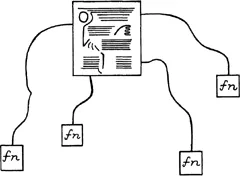
Despite its length, This Compost is also an essay. There are no chapters as such; rather, the headings indicate topoi in the old rhetorical sense : sites of excavation and deliberation. While they are arranged to be read chronologically, the method is somewhat circular, so the reader will find certain topoi recurring in a seasonal rotation. Footnotes appear at the bottom of the page because I write that way; I favor a bifocal prospect, atavistic residue perhaps of hunting and tracking instincts. Ed Sanders says “A footnote is a dangling data-cluster” and compares it to a mobile by Alexander Calder. I like the quadruped diagram Sanders provides (“The Art of the Elegant Footnote,” in Thirsting for Peace in a Raging Century, 162).
As an exercise in ecological solidarity with the materials it conveys, This Compost practices what it preaches in that most of the citations of poetry are not identified in the text, but blended into polyphonic configurations. Sometimes what is given as a single poetic citation is assembled from several poets or poems—although different extracts are always indicated by a marker (~) at the right-hand margin. All sources from books of poetry are clearly identified at the end of the book, in the citations chapter (pp. 201–2). Quoted prose, on the other hand, is identified parenthetically in the text. (Citation from prose poems complicates matters; but if no reference is given in the text, you can bet it’s a prose poem referenced in the citations chapter.) I have taken the liberty of not citing pre-twentieth-century work by page number, since there are so many editions. But the originals—from Emerson’s prose, Whitman’s poetry, or early modern authors like Thomas Browne—tend to be concise or conveniently divided. So extracts from Whitman are identified by section numbers (in the numbering of Whitman’s final “deathbed” edition), and in the case of prose writers I provide chapter or section indicators.
The origins of my citational practice are also the origins of This Compost in that I initially noticed thematic congruencies specific to some primary books published in 1960—The Distances by Charles Olson and The Opening of the Field by Robert Duncan—which led to comparisons with work by Jack Spicer and Louis Zukofsky, among others. The notion of “composition by field” carried obvious implications of compost, which led me to the concept of “necropoetics” developed here by way of Whitman. The notion of a “compost library” arose when I began carefully placing certain extracts side by side without authorial distinction. It’s worth recalling that this tactic was also indebted to those influential if too easily misconstrued essays by Roland Barthes (“The Death of the Author”) and Michel Foucault (“What Is an Author?”), along with the notion of intertextuality developed by Julia Kristeva and Barthes.* Eventually, I recognized the implications for a body of poetry written in and for a community, however loosely defined. Readership was tantamount to collaboration; authorship, in turn, extended far beyond specific acts of writing.
The bibliography includes titles cited or mentioned in the text. Additional titles appear in the biographical glossary, which consists of thumbnail sketches of the poets most prominent in This Compost. The resources used here vary considerably, having much to do with the span of time during which This Compost was written. At the outset, in 1980, there were no standard editions of most of the work I deal with here*—and some of it was still appearing in little magazines—but in the intervening decades they have proliferated (University of California Press doing the lion’s share, issuing The Maximus Poems, “A,” Creeley’s Collected Poems, and numerous other titles by Olson, Zukofsky, and Creeley). I have been able to make use of these and some other definitive collections (like those of Robinson Jeffers [Stanford] and William Carlos Williams [New Directions]), but it proved too much to keep adapting to all the reissues and new editions as they appeared. So, as much as I appreciate the editorial labors of Ben Friedlander and Donald Allen, I have not cited from their edition of Olson’s Collected Prose (which, in any case, omits many texts central to This Compost); nor have I gone beyond the 1972 edition of Pound’s Cantos. I deliberately chose some earlier versions of “Image-Nations” by Robin Blaser over those included in his magnum opus, The Holy Forest (readers will find the appropriate distinctions in the citations). And I decided to stick with In Cold Hell, in Thicket and The Distances as a way of emphasizing Olson’s own arrangement of the poems, despite the fine chronological presentation in the Collected.
This Compost is not altogether a scholarly project. It represents instead an intersection of communities. It might be regarded as an instance of “poet’s prose,” on the model of Robert Duncan’s copious “H. D. Book,” and my ongoing participation in an extensive network of poets has informed the project at every step. It also bears traces of involvement in the milieu of archetypal psychology, culminating at a 1981 conference in Buffalo where the Jungians were treated to memorable readings by Creeley and Duncan. I might also trace the book’s origins to a radio program I hosted in Los Angeles on the Pacifica station KPFK (fm) from 1979 to 1981, ostensibly a book review format that evolved into a lecture series. On the first program I reviewed Zukofsky’s newly published “A.” I didn’t cover much poetry (Hades in Manganese by Clayton Eshleman and Ark : The Foundations by Ronald Johnson were the only ones besides “A”); instead, I delved into the historical and political spectrum that This Compost draws on. Among the many books I “reviewed” on KPFK were The Dream and the Underworld by James Hillman, Keepers of the Game by Calvin Martin, Iron Cages by Ronald Takaki, Discoverers, Settlers, Explorers by Wayne Franklin, The Economics of the Imagination by Kurt Heinzelman, American Hieroglyphics by John Irwin, Beyond Geography by Frederick Turner, The Real Work by Gary Snyder, The Geography of the Imagination by Guy Davenport, Extinction by Paul and Anne Ehrlich, Laying Waste : The Poisoning of America by Toxic Chemicals by Michael Brown, The Age of Surveillance by Frank Donner, The Legacy of Malthus by Allan Chase, and Empire as a Way of Life by William A. Williams. Not all of the above ended up being cited in This Compost, but they guided drafts and suggested the territory.
![]()
Acknowledgments
For early interest and support I am indebted to Charles Bernstein, Burton Hatlen, and James Hillman, who published extracts in L=A=N=G=U=A=G=E / Open Letter (1982), Sagetrieb (1982...