- 336 pages
- English
- ePUB (mobile friendly)
- Available on iOS & Android
eBook - ePub
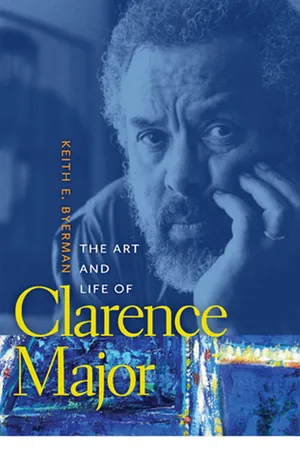
The Art and Life of Clarence Major
Trusted by 375,005 students
Access to over 1.5 million titles for a fair monthly price.
Study more efficiently using our study tools.
Information
Publisher
University of Georgia PressYear
2012Print ISBN
9780820349824
9780820330556
eBook ISBN
9780820343662
Topic
ArteSubtopic
Biografie in ambito artistico
The Art and Life of Clarence Major

Contents
List of Illustrations
Acknowledgments
Introduction. Performing Transgression, Seeking Community
ONE Breaking Boundaries: A Family History
TWO Becoming an Artist
THREE Making It in New York
FOUR Beginning a Professional Career, 1975–1980
FIVE The Machinery of Postmodernism
SIX The Art of Postmodernism
SEVEN Finding a New Life
EIGHT Back to America, Back to Europe
NINE Consolidating a Career
Conclusion. Returning to the Beginning
Notes
Bibliography
Index
Illustrations
FIGURES
1. Major’s great-great-grandmother
2. Anna Bowling Major
3. Ada Huff
4. William Henry Huff
5. Clarence Major Sr.
6. Clarence Major Jr., age four
7. Inez in Chicago, 1946
8. The Majors’ first house in Chicago
9. Major in Chicago, 1952
10. Cover of second issue of the Coercion Review
11. Major and Sheila Silverstone in New York, 1968
12. Major, Ishmael Reed, Joe Johnson, Steve Cannon, and Lesley and Chester Himes
13. Outside one of Major’s New York apartments
14. Major’s home in Boulder
15. Russell Banks, Clarence Major, and Jonathan Baumbach, circa 1978
16. Opening image in Emergency Exit
17. Emergency Exit pages
18. Untitled
19. Major at the Parthenon
20. Communist Party Headquarters, Venice
21. Major’s Davis home
PLATES
(following page 140)
1. The Long Road
2. Yellow Chair
3. Grief
4. Dream of Escape
5. Samona
6. Family Togetherness
7. Rhythm of Life
8. Nightwatchman #2
9. Country Boogie
10. Checkers
11. Saturday Afternoon #1
12. Rebecca, My Great-Grandmother
13. Blue City
14. The Woman Who Danced Once with Dustin Hoffman
15. Two Sisters
16. Joan
17. The Mirror
Acknowledgments
I want to express my appreciation to the library staffs at the Archie Givens Sr. Collection at the University of Minnesota and the Harry Ransom Center at the University of Texas for their invaluable assistance with archival materials. The University Research Committee of Indiana State University provided grants to cover both research expenses and some of the costs of printing images. Colleagues at various conferences offered insightful comments as I worked through ideas that became part of this project. Kit Kincade was infinitely patient and thoughtful as I tried to make sense of some of the puzzles and quandaries that go along with writing biography. But my greatest appreciation goes to Clarence Major, who opened his home and his memory banks to provide me with facts, names, and stories that were not available from any other source, and who allowed me to reprint the various images that appear herein. He has been consistently forthcoming, gracious, and encouraging throughout the years it has taken to complete this book.
[ INTRODUCTION
Performing Transgression, Seeking Community
Clarence Major is an artistic renaissance man; he is a painter, fiction writer, poet, essayist, editor, anthologist, lexicographer, and memoirist. For the first three of these, he must be considered a professional. He has pursued them since childhood and has won awards in all three. He has been part of twenty-eight group exhibitions, has had fifteen one-man shows, and has published fourteen collections of poetry and nine works of fiction. Although he has never achieved the fame of other writers of his generation, such as Toni Morrison or Ernest Gaines, he has a substantial reputation among those interested in experimentation in the arts. He is a technician, working and reworking problems in composition in his various arts. He also thinks across genres, such that a poem or novel is fractured or layered like a modern painting or a painting hints at character or narrative.
His life is experimental as well, stabbing out in various directions and toward numerous identities. He has been married four times, has had many jobs, primarily in academia, has established a wide array of contacts throughout the world, has been connected to a number of the avant-garde movements of the last fifty years, and has challenged many of the social and racial conventions of U.S. society. Together, these suggest a man seeking different paths for himself, never content with what is assumed about him or expected of him. He tries out different roles, moves into different circles. At the same time, his is also a very American story of childhood in the rural South and coming-of-age in the urban North, of initiative and persistence in pursuit of a distinctive self and unique career. After a childhood in a broken, abusive Georgia home and a scrambling life as a bohemian artist, he has settled into life as a distinguished author and painter with a beautiful home in the California suburbs. It is the story of this life and career that I wish to tell.
When I was considering what shape this book would take, I had a conversation with Joe Weixlmann, who was then editor of African American Review, about writing a life of Clarence Major. He seemed the logical person to talk to; after all, the journal had done two special issues on Major, and Weixlmann’s areas of expertise are African American literature and contemporary fiction, especially its experimental forms. He warned me that although Major is an intriguing subject, he could also be reticent and distant if he were offended or felt intruded upon. I am grateful that my experience has been very different; he has been responsive to all my questions, both in person and in e-mail correspondence. He has provided names, dates, and explanations, even in matters where he had concealed information in his own autobiographical statements. Sometimes he would reveal things only when I posed very pointed questions. For example, early in my research I was initially confused when comparing the dates of his first two marriages and divorces with the birthdates of his children. Reluctant to raise what might be a sensitive subject, I cautiously asked him directly about the discrepancies. Not offended at all, he very straightforwardly explained that the first two children he had with Olympia Leak were born while he was still married to Joyce Sparrow. Similarly, he has suggested a number of places holding material by and about him and has opened his house (and garage) so that I could see his paintings. He has sent photographs of family members and made copies of works that are not available anywhere else. His cooperation has made it much easier to tell a detailed story of his life and career.
Why has my experience differed so much from Weixlmann’s prediction? I think it very much has to do with what I see as the central theme of Major’s life and career. It is a story of paradox. On the one hand, he has defined both his life and his art as transgressive of conventions. On the other hand, he has sought approval from and connections to those who could appreciate who he is and what he does. Moreover, he is perfectly willing to operate within the mainstream culture as long as his individuality is not compromised. The very publication of this book validates his significance as a person and an artist. Thus, he has been willing to provide what I needed to write it.
The dialectical pattern I am talking about can be found throughout his life and career. From early in life, he seems to have had an outsider sensibility. As a child, he received attention for his writing and drawing rather than for the athletic skills most African American boys were trying to develop in that part of Chicago. In high school, he wrote an unperformable symphony, a television script, and a collection of poems, all of which he tried to get produced or published. When he studied drawing at the Art Institute of Chicago, it was the work of Van Gogh that he admired; he continues into the present to identify that ultimate outsider as his artistic model. When he returned after his time in the air force, he went to clubs uptown in Chicago that were patronized by the bohemian crowd rather than those in his South Side neighborhood. He published a little magazine that included work by Henry Miller and Lawrence Ferlinghetti. His first two marriages were disasters, in part because he was trying unsuccessfully to settle into a middle-class career. His first novel was published by a press that specialized in erotica. He never completed college, at least not in the usual sense, though he received both bachelor’s and doctoral degrees. He persistently has argued that his art defies conventions, even when that unconventionality is not readily apparent.
At the same time, he has sought audiences to approve his efforts. His mother seems to have been a doting parent who filled her house with his youthful paintings. He sent his television script to the producer of a network drama series. He sent letters along with poems and stories not only to editors of little magazines but also to prominent figures such as William Carlos Williams, Ralph Ellison, Isaac Bashevis Singer, and Sheri Martinelli. He participated in various groups, such as the black artists’ group Umbra, the Fiction Collective, and PEN and was willing to use his networks to get his work published and to get jobs. In other words, he combined the romantic notion of the bohemian, outsider artist with maneuvers necessary to garner attention for himself and his art.
In developing this theme, I am not especially interested in linking it tightly to performance theory or to notions of transgression as articulated by postcolonial or gay studies. I am also not making use of a psychoanalytical model, though notions of desire, deprivation, and anxieties about family dynamics are clearly present. Instead, I believe it makes the most sense to follow the model of Major’s own art, in which the self is not one thing or locked into one pattern and in which the art is constantly undergoing revision. In this sense, both self and art are endless experiments in performance, in which some inner drive or impulse engages with the materiality of the world and seeks to gain the approval of whoever is watching or can be enticed to watch. At various times, Major has described his interest in his chosen arts—painting, fiction, poetry—as technical; he identifies problems and seeks interesting ways to solve them. I would suggest that his way of living out his life has been similar; by rejecting (mostly) a conventional life, he generated a set of problems for himself. How does a black man who does not take race as his principal identity, an artist who deliberately defies mainstream rules, a social and cultural critic who wants to be admired by the world he attacks, and a creator who refuses to commit to one expressive form make his way in the world? The task I have set for myself is to follow the multiple layers of problems and solutions in both the work and the life, to consider the successes and the failures.
In the larger sense, while I have focused, especially in the early chapters, on biography, it is the art that holds greater significance. Major has largely avoided the debates about what constitutes African American art and literature by insisting on his own themes and methods, found in whatever sources he came across and could use. He follows in the grand tradition of U.S. artists who find it more important to follow their own path than to accept the road already opened by others. It is also the case, of course, that such artists are also hustlers who have to persuade (or manipulate) others to accept their vision of the way forward. In this case, as in so many, especially in the modern period, that has happened by creating or joining communities of outsiders, those who share a certain view of conventional aesthetic practice.
The case I wish to make is that the patterns of Major’s life helped to determine the patterns of his art. The same combination of attention to others and performance of self-assurance (even if it was a facade) enabled him to attract woman after woman and to get his work published by literary magazines and small presses; it also helped him in entering networks that could lead to employment or publication.
Ultimately, of course, it is the quality of the work that matters. Major’s independence made it possible for him to do things differently, to make art that is distinctive. Because he never has taken race as his primary identity, he had the freedom to create from a variety of plac...
Table of contents
- The Art and Life of Clarence Major
Frequently asked questions
Yes, you can cancel anytime from the Subscription tab in your account settings on the Perlego website. Your subscription will stay active until the end of your current billing period. Learn how to cancel your subscription
No, books cannot be downloaded as external files, such as PDFs, for use outside of Perlego. However, you can download books within the Perlego app for offline reading on mobile or tablet. Learn how to download books offline
Perlego offers two plans: Essential and Complete
- Essential is ideal for learners and professionals who enjoy exploring a wide range of subjects. Access the Essential Library with 800,000+ trusted titles and best-sellers across business, personal growth, and the humanities. Includes unlimited reading time and Standard Read Aloud voice.
- Complete: Perfect for advanced learners and researchers needing full, unrestricted access. Unlock 1.5M+ books across hundreds of subjects, including academic and specialized titles. The Complete Plan also includes advanced features like Premium Read Aloud and Research Assistant.
We are an online textbook subscription service, where you can get access to an entire online library for less than the price of a single book per month. With over 1.5 million books across 990+ topics, we’ve got you covered! Learn about our mission
Look out for the read-aloud symbol on your next book to see if you can listen to it. The read-aloud tool reads text aloud for you, highlighting the text as it is being read. You can pause it, speed it up and slow it down. Learn more about Read Aloud
Yes! You can use the Perlego app on both iOS and Android devices to read anytime, anywhere — even offline. Perfect for commutes or when you’re on the go.
Please note we cannot support devices running on iOS 13 and Android 7 or earlier. Learn more about using the app
Please note we cannot support devices running on iOS 13 and Android 7 or earlier. Learn more about using the app
Yes, you can access The Art and Life of Clarence Major by Keith Byerman in PDF and/or ePUB format, as well as other popular books in Arte & Biografie in ambito artistico. We have over 1.5 million books available in our catalogue for you to explore.