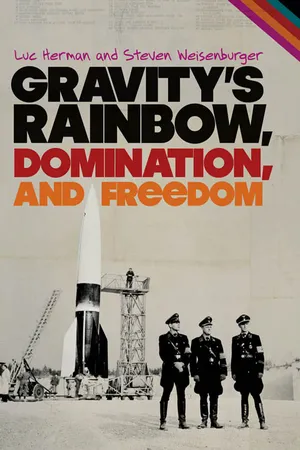
Gravity's Rainbow, Domination, and Freedom
eBook - ePub

Gravity's Rainbow, Domination, and Freedom

  1. 272 pages
  2. English
  3. ePUB (mobile friendly)
  4. Available on iOS & Android
eBook - ePub

Gravity's Rainbow, Domination, and Freedom

About this book

When published in 1973, Gravity's Rainbow expanded our sense of what the novel could be. Pynchon's extensive references to modern science, history, and culture challenged any reader, while his prose bent the rules for narrative art and his satirical practices taunted U.S. obscenity and pornography statutes. His writing thus enacts freedom even as the book's great theme is domination: humanity's diminished "chances for freedom" in a global military-industrial system birthed and set on its feet in World War II. Its symbol: the V-2 rocket.

"Gravity's Rainbow," Domination, and Freedom broadly situates Pynchon's novel in "long sixties" history, revealing a fiction deeply of and about its time. Herman and Weisenburger put the novel's abiding questions about freedom in context with sixties struggles against war, restricted speech rights, ethno-racial oppression, environmental degradation, and subtle new means of social and psychological control. They show the text's close indebtedness to critiques of domination by key postwar thinkers such as Erich Fromm, Herbert Marcuse, and Hannah Arendt. They detail equally powerful ways that sixties countercultural practices—free-speech resistance played out in courts, campuses, city streets, and raucously satirical underground presswork—provide a clearer bearing on Pynchon's own satirical practices and their implicit criticisms.

If the System has jacketed humanity in a total domination, may not a solitary individual still assert freedom? Or has the System captured all—even supposedly immune elites—in an irremediable dominion? Reading Pynchon's main characters and storylines, this study realizes a darker Gravity's Rainbow than critics have been willing to see.

Frequently asked questions

Yes, you can cancel anytime from the Subscription tab in your account settings on the Perlego website. Your subscription will stay active until the end of your current billing period. Learn how to cancel your subscription.
At the moment all of our mobile-responsive ePub books are available to download via the app. Most of our PDFs are also available to download and we're working on making the final remaining ones downloadable now. Learn more here.
Perlego offers two plans: Essential and Complete
  • Essential is ideal for learners and professionals who enjoy exploring a wide range of subjects. Access the Essential Library with 800,000+ trusted titles and best-sellers across business, personal growth, and the humanities. Includes unlimited reading time and Standard Read Aloud voice.
  • Complete: Perfect for advanced learners and researchers needing full, unrestricted access. Unlock 1.4M+ books across hundreds of subjects, including academic and specialized titles. The Complete Plan also includes advanced features like Premium Read Aloud and Research Assistant.
Both plans are available with monthly, semester, or annual billing cycles.
We are an online textbook subscription service, where you can get access to an entire online library for less than the price of a single book per month. With over 1 million books across 1000+ topics, we’ve got you covered! Learn more here.
Look out for the read-aloud symbol on your next book to see if you can listen to it. The read-aloud tool reads text aloud for you, highlighting the text as it is being read. You can pause it, speed it up and slow it down. Learn more here.
Yes! You can use the Perlego app on both iOS or Android devices to read anytime, anywhere — even offline. Perfect for commutes or when you’re on the go.
Please note we cannot support devices running on iOS 13 and Android 7 or earlier. Learn more about using the app.
Yes, you can access Gravity's Rainbow, Domination, and Freedom by Luc Herman, Steven Weisenburger in PDF and/or ePUB format, as well as other popular books in Literature & North American Literary Criticism. We have over one million books available in our catalogue for you to explore.

Index

Abish, Walter, 158
acedia, 1, 207–8
Achtfaden, Horst, 126, 127, 138
adenoid riff, 6, 8, 10, 11, 17, 67
Adorno, Theodore, 58
Advent episode, 109–10, 112–13
Affluent Society, The (Galbraith), 58
“Against Theory” (Michaels and Knapp), 155
Agamben, Giorgio, 15, 144, 145–46, 208–9
al-Awlaki, Anwar, 197, 198
Alphabetical Africa (Abish), 158
Althusser, Louis, 98
“America” (Ginsberg), 40, 206, 211
anthropologists, 155–56
antiwar activism, 4, 206
Antwerp, 214
Anubis (god), 52
Anubis (ship), 77, 78, 96, 121, 122
apocalypse, 216–17
Aquinas, Thomas, 207
Arendt, Hannah, 4, 15, 42, 146
and the camps, 145, 148–49
The Human Condition, 88–89
Origins of Totalitarianism, 88–89, 143, 145, 149
Armies of the Night (Mailer), 59
art, 26, 39–41, 43–44, 48
Art of Poetry (Horace), 40
astrology, 154, 166
Austen, Jane, 74, 171
Austin, J. L., 89
Baartman, Saartjie, 195
“Babysitter, The” (Coover), 158
Bach, Johann Sebastian, 178, 180
Baraka, Amiri, 40, 57
Barber (Rossini), 176–77
Barr, Norman, 207
Barthes, Roland, 155
“Bartleby the Scrivener” (Melville), 201, 208–9, 212, 213, 217
Bauman, Zygmunt, 223n7
Beardsley, Monroe, 155
Beckett, Samuel, 48
Beethoven, Ludwig von, 176, 177, 178, 179, 181
Beethoven: The Man Who Freed Music (Schauffler), 179
behaviorism, 7, 16, 88, 97, 98, 149
Bell, Daniel, 42
Benito Cereno (Melville),...

Table of contents

  1. Cover Page
  2. Title Page
  3. Copyright Page
  4. Contents
  5. Acknowledgments
  6. “What’s Free?” (An Introduction)
  7. One. Novel and Decade
  8. Two. Domination
  9. Three. Freedom
  10. “Too Late” (A Conclusion)
  11. Notes
  12. Index