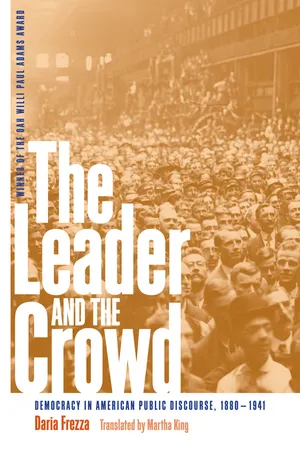
Daria Frezza covers six tumultuous decades of transatlantic history to examine how European theories of mass politics and crowd psychology influenced American social scientists' perception of crowds, mobs, democratic "people," and its leadership. In the last decades of the nineteenth century, the development of an urban-industrial mass society and the disordered influx of millions of immigrants required a redefinition of these important categories in American public discourse. Frezza shows how in the Atlantic crossing of ideas American social scientists reelaborated the European theories of crowd psychology and the racial theories then in fashion. Theorists made a sharp distinction between the irrationality of the crowd, including lynchings, and the rationality of the democratic "public."
However, this paradigm of a rational Anglo-Saxon male public in opposition to irrational mobs—traditionally considered to be composed of women, children, "savages"—was challenged by the reality of southern lynch mobs made up of white Anglo-Saxons, people who used mob violence as an instrument of subjugation over an allegedly inferior race. After World War I, when the topic of eugenics and immigration restrictions ignited the debate of exclusion/inclusion regarding U.S. citizenship, Franz Boas's work provided a significant counterbalance to the biased language of race. Furthermore, the very concept of democracy was questioned from many points of view.
During the Depression years, social scientists such as John Dewey critically analyzed the democratic system in comparison to European dictatorships. The debate then acquired an international dimension. In the "ideological rearmament of America" on the eve of World War II, social scientists criticized Nazi racism but at the same time stressed how racism was also deeply rooted in America. This is a fresh and provocative look at the parallels between the emergence of America as a world power and the maturing of the new discipline of social science.