![]()
Charlotte, NC
The Global Evolution of a New South City
Edited by William Graves
and Heather A. Smith
![]()
Contents
Acknowledgments
Maps
HEATHER A. SMITH AND WILLIAM GRAVES
Introduction. From Mill Town to Financial Capital:
Charlotte’s Global Evolution
DAVID GOLDFIELD
A Place to Come To
MATTHEW D. LASSITER
Searching for Respect:
From “New South” to “World Class” at the Crossroads of the Carolinas
RONALD L. MITCHELSON AND DEREK H. ALDERMAN
Red Dust and Dynamometers:
Charlotte as Memory and Knowledge Community in NASCAR
WILLIAM GRAVES AND JONATHAN KOZAR
Blending Southern Culture and International Finance:
The Construction of a Global Money Center
RONALD V. KALAFSKY
Beyond Local Markets:
The Export Performance and Challenges of Charlotte Manufacturers
TYREL G. MOORE AND GERALD L. INGALLS
A Place for Old Mills in a New Economy:
Textile Mill Reuse in Charlotte
HEATHER A. SMITH AND EMILY THOMAS LIVINGSTONE
Banking on the Neighborhood:
Corporate Citizenship and Revitalization in Uptown Charlotte
GERALD L. INGALLS AND ISAAC HEARD JR.
Developing a Typology of African American Neighborhoods in the American South:
The Case of Charlotte
STEPHEN SAMUEL SMITH
Development and the Politics of School Desegregation and Resegregation
DAVID WALTERS
Centers and Edges:
The Confusion of Urban and Suburban Paradigms in Charlotte-Mecklenburg’s Development Patterns
TOM HANCHETT
Salad-bowl Suburbs:
A History of Charlotte’s East Side and South Boulevard Immigrant Corridors
JOSÉ L. S. GÁMEZ
Mi Reina:
Latino Landscapes in the Queen City (Charlotte, N.C.)
OWEN J. FURUSETH
Epilogue:
Charlotte at the Globalizing Crossroads
Contributors
Index
![]()
Acknowledgments
Charlotte, NC: The Global Evolution of a New South City has truly been a collaborative enterprise, and the editors wish to express their deepest thanks to the book’s author team for their contributions and dedication to this project. We are especially appreciative of their willingness to adjust early drafts and chapter structures so that we could ensure a cohesive and compelling volume. We are also deeply grateful to our editor at the University of Georgia Press. Derek Krissoff’s unwavering patience and counsel were invaluable throughout the manuscript development process.
Patrick Jones of the Cartography and Graphics Lab in the Department of Geography and Earth Sciences at UNC Charlotte provided his expertise to the development and standardization of the volume’s tables and figures. We would like to thank Carlan Graves, for her copyediting of the entire book prior to its initial submission to the press, and Linda Wessels for her thoughtful and careful editing during the pre-production phase. To Dennis Rash we convey our appreciation for his enduring enthusiasm about our work. We would also like to acknowledge our students at UNC Charlotte for their patience and understanding as looming deadlines translated into rescheduled meetings and distracted professors.
In many ways our family stories parallel the central theme of this book — the hybridization of identity and the richness of experience that comes through a complex blending of the southern and the global. While Bill and his family are native southerners with longstanding North Carolina roots, Heather’s family (but one) are immigrants coming from the already global cities of Toronto, London, and Vancouver. The different lenses through which we view, and the different ways in which our families experience, Charlotte’s globalizing transition provided the genesis for this project. It is to our tremendously supportive spouses and to our globally-aware, Charlotte-raised daughters that we dedicate this book.
Heather Smith and Bill Graves
![]()
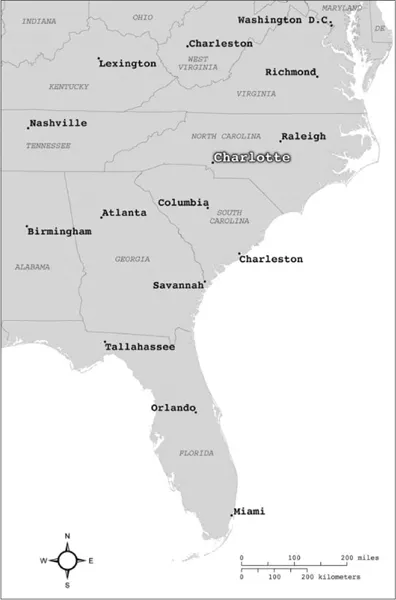
Charlotte is in an unlikely location for a globalizing city. (Source: UNC Charlotte Cartography Lab.)
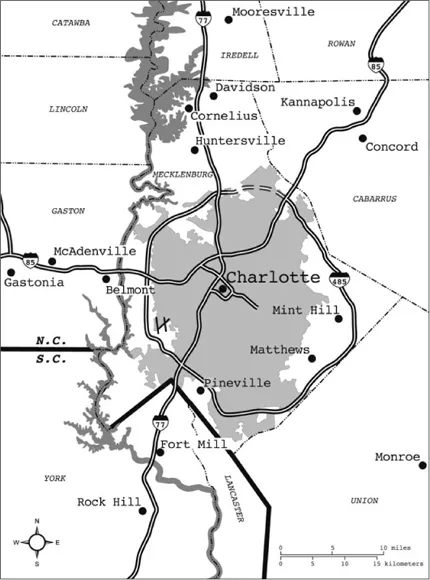
Metropolitan Charlotte. (Source: UNC Charlotte Cartography Lab.)
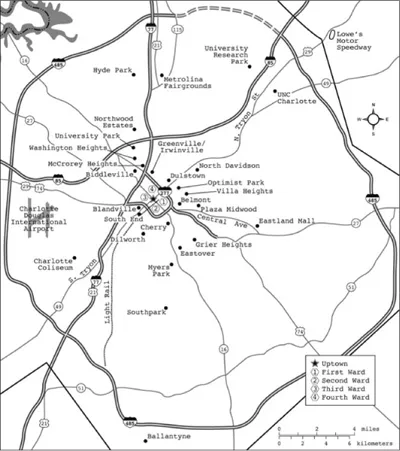
Noted Charlotte neighborhoods and landmarks. (Source: UNC Charlotte Cartography Lab.)
![]()
Introduction.
From Mill Town to Financial Capital
Charlotte’s Global Evolution
Heather A. Smith and William Graves
Charlotte, North Carolina, is not a “global city.”1 It is, however, a globalizing one.
In less than four decades, Charlotte has transformed itself from a regional backwater into a globally ascendant but still distinctively southern city. Once a regional manufacturing and textile center, Charlotte is now one of the nation’s premier banking and finance cores with tendrils reaching firmly into global markets.2 This once black-and-white, distinctively bicultural city has also emerged as one of the country’s leading Hispanic hypergrowth metros and is now considered a rising immigrant gateway.3
While a restructuring economy and changing demographics are the bedrock on which Charlotte’s emerging global status rests, the hallmarks of a globalizing city are many and varied. Expanding connectivity with global economic markets; a rapidly growing foreign-born and increasingly transnational population; broadening social and cultural diversity; a widening gap between the city’s disenfranchised poor and its globally networked elite; fixed capital investment in the form of corporate headquarters, production facilities, condominium skyscrapers, and multinational hotel towers; major public transit and infrastructure development; the centralization and construction of cultural and sporting venues; and gentrification in the historic core and streetcar suburbs are features shared by Charlotte and other globalizing cities.4
Charlotte’s evolution into what scholars view as an incipient world city is remarkable given its regional disadvantages.5 The city’s unexceptional location (far from ports, navigable rivers, or mountain gateways), the cultural baggage of its impoverished southern heritage, its economic history as a low-wage industrial center, and its politically peripheral position in state politics make it an unlikely site for a globally ascendant center. And yet, Charlotte is today included among cities “like Atlanta, Georgia; Rochester, New York; [and] Columbus, Ohio … where an imaginative and aggressive leadership has sought to carve out distinctive niches in the global marketplace.”6 It is a credit to the city’s leaders that they were able to envision a globally connected future despite the place-based disadvantages and obstacles. Indeed, it could be argued that Charlotte’s peripheral economic and geographic history was an advantage that shielded the city from much of the social and economic unrest that engulfed the region post-Reconstruction. This, in turn, provided an opportunity for the city’s leadership to blaze an alternative path. Forged through ceaseless self-promotion and, in some cases, a willingness to bend the rules of southern economic development, this path led Charlotte beyond the literal and figurative boundaries of both the traditional and the New South. The city stands today at the vanguard of a globalizing South that is less “a world apart” than it is “a part of the world.”7
As the chapter authors of this volume detail, the effects of globalization on Charlotte are widespread and undeniable. The city’s expanding and contracting fortunes are tied to the vagaries of the global economy. Its spatial reorganization is achieved through processes of redevelopment and revitalization. The city’s neighborhood landscapes are undergoing cultural hybridization, and faces and accents are changing within its labor force and leading entrepreneurial efforts. Charlotte’s position as a nascent immigrant gateway is affected by global geographies of poverty, while its role as a destination for American-born labor is a function of deindustrialization in the North and ballooning costs of living in the West. Challenges face school and health care systems reshaped by the expectations and needs of newcomers. And there is the extraregional reach and growing global appeal of NASCAR.
Despite these realities, the city’s evolution and global rank are frequently dismissed by native Charlotteans and overlooked by globalization scholars. Locals scoff, citing Charlotte as a global city as an “overblown claim” or grousing that few people outside the South have heard of the city or can “point it out on a map.”8 In the scholarly realm, Charlotte’s position is treated with only a little less skepticism. Some argue that the city does not “bear convincing objective markers of global status.”9 Others cite Charlotte as a “wannabe world city” focusing only on its conscious attempts to attract “big city functions like banking” away from higher-tier global cities like New York and San Francisco.10
Still others take a different tack and point to Charlotte’s command-and-control function (as measured by the nature and number of its corporate headquarters and multinational firms) as evidence of its global position as a subregional specialized service center subordinate to its regional and national counterparts, Atlanta and New York.11 Recent writing even places Charlotte within the global city hierarchy categorizing it as a fifth-tier global city.12
While its recognition as a city of note within the global city literature is certainly significant, the intent of this volume is neither to position Charlotte within the global city hierarchy nor to provide an inventory of the ways in which Charlotte meets or fails to meet global-city criteria. Its aim is to explore how the external forces of globalization combine with the city’s internal dynamics and history to reshape the local structures, landscapes, and identities of a once quintessentially southern place. It examines the process of globalization as it meets the tradition of the South and restructures a single city — Charlotte, North Carolina.
Most previous work on globalization examines the character and connectivity of established (already global) cities, systems, and institutions. Charlotte has only recently begun its transformation and, as such, presents an exceptional opportunity to explore the local effects of global change as they unfold. The tendency to view places as products of either global or provincial forces has led scholars to ignore the process of places becoming global. Charlotte’s status as globalizing allows the authors of this volume to look beyond the traditional all-or-nothing dichotomies of global ...