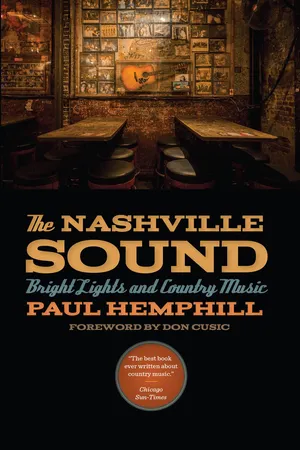
While on a Nieman Fellowship at Harvard, journalist and novelist Paul Hemphill wrote of that pivotal moment in the late sixties when traditional defenders of the hillbilly roots of country music were confronted by the new influences and business realities of pop music. The demimonde of the traditional Nashville venues (Tootsie's Orchid Lounge, Robert's Western World, and the Ryman Auditorium) and first-wave artists (Roy Acuff, Ernest Tubb, and Lefty Frizzell) are shown coming into first contact, if not conflict, with a new wave of pop-influenced and business savvy country performers (Jeannie C. "Harper Valley PTA" Riley, Johnny Ryles, and Glen Campbell) and rock performers (Bob Dylan, Gram Parsons, the Byrds, and the Grateful Dead) as they took the form well beyond Music City. Originally published in 1970, The Nashville Sound shows the resulting identity crisis as a fascinating, even poignant, moment in country music and entertainment history.
- 296 pages
- English
- ePUB (mobile friendly)
- Available on iOS & Android
eBook - ePub
About this book
Information
Subtopic
MusicPART ONE
Hillbilly Heaven
MUSIC CITY, U.S.A.
I don’t care much for that kind of music. But one time we were on a trip and stopped at a place to eat in Indiana, and when they found out we were from Nashville they treated us like celebrities. All they could talk about was the Opry. I’m going to have to go see it one day.
—A CITIZEN OF NASHVILLE, TENN.
It would take a good man all day to travel by car between the most distant points in the State of Tennessee, and even then he would have to take his meals and a relief driver and a hefty supply of No-Doz with him. “Three ‘States’ of Tennessee,” bleats a state promotional brochure, and anybody who has attempted that 600-mile haul from Memphis on the banks of the Mississippi River to Bristol on the high Virginia border would understand immediately. Few states have such a varied face as Tennessee, last stop before the Deep South, looking, on the road maps, like a cockeyed mountain cabin listing heavily to the right. To the east (where natives are always quick to specify they are “from East Tennessee”) are the highest peaks in eastern North America, the tired old Appalachians, the land of TVA and hillbillies and rhododendron and moonshine whiskey and national parks and new ski resorts and the big atomic plant at Oak Ridge. At the opposite end of the state is the flat, steaming delta country that feeds off the big river: prolific soil and Beale Street and latticework and endless cotton fields and magnolia-and-lace and black people from the barren flatlands of Mississippi and Arkansas looking for work in Memphis. And in between, as distinct from the two extreme corners of the state as they are from each other, there is Middle Tennessee, where the highways begin to flatten out for the run toward the Mississippi, undulating past Tennessee walking horses and the Jack Daniel’s bourbon distillery and cedar-lined country lanes and orderly farms and nursery-rhyme hills that blip across the horizon as if a child had scrawled them with a crayon.
It is in the heart of Middle Tennessee, and in the virtual center of the state, that the capital city, Nashville, squats on the red banks of the Cumberland River like a frog about to jump. Nashville (“200 miles southeast of the center of population of the United States”) is an old town, the way Southerners measure them, founded in 1779 by a band of pioneers who came into what was then North Carolina territory and knocked down the trees and put up a log stockade on the west bank of the Cumberland. Over the years the town grew into the only city of appreciable size between Memphis to the west (206 miles away), Knoxville to the east (178), Louisville, Ky., to the north (179) and Chattanooga to the south (123), booming itself as the “Commercial Capital of the Central South” (banking and insurance are the big businesses), and becoming Big Daddy to a retail trading area of a million and a half people. Today, then, Nashville holds nearly 500,000 people, most of them transplants from the outlying regions of Middle Tennessee who have come in to work in Nashville’s medium-sized industries: religious printing, automobile glass, shoes, chemicals, textiles, and so on. The city is progressive enough (it established one of the first workable “metro” governments in the U.S.), suffers the usual growing pains (blacks have been complaining about Interstate Highways isolating their neighborhoods) and likes to talk about its “respectable” institutions: 14 colleges and universities (eight of them religious-oriented), a good symphony orchestra, the Belle Meade Country Club, neat lily-white subdivisions in all directions, the Iroquois Steeplechase, and a handful of graceful architectural pieces such as the Parthenon (a replica of the Athenian temple) and The Hermitage (Andrew Jackson’s old plantation on the edge of town). “Because of its many buildings of classic design, its interest in the arts and in education,” explains a Chamber of Commerce flyer, “Nashville is known as the Athens of the South.”
Well, all right. No argument. But a funny thing happened on the way to the symphony. Ever since 1925 Nashville had hosted WSM radio’s Grand Ole Opry: the oldest continuing radio show in America, a five-hour procession of fiddlers and country comedians and yodelers and cloggers that every Saturday night drew a few thousand visitors to a hulking old downtown tabernacle called Ryman Auditorium and was broadcast all the way to Canada. It was fashionable for a Nashvillian to say he had never been to the Opry; a play or the symphony, by all means, or maybe even to Sulphur Dell to see the minor-league Nashville Vols play baseball, but never to the Opry. It was, after all, “hillbilly music,” and it was considered poor form for a leading citizen of the Athens of the South to admit he enjoyed such goings-on. Anyway, after World War II, small recording studios began popping up here and there to accommodate the colony of country musicians and writers living in or around Nashville to be near the Opry. Then somebody else opened up a sheet-music publishing house. Finally, by the early Fifties, all of the makings of a recording complex were there: publishing houses, competing record-pressing plants, talent agencies, clothiers specializing in show costumes, shops selling guitars and other musical instruments, and even boardinghouses catering to hungry young men fresh in from the country to try their luck at writing and singing country songs. The Opry was getting so big, they added a shortened Friday-night version and started thinking about split sessions on Saturday nights. And the recording business had blossomed into a fullblown industry, adding first $30 million, then $50 million and finally $60 million a year to the Nashville economy. Like it or not, the business-minded Founding Fathers had to agree to still another subtitle: “Music City, U.S.A.”
Suddenly, old Nashville has become the second-largest recording center in the world, only a step behind New York. Scheduling their first recording session at 10 A.M. and finishing their last one of the day at one o’clock the next morning, the city’s 40 studios (five years ago there were only ten) produce more 45 r.p.m. or “single” records than any city in the world. In Nashville there are more than 1,500 union musicians and an equal number of songwriters, served by 29 talent agencies, seven record-pressing plants, 400 music-publishing houses, 53 record companies, offices for three performing-rights organizations, and seven trade papers. As a clue to what music means to Nashville, the city’s largest annual convention is not a gathering of insurance or banking executives but the Opry Anniversary Celebration (known to anybody who has been there as the Deejay Convention): an explosive week each mid-October when some 6,000 disc jockeys, performers and anybody who is anybody in country music come to town to drink, play golf, interview each other and raise general hell.
When you say “music industry” in Nashville you mean country music, of course, even though Columbia Records does 10 percent of its pop recording there and such non-country stars as Connie Francis, A1 Hirt, Perry Como, Patti Page and even Bob Dylan and Buffy Sainte-Marie occasionally come to town in search of what is vaguely called “the Nashville Sound.” Nashville is and always has been the spiritual home of country music, “hillbilly heaven,” a fact properly noted in more than one country song (“Golden Guitar,” for example, is about a blind performer killed by a train en route to his debut on the Opry), and it is never so evident as on a warm weekend, when the crowds pour into town for the Friday-and Saturday-night Opry performances—coming in from an average of 500 miles away by every means imaginable, living out of campers in downtown parking lots, strolling up and down Opry Place and Broadway in their Western clothes, nosing through the souvenir and record shops, having a beer at Tootsie’s Orchid Lounge, taking one of the tour buses from the Opry House so they can see Music Row and Hank Williams’ old home (“That 1952 Cadillac in the driveway is the one Hank died in on January 1, 1953”) and the Biltmore Courts Motel (“Right there’s where Don Gibson wrote ‘Oh, Lonesome Me’”), and finally squatting on the curb in front of the ugly red-brick Grand Ole Opry House three hours before the doors open, sitting there emptying a box of Minnie Pearl’s Fried Chicken and trying to figure out a way to get in for a show that was sold out seven weeks in advance. “When I die,” says the old guitar picker, “I’m going to Nashville.”
Begrudgingly, not relishing a single minute of it, the other Nashville has given up the trenches and raised the white flag, if only to half-staff. “Sure, I love country music,” goes the typical comment. “It isn’t every day you can pick up an industry like that.” As the Sixties came to an end, country music meant nearly $100 million a year to Nashville’s economy, not to mention the international publicity the industry was bringing to the town. So many of the stars were sinking their money into fast-food franchises (Minnie Pearl’s Fried Chicken, Tennessee Ernie Steak ’n’ Biscuits, Tex Ritter’s Chuck Wagon System) that some people were touting Nashville as the franchise center of the nation. The city put up signs at the city limits saying WELCOME TO MUSIC CITY U.S.A. and decorated the airport lounge in a country-music motif and changed the name of Fifth Avenue North, along the block where the Opry House sits, to Opry Place. Vanderbilt University, in an expression of academic neutrality, announced a course in entertainment law when Jeannie C. Riley was hauled into court in a dispute over rights to “Harper Valley PTA.” The state in 1965 adopted “Tennessee Waltz” as its official song, and represented itself in Richard Nixon’s inaugural parade with a $15,000 float honoring country music, featuring Lester Flatt and Earl Scruggs in the flesh. But even when the city does promote its best-known business it proceeds with the brakes on: in the blue pages of the Greater Nashville Telephone Directory, for example, the last item under “Points of Interest” contains 100 words describing the Grand Ole Opry as a “folk music program.” Indeed, most promotional material on the Opry and the music industry in general is cranked out by WSM (National Life & Accident Insurance Company’s voice, the daddy of the Opry) or the Country Music Association.
Four blocks up the hill from the Opry House is the Nashville Area Chamber of Commerce, a glassy modern building on Union Street. The manager of the Conventions and Visitors Division is Bill Hartnett, a thin, floppy-eared man who wears glasses and a bow tie and likes to talk about the time he got to go to the airport to meet Paul Harvey (“a real down-to-earth guy, just like you or me”). Hartnett, who professes to be a fan of country music, is caught in the middle between the two Nashvilles even when he goes home. “I’ve been in this town for eighteen years and I’ve seen the Opry from behind the stage, out front and underneath,” he was saying one bitter winter day as low snow-clouds hugged the top of the new 30-story Life & Casualty Tower. “I like it, but my wife is a conservatory-trained pianist and she loves the symphony. Now. Let’s say we’ve got ten friends in town for the weekend and I suggest we feed ’em, drink ’em and then take ’em to the Opry. Well, the first thing she’ll say is that she’s just lined up a bridge game, and then she’ll say she just broke a leg. Okay, maybe a week later I tell her I’ve got two tickets to the Nashville Symphony and suggest that we go out, just the two of us. You know how you’ve got to do the wives now and then. Well, sir, you know what she’ll say to that? She’ll say, ‘Is that Eddy Arnold going to be there?’ And if he is, she won’t go. You’ve got these people in town who wear tuxedoes and go to the symphony, and they just don’t care for the country-music crowd or the music. It’s my guess that no more than half the civilian population of Nashville has ever been to the Opry.” But nobody knows better than Bill Hartnett what put Nashville on the map, because he lives with it every day. His office received a total of 8,800 inquiries by mail during 1968, and three out of every five dealt with country music. “They wanted to know how to get into the Opry and ‘What is the Country Music Hall of Fame?’ and ‘Do they really walk the streets with guitars over their shoulders?’ The thing is, when you get outside Nashville or Tennessee, that’s about all anybody knows about us. In this 200-mile radius around Nashville there are two million people, and beyond that perimeter is where the country stars go to put on their shows because there are a lot of people in that perimeter who couldn’t care less about hearing somebody pick a guitar.”
Hartnett answered a call from somebody wanting to know something about a Vanderbilt basketball game (“Tell you what, why don’t you call the sports publicity office over at the school?”), then sank back in his chair and laughed to himself. “I saw a guy one day, looked like he was about twenty-seven, standing in the main room at the Third National Bank. Had on overalls and dirty shoes and a wool hat pushed back on his head, and he was pulling these rolled-up scraps of paper out of his pockets and handing ’em to one of the directors of the bank.” He stood up to demonstrate. “Funniest thing you ever saw. He’d reach in up here and fish one out, then he’d go to his back pocket, then he’d find another one in a side pocket. When he got through, he flattened ’em out one at a time and put an X on the back of each one. Must’ve taken him ten minutes just to do all of that. Then he went over to a window and gave all of those scraps of paper to a teller, shook hands with this bank director, and left. I’d been watching everything, so I went over to the director and asked him what the devil was going on. ‘Oh,’ he said, ‘that’s a musician. Been on the road about eight weeks, and those were the checks he got for singing.’ I said, ‘Do you mind telling me how much he deposited?’ And do you know what he said? ‘Thirty-five thousand dollars.’”
This is the kind of story Nashvillians like to use when they are talking about the impact of country music on their city, but Hartnett feels there has been a subtle change in attitude. “I do believe we’re going through a revolution,” he puts it. “For one thing, the ones who’re coming along now (in country music) are a lot smarter than they used to be. Oh, sure, we still have these characters who come in with five bucks in their pocket, and they’re gonna go down to Sixteenth Avenue to make their first million, but they wind up hungry and living at the Union Mission after a few days. I mean, you can look at Jeannie C. Riley and see it’s still possible to make it overnight like that. But most of the new stars are different, went to college and got good sense and all, and the first-family people notice that. And another thing, the top people are becoming more acutely aware of what country music means to Nashville. If the music industry left town today, can you imagine what it’d do to this place?”
That’s what the gang on Music Row thought they were saying uptown: We don’t like you, but your money’s good. The gap isn’t as wide now as it was in the Forties when Roy Acuff got so mad at a governor for saying he was “disgracing the state by making Nashville the hillbilly capital of the world” that he ran for governor (getting roundly defeated but singing a lot of songs in the process). The gap is still there, however, and most of the country-music people react to it by withdrawing into a close-knit community of their own. They live in the same subdivisions, party together, marry their own, take care of their own (with the Opry Trust Fund, which goes to those down on their luck), come down with lockjaw when an outsider noses around looking for dirt on a colleague, and generally stay out of the mainstream of Nashville life except when they feel like buying a piece of it. Nashville has its personal rivalries and petty jealousies, of course, but the need to stand together against the enemy from without has kept infighting to a minimum. With some bitterness, as though it were the only thing you have to know about how Nashville treats its country musicians, they like to talk about what happened to a sharp young singer-writer-publisher named Jim Glaser during a cocktail party connected with the Deejay Convention. “Everybody was there,” says Bob Woltering, editor of a monthly country-music tabloid called Music City News, “and when somebody introduced one of those First Family ladies to Glaser she said, ‘Oh, I’ve always wanted to meet one of y’all.’ Jim was so mad he looked right over her shoulder and walked away. Just left her standing there with a drink in her hand and egg on her face.” Presumably he couldn’t get back to his own turf, Music Row, fast enough.
Music Row (or, sometimes, Record Row) is the local name for an eight-square-block area about two miles from downtown, in the urban renewal area around Sixteenth and Seventeenth Avenues South, near Vanderbilt University and a vast Negro section, where almost all of Nashville’s music related businesses operate out of a smorgasbord of renovated old single-and two-story houses and sleek new office buildings. Music Row is, then, the very heartbeat of the entire country music industry: where RCA Victor does all of its country recording, where Decca and Columbia Records do better than 90 percent of theirs, and where a sizable majority of the nation’s country talent agencies and publishing houses are based. (“There’s so damn much of this drop-in visiting around there that you can’t get your work done,” complains one independent producer who refuses to move to The Row, but he is a rarity.) At the head of The Row is the modernistic $750,000 building opened in the spring of 1967 by the Country Music Association to house the CMA executive offices and the Country Music Hall of Fame and Museum, where more than 100,000 fans a year come to see the bronze plaques honoring members of the Hall of Fame and a collection of artifacts such as the cigarette lighter carried by singer Patsy Cline when she died in a plane crash (it is decorated with a Confederate flag design and still plays “Dixie” when opened). Next door is the fiercely dignified dark-brick headquarters of Broadcast Music, Inc., country music’s ASCAP, and it is poetic that BMI and the CMA would stand shoulder to shoulder at the top of Music Row, like twin Statues of Liberty, because not until BMI was formed in 1939 did it become possible for country songwriters to make a decent living. Beyond these two structures, Music Row isn’t anything worth taking pictures of except for the three-story sand-colored RCA Victor studios and the more modest Decca, Capitol and Columbia buildings. The rest of The Row is a montage of FOR SALE signs, old houses done up with false fronts to look like office buildings, leggy secretaries swishing down the sidewalks, dusty Cadillacs parked close to the buildings as though they were stray dogs hiding under houses in the mid-August heat, Johnny Cash sneaking into a...
Table of contents
- Cover Page
- Title Page
- Copyright Page
- Contents
- Foreword to the 2015 Edition
- Preface
- Prologue: Friday Night at Tootsie’s Orchid Lounge
- PART ONE: HILLBILLY HEAVEN
- PART TWO: WHITE SOUL
- PART THREE: SPREADING THE WORD
- Epilogue: Saturday Night at the Opry
- Index
Trusted by 375,005 students
Access to over 1.5 million titles for a fair monthly price.
Study more efficiently using our study tools.
Frequently asked questions
Yes, you can cancel anytime from the Subscription tab in your account settings on the Perlego website. Your subscription will stay active until the end of your current billing period. Learn how to cancel your subscription
No, books cannot be downloaded as external files, such as PDFs, for use outside of Perlego. However, you can download books within the Perlego app for offline reading on mobile or tablet. Learn how to download books offline
Perlego offers two plans: Essential and Complete
- Essential is ideal for learners and professionals who enjoy exploring a wide range of subjects. Access the Essential Library with 800,000+ trusted titles and best-sellers across business, personal growth, and the humanities. Includes unlimited reading time and Standard Read Aloud voice.
- Complete: Perfect for advanced learners and researchers needing full, unrestricted access. Unlock 1.5M+ books across hundreds of subjects, including academic and specialized titles. The Complete Plan also includes advanced features like Premium Read Aloud and Research Assistant.
We are an online textbook subscription service, where you can get access to an entire online library for less than the price of a single book per month. With over 1.5 million books across 990+ topics, we’ve got you covered! Learn about our mission
Look out for the read-aloud symbol on your next book to see if you can listen to it. The read-aloud tool reads text aloud for you, highlighting the text as it is being read. You can pause it, speed it up and slow it down. Learn more about Read Aloud
Yes! You can use the Perlego app on both iOS and Android devices to read anytime, anywhere — even offline. Perfect for commutes or when you’re on the go.
Please note we cannot support devices running on iOS 13 and Android 7 or earlier. Learn more about using the app
Please note we cannot support devices running on iOS 13 and Android 7 or earlier. Learn more about using the app
Yes, you can access The Nashville Sound by Paul Hemphill in PDF and/or ePUB format, as well as other popular books in Media & Performing Arts & Music. We have over 1.5 million books available in our catalogue for you to explore.