![]()
Chapter 1
The Nature of Probability
Probable impossibilities are to be preferred to improbable possibilities. (Aristotle, 384–322 BC)
1.1. Probability and Everyday Speech
The life experienced by any individual consists of a series of events within which he or she plays a central role. Some of these events, like the rising and setting of the sun, occur without fail each day. Others occur often, sometimes on a regular, if not daily, basis and might, or might not, be predictable. For example, going to work is normally a predictable and frequent event but the mishaps, such as illnesses, that occasionally prevent someone from going to work are events that are to be expected from time to time but can be predicted neither in frequency nor timing. To the extent that we can, we try to compensate for the undesirable uncertainties of life—by making sure that our homes are reasonably secure against burglary—a comparatively rare event despite public perception—or by taking out insurance against contingencies such as loss of income due to ill health or car accidents.
To express the likelihoods of the various events that define and govern our lives, we have available a battery of words with different shades of meaning, some of which are virtually synonymous with others. Most of these words are so basic that they can best be defined in terms of each other. If we say that something is certain then we mean that the event will happen without a shadow of doubt; on any day, outside the polar regions, we are certain that the sun will set. We can qualify certain with an adverb by saying that something is almost certain meaning that there is only a very small likelihood that it would not happen. It is almost certain that rain will fall sometime during next January because that month and February are the wettest months of the year in the United Kingdom. There are rare years when it does not rain in January but these represent freak conditions. However, when we say that an event is likely, or probable, we imply that the chance of it happening is greater than it not happening. August is usually sunny and warm and it is not unusual for there to be no rain in that month. Nevertheless, it is probable that there will be some rain in August because that happens in most years.
The word possible or feasible could just mean that an event is capable of happening without any connotation of likelihood, but in some contexts it could be taken to mean that the likelihood is not very great—or that the event is unlikely. Finally, impossible is a word without any ambiguity of meaning; the event is incapable of happening under any circumstances. By attaching various qualifiers to these words—almost impossible as an example—we can obtain a panoply of overlapping meanings but at the end of the day, with the exception of the extreme words, certain and impossible, there is a subjective element in both their usage and interpretation.
While these fuzzy descriptions of the likelihood that events might occur may serve in everyday life, they are clearly unsuitable for scientific use. Something much more objective, and numerically defined, is needed.
1.2. Spinning a Coin
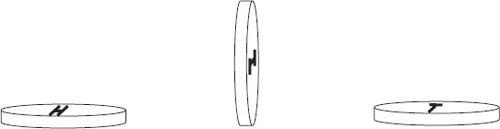
We are all familiar with the action of spinning a coin—it happens at cricket matches to decide which team chooses who will bat first and at football matches to decide which team can choose the end of the pitch to play the first half. There are three possible outcomes to the event of spinning a coin, head, tail, or standing on an edge. That comes from the shape of a coin, which is a thin disk (Fig. 1.1).
Fig. 1.1. The three possible outcomes for spinning a coin.
However, the shape of the coin contains another element, that of symmetry. Discounting the possibility that the coin will end up standing on one edge (unlikely but feasible in the general language of probabilities), we deduce from symmetry that the probability of a head facing upward is the same as that for a tail facing up. If we were to spin a coin 100 times and we obtained a head each time, we would suspect that something was wrong—either that it was a trick coin with a head on each side or one that was so heavily biased it could only come down one way. From an instinctive feeling of the symmetry of the event we would expect that the two outcomes had equal probability so that the most likely result of spinning the coin 100 times would be 50 heads and 50 tails, or something fairly close to that result. Since we expect a tail 50% of the times we spin the coin, we say that the probability of getting a tail is 1/2, because that is the fraction of the occasions that we expect that outcome. Similarly, the probability of getting a head is 1/2. We have taken the first step in assigning a numerical value to the likelihood, or probability, of the occurrence of particular outcomes.
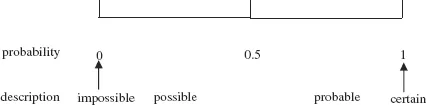
Supposing that we repeated the above experiment of spinning a coin but this time it was with the trick coin, the one with a head on both sides. Every time we spin the coin we get a head; it happens 100% of the time. We now say that the probability of getting a head is 1 because that is the fraction of the occasions we expect that outcome. Getting a head is certain and that is what is meant by a probability of 1. Conversely, we get a tail on 0% of the times we flip the coin; the probability of getting a tail is 0. Getting a tail is impossible and that is what is meant by a probability of 0. Figure 1.2 shows this assignment of probabilities in a graphical way.
Fig. 1.2. The numerical probability range with some notional verbal descriptions of regions.
The range shown for probability in Fig. 1.2 is complete. A probability cannot be greater than 1 because no event can be more certain than certain. Similarly, no probability can be less that 0, i.e., negative, since no event can be less possible than impossible.
We are now in a position to express the probabilities for spinning an unbiased coin in a mathematical form. If the probabilities of getting a head or a tail are ph and pt, respectively, then we can write
1.3. Throwing or Spinning Other Objects
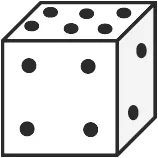
Discounting the slight possibility of it standing on an edge there are just two possible outcomes of spinning a coin, head or tail, something that comes from the symmetry of a disk. However, if we throw a die, then there are six possible outcomes—1, 2, 3, 4, 5, or 6. A die is a cubic object with six faces and, without numbers marked on them, all the faces are similar and similarly disposed with respect to other faces (Fig. 1.3).
From the symmetry of the die, it would be expected that the fraction of throws yielding a particular number, say a 4, would be 1/6 so that the probability of getting a 4 is p4 = 1/6 and that would be the same probability of getting any other specified number. Analogous to the coin equation (1.1), we have for the probability of each of the six possible outcomes
Fig. 1.3. A die showing three of the six faces.
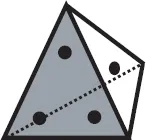
Fig. 1.4. A regular tetrahedron—a “die” with four equal-probability outcomes.
It is possible to produce other symmetrical objects that would give other numbers of possible outcomes, each with the same probability. In Fig. 1.4, we see a regular tetrahedron, a solid object with four faces, each of which is an equilateral triangle. The two faces that we cannot see have two and four spots on them, respectively. This object would not tumble very well if thrown onto a flat surface unless thrown quite violently but, in principle, it would give, with equal probability, the numbers 1–4, so that
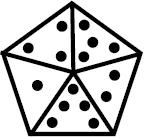
A better device in terms of its ease of use is a regular shaped polygon mounted on a spindle about which it can be spun. This is shown in Fig. 1.5 for a device giving numbers 1–5 with equal probability. The spindle is through the center of the pentagon and perpendicular to it. The pentagon is spun about the spindle axis like a top and eventually comes to rest with one of the straight boundary edges resting on the supporting surface, which indicates the number for that spin.
Fig. 1.5. Adevice for giving
p1 =
p2 =
p3 =
p4 =
p5 =
.
We have now been introduced to the idea of probability expressed as a fractional number between 0 and 1, the only useful way for a scientist or mathematician. Next we will consider slightly more complicated aspects of probability when combinations of different outcomes can occur.
Problems 1
1.1. Meteorology is not an exact science and hence weather forecasts have to be couched in terms that express that lack of precision. The following is a Meteorological Office forecast for the United Kingdom covering the period 23 September to 2 October 2006.
Low pressure is expected to affect northern and w...