Environmental Applications of Nanomaterials
eBook - ePub

Environmental Applications of Nanomaterials

Synthesis, Sorbents and Sensors

  1. 752 pages
  2. English
  3. ePUB (mobile friendly)
  4. Available on iOS & Android
eBook - ePub

Environmental Applications of Nanomaterials

Synthesis, Sorbents and Sensors

About this book

This book is concerned with functional nanomaterials, materials containing specific, predictable nanostructures whose chemical composition, or interfacial structure enables them to perform a specific job: to destroy, sequester, or detect some material that constitutes an environmental threat. Nanomaterials have a number of features that make them ideally suited for this job: they have a high surface area, high reactivity, easy dispersability, and rapid diffusion, to name a few. The purpose of this book is to showcase how these features can be tailored to address some of the environmental remediation and sensing/detection problems faced by mankind today. A number of leading researchers have contributed to this volume, painting a picture of diverse synthetic strategies, structures, materials, and methods. The intent of this book is to showcase the current state of environmental nanomaterials in such a way as to be useful both as a research resource and as a graduate level textbook. We have organized this book into sections on nanoparticle-based remediation strategies, nanostructured inorganic materials (e.g. layered materials like the apatites), nanostructured organic/inorganic hybrid materials, and the use of nanomaterials to enhance the performance of sensors.

Contents:

  • Nanoparticle-based Approaches:
    • Nanoparticle Metal Oxides for Chlorocarbon and Organophosphonate Remediation (Olga B Koper, Shyamala Rajagopalan, Slawomir Winecki and Kenneth J Klabunde)
    • Nanoscale Zero-Valent Iron (nZVI) for Site Remediation (Daniel W Elliott, Hsing-Lung Lien and Wei-xian Zhang)
    • Synthesis, Characterization, and Properties of Zero-Valent Iron Nanoparticles (Donald R Baer, Paul G Tratnyek, You Qiang, James E Amonette, John Linehan, Vaishnavi Sarathy, James T Nurmi, Chongmin Wang and J Antony)
  • Nanostructured Inorganic Materials:
    • Formation of Nanosized Apatite Crystals in Sediment for Containment and Stabilization of Contaminants (Robert C Moore, Jim Szecsody, Michael J Truex, Katheryn B Helean, Ranko Bontchev and Calvin Ainsworth)
    • Functionalized Nanoporous Sorbents for Adsorption of Radioiodine from Groundwater and Waste Glass Leachates (Shas V Mattigod, Glen E Fryxell and Kent E Parker)
  • Nanoporous Organic/Inorganic Hybrid Materials:
    • Nature's Nanoparticles: Group IV Phosphonates (Abraham Clearfield)
    • Twenty-five Years of Nuclear Waste Remediation Studies (Abraham Clearfield)
    • Synthesis of Nanostructured Hybrid Sorbent Materials Using Organosilane Self-assembly on Mesoporous Ceramic Oxides (Glen E Fryxell)
    • Chemically Modified Mesoporous Silicas and Organosilicas for Adsorption and Detection of Heavy Metal Ions (Oksana Olkhovyk and Mietek Jaroniec)
    • Hierarchically Imprinted Adsorbents (Hyunjung Kim, Chengdu Liang and Sheng Dai)
    • Functionalization of Periodic Mesoporous Silica and Its Application to the Adsorption of Toxic Anions (Hideaki Yoshitake)
    • Layered Semi-crystalline Polysilsesquioxane: A Mesostructured and Stoichiometric Organic-Inorganic Hybrid Solid for the Removal of Environmentally Hazardous Ions (Hideaki Yoshitake)
    • A Thiol-functionalized Nanoporous Silica Sorbent for Removal of Mercury from Actual Industrial Waste (Shas V Mattigod, Glen E Fryxell and Kent E Parker)
    • Functionalized Nanoporous Silica for Oral Chelation Therapy of a Broad Range of Radionuclides (Wassana Yantasee, Wilaiwan Chouyyok, Robert J Wiacek, Jeffrey A Creim, R Shane Addleman, Glen E Fryxell and Charles Timchalk)
    • Amine-functionalized Nanoporous Materials for Carbon Dioxide (CO 2 ) Capture (Feng Zheng, R Shane Addleman, Christopher L Aardahl, Glen E Fryxell, Daryl R Brown and Thomas S Zemanian)
    • Carbon Dioxide Capture from Post-combustion Streams Using Amine-functionalized Nanoporous Materials (Rodrigo Serna-Guerrero and Abdelhamid Sayari)
  • Nanomaterials that Enhance Sensing/Detection of Environmental Contaminants:
    • Nanostructured ZnO Gas Sensors (Huamei Shang and Guozhong Cao)
    • Synthesis and Properties of Mesoporous-based Materials for Environmental Applications (Jianlin Shi, Hangrong Chen, Zile Hua and Lingxia Zhang)
    • Electrochemical Sensors Based on Nanomaterials for Environmental Monitoring (Wassana Yantasee, Yuehe Lin and Glen E Fryxell)
    • Nanomaterial-based Environmental Sensors (Dosi Dosev, Mikaela Nichkova and Ian M Kennedy)
    • Carbon Nanotube- and Graphene-based Sensors for Environmental Applications (Dan Du)
    • One-dimensional Hollow Oxide Nanostructures: A Highly Sensitive Gas-sensing Platform (Jong-Heun Lee)
    • Preparation and Electrochemical Application of Titania Nanotube Arrays (Peng Xiao, Guozhong Cao and Yunhuai Zhang)


Readership: Graduate students and researchers in nanomaterials and nanostructures.
Frequently asked questions

Yes, you can cancel anytime from the Subscription tab in your account settings on the Perlego website. Your subscription will stay active until the end of your current billing period. Learn how to cancel your subscription.
No, books cannot be downloaded as external files, such as PDFs, for use outside of Perlego. However, you can download books within the Perlego app for offline reading on mobile or tablet. Learn more here.
Perlego offers two plans: Essential and Complete
  • Essential is ideal for learners and professionals who enjoy exploring a wide range of subjects. Access the Essential Library with 800,000+ trusted titles and best-sellers across business, personal growth, and the humanities. Includes unlimited reading time and Standard Read Aloud voice.
  • Complete: Perfect for advanced learners and researchers needing full, unrestricted access. Unlock 1.4M+ books across hundreds of subjects, including academic and specialized titles. The Complete Plan also includes advanced features like Premium Read Aloud and Research Assistant.
Both plans are available with monthly, semester, or annual billing cycles.
We are an online textbook subscription service, where you can get access to an entire online library for less than the price of a single book per month. With over 1 million books across 1000+ topics, we’ve got you covered! Learn more here.
Look out for the read-aloud symbol on your next book to see if you can listen to it. The read-aloud tool reads text aloud for you, highlighting the text as it is being read. You can pause it, speed it up and slow it down. Learn more here.
Yes! You can use the Perlego app on both iOS or Android devices to read anytime, anywhere — even offline. Perfect for commutes or when you’re on the go.
Please note we cannot support devices running on iOS 13 and Android 7 or earlier. Learn more about using the app.
Yes, you can access Environmental Applications of Nanomaterials by Glen E Fryxell, Guozhong Cao in PDF and/or ePUB format, as well as other popular books in Physical Sciences & Environmental Science. We have over one million books available in our catalogue for you to explore.

Information

Publisher
ICP
Year
2012
Print ISBN
9781848168046
eBook ISBN
9781908977069

Nanoporous Organic/Inorganic Hybrid Materials

Chapter 6

Nature's Nanoparticles: Group IV Phosphonates

Abraham Clearfield
Texas A&M University, College Station, TX, USA

6.1 Introduction

6.1.1 Natural nanoparticle formation

From the time nanoscience and technology became fashionable, practitioners have devised a very large number of methods by which nano-sized particles or systems can be produced. In my own work it is nature that has been the producer of nanoparticles. We have just been the recipient. This has been true for zirconium phosphates, several types of zirconium phosphonates, aluminum phosphonates and our latest discovery, tin phosphonates. These compounds have been utilized to develop layer-by-layer films, as ion exchangers, additives for proton-conducting fuel cells, as catalysts and catalyst carriers and in many diverse uses as nanoparticles. We shall begin our odyssey with a description of the synthesis, structure and properties of α-zirconium phosphate, Zr(O3POH)2•H2O.

6.1.2 α-zirconium phosphate and nanoparticles

6.1.2.1 History and structure

The emergence of zirconium phosphate as a compound of interest arose from work done at Oak Ridge National Laboratory in the 1950s.1 There was a need for ion exchangers to remove radioactive species from reactor cooling water. The organic ion-exchange resins of that time were degraded by the radioactive species in hot reactor water. Therefore, a search was under way worldwide for inorganic ion exchangers that would not be so affected. Hydrous oxides were considered and it was observed that hydrous zirconia sorbed large amounts of phosphate, becoming a cation exchanger.1 Subsequently, zirconium phosphate was prepared as a gelatinous amorphous precipitate on addition of phosphoric acid to a soluble zirconium salt. The dried gel possessed interesting cation exchange properties. However, in hot water a significant loss of phosphate ion resulted due to hydrolysis.
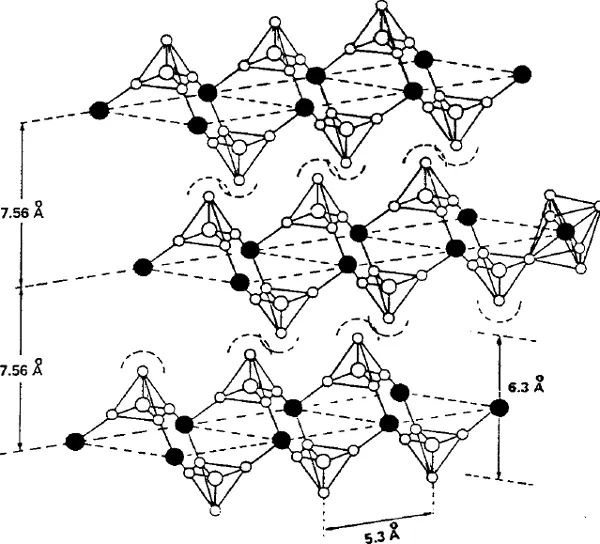
At that time, I was employed by a branch of NL Industries that manufactured zirconium chemicals. I suggested a study of a family of zirconium-based ion exchangers but met with only lukewarm enthusiasm. However, I was teaching in the evening school at Niagara University and proposed the project to a M.S. candidate, James Stynes. The result was that we were able to convert the zirconium phosphate gel to crystals and establish the composition as Zr(HPO4)2•H2O and the layered nature of the compound.2 The crystal structure was determined first by film methods3a and later by automated diffractometry.3b The unit cell dimensions are a = 9.060(2), b = 5.297(1), c = 15.414(3)Å, β = 101.71(2), monoclinic space group P21/n. A schematic drawing of the structure is shown in Figure 6.1. The Zr atoms are slightly above and below the mean plane of the layer and are six-coordinate to oxygens from six phosphate groups. Each monohydrogen phosphate bonds to three Zr atoms arranged at the apices of a near equilateral triangle. The P-OH group points into the interlayer space and hydrogen bonds to the water molecule. The water in turn hydrogen bonds to a framework oxygen in the same layer. There are no interlayer hydrogen bonds but only van der Waals forces holding the layers together.

6.1.2.2 Crystal growth and ion-exchange behavior

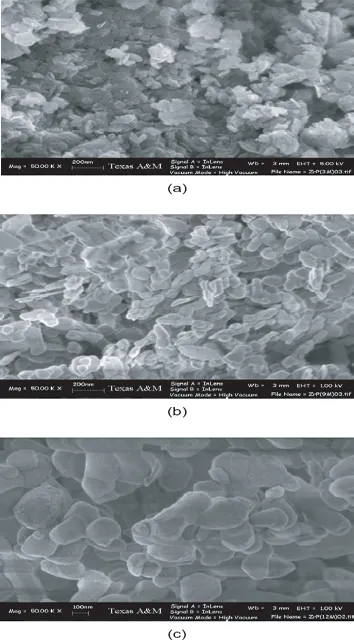
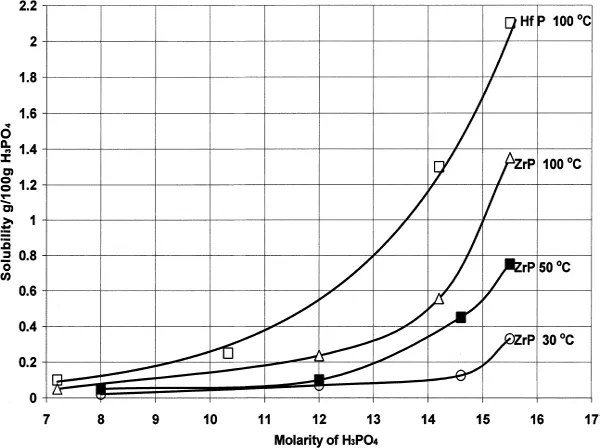
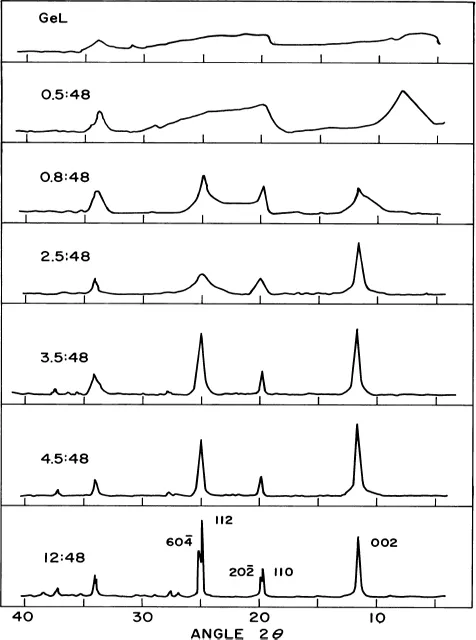
In order to grow single crystals for the first X-ray study3a the gel was held in a sealed quartz tube with 12M H3PO4 at 170°C for four weeks. Subsequently, crystals could be grown in a day or two in an HF solution.4 These differences in the rate of crystal growth were of interest because we had observed a rather pronounced difference in the ion-exchange behavior of batches of crystals grown under different conditions. Examination of the dried gel particles showed that the particles had no crystalline-type shape and were on the order of 10–40 nm in size. Even when refluxed in 0.35M H3PO4 for several days the particles did not grow significantly. Figure 6.2 illustrates the condition of the crystals grown in increasing concentrations of phosphoric acid. The slow crystal growth is the result of the low solubility of zirconium phosphate in the solutions of low phosphoric acid concentration. The estimated solubility of crystalline zirconium phosphate in 1M H3PO4 at 25°C is estimated to be on the order of 10–6 g/L. A graph of solubility in phosphoric acid concentration of 7M and greater at several temperatures is given in Figure 6.3.5 The crystallization mechanism is that of Ostwald ripening in accord with the solubility shown in Figure 6.3. This fact is illustrated by the X-ray patterns in Figure 6.4.6
images
Figure 6.1. Schematic representation of α-zirconium phosphate layers as viewed down the b-axis direction: Zr, ●; P, ○; O, °.
The picture that arises from our studies is that of crystal perfection accompanying particle growth. The behavior of the particles is strongly tied to their crystallinity. We shall illustrate by their ion-exchange behavior and intercalation and exfoliation properties. Because there are several additional phases of zirconium phosphate, we shall refer to the present one as the alpha phase or α-ZrP. The variation of the ion-exchange curves as a function of crystallinity is shown in Figures 6.5(a) and 6.5(b). To understand why the titration curves change in shape as the crystallinity increases we first consider the behavior of a strong acid polystyrene sulfonic acid ion-exchange resin. These resins are influenced by the degree of crosslinking by divinyl benzene. For an 8% cross-linked resin, the cross-links between the linear polystyrene chains create cavities that are about 50Å in diameter. The cavities are filled with water, causing the resin beads to swell. Consider the exchange of Na+ for protons of the sulfonic acid groups, which are present in the cavities as hydronium ions. As the protons are displaced to the outer solution, the Na+ spreads uniformly throughout the resin bead so that only one solid phase is present. Using the terminology of the phase rule, the system has three components. One choice of components is the hydrogen ion displaced or the pH, the total sodium ion added and ion-exchange capacity which gives us the amount of H+ left in the solid phase. At constant temperature and pressure the phase rule equation f = c − p + 2 becomes f = c − p + 0, where f = degrees of freedom, c = number of components, p = number of phases. There are two phases present, the solid exchanger and the solution phase, so that the system has a degree of freedom. Thus, for each addition of NaOH, the pH increases slightly until the capacity is reached, whereupon the pH increases sharply. The titration curve is analogous to that of a strong acid-strong base titration.
images
Figure 6.2. Scanning electron micrographs of α-ZrP as grown by refluxing the gel in increasing concentrations of H3PO4. Conditions: 10 g ZrOCl2•8H2O in 100ml H3PO4 of molarity (a) 3, (b) 9 and (c) 12.
images
Figure 6.3. Solubility of α-ZrP and α-HfP in grams per 100 g of aqueous phosphoric acid.
For the ZrP gel and also for 0.5:48 (Figure 6.4) where the crystallinity is poorly developed, the added Na+ spreads throughout the entire ZrP nanoparticle. Thus, the pH increases with each addition because of the one degree of freedom. The pH rises more steeply than for the sulfonic acid resin because the P-OH groups are weak acid groups and some sodium ion hydrolysis occurs, leaving some NaOH in the solution phase. An interesting feature of the exchange is the fact that as the 0.5:48 sample becomes infused with water, the interlayer spacing originally at ~8Å increases to 11.2Å. The sodium ion is then able to diffuse equally throughout the particle. In the case of the fully crystalline phase, which requires about three weeks of refluxing in 12M H3PO4 to achieve this level of crystallinity,7 a second phase of composition Zr(NaPO4)(HPO4)•5H2O with an 11.8Å interlayer spacing forms at the first uptake of Na+. This phase spreads inward from the edges until the crystallite is completely converted to the half-exchanged phase. Because two solid phases are always present, there are no degrees of freedom and the system is invariant until the endpoint is reached at 3.53 mequiv/g of Zr(HPO4)2. A second exchange process converts the half-exchanged phase to Zr(NaPO4)2•3H2O. The ideal titration curve would then resemble the dashed line in Figure 6.5(b). In between the gel-like phases and the fully crystalline phase there are two phases formed at low sodium ion uptake, and one of them is a solid solution. Eventually the phase with a low level of Na+ is converted to the solid solution phase which proceeds to completion of the sodium uptake. As the crystallinity of the exchanger increases, the solid solution ranges become narrower but the number of changes of phase increase. The situation is quite complex.8 A good summary of these and other aspects of the ion-exchange processes has been presented by Alberti.9
images
Figure 6.4. X-ray diffraction powder patterns of α-ZrP prepared by refluxing the gel in different concen...

Table of contents

  1. Cover Page
  2. Title Page
  3. Copyright Page
  4. Contents
  5. Preface to the First Edition
  6. Preface to the Second Edition
  7. Nanoparticle-Based Approaches
  8. Nanostructured Inorganic Materials
  9. Nanoporous Organic/Inorganic Hybrid Materials
  10. Nanomaterials that Enhance Sensing/Detection of Environmental Contaminants
  11. Index