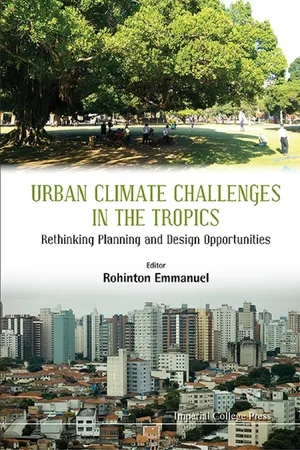
Among the places worst hit by climate change are areas of high urban growth in the warm, humid tropics of Asia and Latin America. In these places, the global trend of rapid urbanisation and conditions of local warming compound the effects of climate change.This three-part book explores the unique local climate consequences of urban growth trajectories of tropical cities and provides strategies and design approaches to enhance the quality of life of tropical urban dwellers in the face of urban warming. Part One considers the philosophical basis of the climate challenge in this context and investigates tropical urbanism from the viewpoints of urban activity patterns and the notion of 'thermal pleasure'. Part Two explores specific, practical techniques in enhancing ventilation, shading and greenery as well as the challenges in local climate assessment in the tropics. Part Three explores the barriers and future opportunities for climate-sensitive urban planning and presents specific examples of good practice, contextualized within the wider global debate on adapting to climate change. Urban Climate Challenges in the Tropics is an indispensable companion for planners, designers, architects and students of all levels.Contents:Introduction (Rohinton Emmanuel)Achieving Thermal Pleasure in Tropical Urban Outdoors (Rohinton Emmanuel)Management of Shading and Public Places (Tzu-Ping Lin)Urban Air Ventilation in High-Density Cities in the Tropics (Edward Ng)Vegetation and Climate-sensitive Public Places (Denise H S Duarte)Urban Thermal Comfort in the Tropics (Erik Johansson)Urban Climate Mapping in the Tropics Narein Perera)Urban Climate Modeling: Challenges in the Tropics (Renganathan Giridharan)Urban Exemplars of Climate-sensitive Design (Patricia Drach)Integration of Climate Knowledge in Urban Design and Planning (Gerald Mills)Readership: Planners, designers, architects and advanced undergraduate and graduate students of architecture or planning and environmental management with a focus on the tropics.Places the urban climate amelioration debate within the wider climate change debateFocuses specifically on an important and rapidly urbanizing region (the tropics)Provides practical advice to researchers and practitioners dealing with urban sustainability and climate sensitive design in the tropicsTropical Architecture; Urban Heat Island; Climate Change; Urban Sustainability; Thermal Comfort; Energy Efficiency Key Features:Places the urban climate amelioration debate within the wider climate change debateFocuses specifically on an important and rapidly urbanizing region (the tropics)Provides practical advice to researchers and practitioners dealing with urban sustainability and climate sensitive design in the tropics
eBook - ePub
Urban Climate Challenges In The Tropics: Rethinking Planning And Design Opportunities
Rethinking Planning and Design Opportunities
- 384 pages
- English
- ePUB (mobile friendly)
- Available on iOS & Android
eBook - ePub
Urban Climate Challenges In The Tropics: Rethinking Planning And Design Opportunities
Rethinking Planning and Design Opportunities
About this book
Information
Topic
ArchitectureSubtopic
Urban Planning & LandscapingChapter 1
Introduction
Rohinton Emmanuel
The developing world has seen an urban transformation dramatic even by the standards of our urbanized world today. Urban population in the developing world has overtaken that of the developed world in less than a generation. However, the urban challenges within this region remain diverse: managing the near-saturated urbanization in Latin America (the world’s most urbanized continent), rapid transformation into ‘metacities’ in Asia and the fastest rates of urbanization (albeit from a low base) in Africa. The urban growth in the tropics — much of it in the developing world — is particularly distinctive, from demographic, cultural and climatic points of view.
In parallel to the urban transformation (or because of it), the global climate is warming and the evidence is both unequivocal and unprecedented in recent times (i.e. decades to millennia, IPCC, 2014). While the general trend is towards a warmer climate, the regional variations are particularly problematic in the tropical regions. Irrespective of the future emission paths, South and Southeast Asia will experience unprecedented heat extremes while Central and Sub-Saharan Africa will experience extreme heat and drought even under a moderate (<2°C increase in global average temperature) global warming scenario (Schellnhuber et al., 2013). Low-altitude locations in South Asia can expect changes in temperature extremes that are generally consistent with broad-scale warming (Revadekar et al., 2013). Yan et al. (2002) showed a reduction of cold days in China over the 20th century while warm days have increased since 1961. In Central and Southern Asia, Klein et al. (2006) point out the increase in both the cold and warm tails of the distributions of daily minimum and maximum temperature between 1961 and 2000. Significant increases in the annual number of hot days and warm nights, and decreases in cold days and cold nights, were reported by Manton et al. (2001) and Griffiths et al. (2005) from Southeast Asia and the South Pacific. Additionally, increases in warm extremes were reported by Sheikh et al. (2015) across South Asia.
Much of the climate change risk is concentrated in urban areas. These include rising sea levels and storm surges, heat stress, extreme precipitation, inland and coastal flooding, landslides, drought, increased aridity, water scarcity and air pollution (Revi et al., 2014). Given the current level of urban growth and the concentration of populations involved, climate change will interact with the urban risks in a variety of ways, some of which will exacerbate the level of climate risk (IPCC, 2014). Furthermore, there are health inequalities, especially in developing cities, that are further exacerbated by urban warming (cf. Campbell-Lendrum and Corvalán, 2007).
However, research on the augmentation of climate change effects by local urban warming (characterized by urban heat islands) remains weak. Initially, even the Intergovernmental Panel on Climate Change (IPCC) overlooked the role of cities both as a forcing factor as well as a key stakeholder in managing climate change (Hebbert and Jankovic, 2013). Even when the role of cities in what is termed the ‘transformative adaptation’ is acknowledged (as in the IPCC’s 5th Assessment Report, cf. Revi et al., 2014), strategies to tackle local warming barely receive a mention. To be fair, a key difficulty in untangling the urban warming from global climate change is the computational and parametric challenges associated with representing urban areas in climate models (Jin et al., 2005; Grawe et al., 2013). Additionally, translating future climate change projections at finer spatial scales relevant to cities typically uses statistical downscaling techniques to global climate models without modeling the urban areas themselves (Lemonsu et al., 2013), a technique not without problems. Although the situation is continuing to improve (cf. Hebbert and Jankovic, 2013), much more still needs to be done to (a) ameliorate the urban heat island (UHI) effect and (b) use UHI mitigation as part of climate change adaptation (Emmanuel and Loconsole, 2015).
The amelioration of the heat island effect in the urban tropics is particularly weak on account of two facts. On the one hand, knowledge of tropical heat islands remains patchy and numerically weak (cf. Hung et al., 2006; Roth, 2007). On the other, the proliferation of strategies focusing on heating-only climates (or the dualmode heating-and-cooling-load climates) does not readily translate to cooling-only (or, soon-to-be cooling-only) regions.
Hence this book.
The premise of the book is that climate-sensitive design is a key enabler of climate change adaptation, especially in cities. This is particularly urgent in cities where the cooling load is the only or the principal design problem (i.e. the tropics). In the face of changing climate, climate-sensitive design in the tropics needs to recognize the limitations of naturally ventilated buildings (Ward et al., 2012), facilitate the linking of the ‘in’ and ‘out’ (Emmanuel, 2010), optimize both the ‘in’ and the ‘out’ (Ng and Yuan, 2012) and enable ‘situation-specific adaptive behavior’ of urban dwellers (cf. Rijal et al., 2012).
1.1Antecedents
We begin at the commons.
In his address at the 150th anniversary celebrations of the Royal Institute of British Architects in 1984, Illich (1992) put forward the following thesis:
It would be a mistake to limit the effects of dwelling to the shaping of the interiors: what lies outside one’s front door is as much shaped by dwelling, albeit in a different way. Inhabited land lies on both sides of the threshold; the threshold is like the pivot of the space that dwelling creates. On this side is home, and on the other lies the commons: the space that households inhabit is common. . . One demonstration of the destruction of commons is the degree to which our world has become uninhabitable. As the number of people increases, paradoxically we render the environment uninhabitable. (pp. 59–60)
It is this threshold that acts as the linchpin linking the ‘in’ and ‘out.’
The tradition of sharing exterior space — what Illich called the commons — is very strong in the tropics. “It takes time for the immigrant [from the tropics to the USA] to recognize that highways are neither streets nor paths but resources reserved for transportation. . . Many Puerto Ricans who arrive in New York need years to discover that sidewalks are not part of a plaza” (Illich, 1992: 59–60). If each citizen in the tropics is to be housed in ‘comfort’, as defined by a narrow range of environmental parameters, the cost in terms of energy use, urban sprawl and related ecological impacts will be enormous and, for these mostly economically poor nations, impossible to afford. Only by a careful design of the spaces around buildings to make them comfortable can designers and planners ever hope to achieve a reasonable way of dwelling in the densely populated parts of the tropics.
The ways people use the commons is conditioned by the climate and by traditions of the particular culture, for, as Illich says, “just as no two communities have the same style of dwelling, none can have the same commons” (Illich, 1992: 59). The tropical urban design challenge is to facilitate the use of commons in ways that are contextually appropriate.
Although the general causes of urban climate are the same across the world, the planning and building responses need not be; however, scholars and practitioners usually assume that strategies developed for temperate regions will work for the tropics as well. A review of literature related to urban design in the tropics (which, by the way, is scant) suggests a number of assumptions that need to be re-examined. For example, Givoni (1989), typical of many authors in this field, assumes the following:
- higher humidities in the tropics warrant design for higher wind movement to be the design priority;
- thermal comfort in the tropics depends more on air movement than on the reduction of solar radiation;
- night-time cooling occurs in the tropics.
This book is replete with examples of the fallacy of these statements. As long as radiation levels remain low, higher relative humidities and lower air movements are well within the thermal comfort range of most people in the tropics. The presence of dense vegetation makes green areas of tropical cities the best location in terms of thermal comfort, even if air movement is severely restricted. What is frustrating is that this was known from the very early days of heat island studies in the tropics, yet the ventilation-only fallacy remains. For example, one of the earliest heat island studies in Singapore — using the temperature–humidity index (THI) — found that when buildings are constructed of concrete and exposed to the elements, even the presence of very high wind movement does not provide thermal comfort. When they are shaded and surrounded by vegetation, comfort levels rise, despite the absence of high wind movement (Greenwood and Hill, 1968).
The principal climate variables altered by urban design are radiation and wind pattern; urban design in the tropics should take radiation control as the primary climatic design strategy. This too was implicit in tropical UHI studies from the beginning. Nieuwolt (1986), for example, shows that even at ‘medium’ air temperatures (30–35°C), natural ventilation becomes less effective as a thermal comfort strategy. Carmona (1986) concluded that in the urban tropics shading and heat avoidance in general have at least an equal effect on thermal comfort as natural ventilation.
Yet, urban heat amelioration continues to be shoehorned into conventional design and planning strategies. And, there are historical reasons for this persistence.
1.2Climate and Tropical Design — a (Very) Short History of Misalignment
Before we embark on the appropriate strategies for climate-sensitive design in the urban tropics and the practicalities of conceiving and testing them, it is important to acknowledge how we got here. There are historical reasons for this and, lessons for future directions.
It is rather unfortunate that Europeans’ early encounter with tropical climate coincided with a period when the miasmic theory of disease held sway in Europe. The miasmic theory held that miasma (bad air) is the cause of diseases such as cholera. Chang and King (2011) say thus:
Based on miasmic theory, it was reasoned that the hotter and more humid the climate, the faster the rate of putrefaction and, hence, the greater quantity of miasma. Taking England’s climate as the norm, that of the Mediterranean stations occupied ‘an intermediate position between England and those of the tropics: generally warm, at times depressing and variable, but not necessarily unhealthy to healthy people’ (BHIC, 1863: A1). With regard to India, the tropical climate there was assumed to be ‘hostile to human life, and to be especially deadly to the English race’ (RCSSAI, 1863: xxxi). This basic threefold categorization, to be later summarized into a distinction between ‘home’, ‘subtropical’ and ‘tropical’, becomes a significant marker in the development of the episteme on tropical architecture. (p. 289)
The miasmic theory led to a view of tropical climate as ‘inherently unhealthy’ even into the late 19th and early 20th centuries, despite the growing evidence of the microbial origins of many tropical diseases (Adamson, 2012).
However, even as the tropics were seen as ‘unhealthy’ or even ‘dangerous’, there was also the formulation that it was paradise. Ironically, this formulation of opposing tropes of danger and...
Table of contents
- Cover Page
- Title
- Copyright
- Contents
- Acknowledgments
- Author Affiliations
- 1. Introduction
- 2. Achieving thermal pleasure in tropical urban outdoors
- 3. Management of shading and public places
- 4. Urban air ventilation in high-density cities in the tropics
- 5. Vegetation and climate-sensitive public places
- 6. Urban thermal comfort in the tropics
- 7. Urban climate mapping in the tropics
- 8. Urban climate modeling: challenges in the tropics
- 9. Urban exemplars of climate-sensitive design
- 10. Integration of climate knowledge in urban design and planning
- Index
Trusted by 375,005 students
Access to over 1.5 million titles for a fair monthly price.
Study more efficiently using our study tools.
Frequently asked questions
Yes, you can cancel anytime from the Subscription tab in your account settings on the Perlego website. Your subscription will stay active until the end of your current billing period. Learn how to cancel your subscription
No, books cannot be downloaded as external files, such as PDFs, for use outside of Perlego. However, you can download books within the Perlego app for offline reading on mobile or tablet. Learn how to download books offline
Perlego offers two plans: Essential and Complete
- Essential is ideal for learners and professionals who enjoy exploring a wide range of subjects. Access the Essential Library with 800,000+ trusted titles and best-sellers across business, personal growth, and the humanities. Includes unlimited reading time and Standard Read Aloud voice.
- Complete: Perfect for advanced learners and researchers needing full, unrestricted access. Unlock 1.5M+ books across hundreds of subjects, including academic and specialized titles. The Complete Plan also includes advanced features like Premium Read Aloud and Research Assistant.
We are an online textbook subscription service, where you can get access to an entire online library for less than the price of a single book per month. With over 1.5 million books across 990+ topics, we’ve got you covered! Learn about our mission
Look out for the read-aloud symbol on your next book to see if you can listen to it. The read-aloud tool reads text aloud for you, highlighting the text as it is being read. You can pause it, speed it up and slow it down. Learn more about Read Aloud
Yes! You can use the Perlego app on both iOS and Android devices to read anytime, anywhere — even offline. Perfect for commutes or when you’re on the go.
Please note we cannot support devices running on iOS 13 and Android 7 or earlier. Learn more about using the app
Please note we cannot support devices running on iOS 13 and Android 7 or earlier. Learn more about using the app
Yes, you can access Urban Climate Challenges In The Tropics: Rethinking Planning And Design Opportunities by Rohinton Emmanuel in PDF and/or ePUB format, as well as other popular books in Architecture & Urban Planning & Landscaping. We have over 1.5 million books available in our catalogue for you to explore.