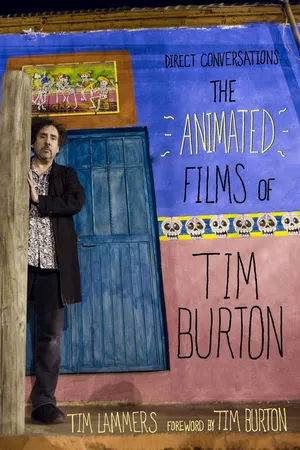
Throughout his career, movie journalist Tim Lammers has talked with director Tim Burton and the key players who helped bring the stop-motion films The Nightmare Before Christmas, Corpse Bride, and Frankenweenie to life. Now for the first time, Lammers has assembled the stories from Burton and his band of creatives all in one place. In Direct Conversations: The Animated Films of Tim Burton, you will not only hear from Burton, but Danny Elfman, Chris Sarandon, Allison Abbate, Martin Landau, Elijah Wood, Atticus Shaffer, Helena Bonham Carter, Alan Rickman, the late Ray Harryhausen, and more. The release of Direct Conversations: The Animated Films of Tim Burton comes as the 1993 classic The Nightmare Before Christmas celebrates its 20th anniversary. Direct Conversations: The Animated Films of Tim Burton also includes a foreword by Tim Burton.
eBook - ePub
Direct Conversations: The Animated Films of Tim Burton (Foreword by Tim Burton)
- 55 pages
- English
- ePUB (mobile friendly)
- Available on iOS & Android
eBook - ePub
Direct Conversations: The Animated Films of Tim Burton (Foreword by Tim Burton)
About this book
Information
Subtopic
Film & VideoChapter One: The Girl with Blue Hair
The time was February 2006, when after various inquiries over the years, I finally landed an interview with Tim Burton. While not completely press shy, the filmmaker—easily one of most influential artists of our times—is hard to pin down, unless you can catch him somewhere in the press gauntlet before his films are released. Even when he's nominated for an Oscar, like he was for directing two of his stop-motion films, the opportunities are few.
But this time around, thanks to a dear friend of mine at Warner Bros., the time had come. Burton was doing a few press calls to talk about Corpse Bride—technically his first turn as a director of a stop-motion feature, even though his influences were all over the Henry Selick-helmed The Nightmare Before Christmas thirteen years earlier. A beautifully staged Gothic romantic tale co-directed by Burton and filmmaker Mike Johnson, Corpse Bride was up for a Best Animated Feature Oscar.
The wonderful thing I immediately sensed while talking with Burton was that he wasn't feigning any modesty. He never once said "it's just an honor to be nominated," nor was he serving up any thoughtless sound bites to pass the time. That's because Corpse Bride, like all of Burton's films, clearly has deep meaning to him. Making the film wasn't about being nominated or winning awards but putting forth the possibility that it would somehow resonate with viewers on an emotional level.
For me, the impact of Corpse Bride had everything to do with my then ten-year-old daughter, Cleo, who was sparked with an idea as our family screened the film in September 2005. Cleo was so taken by the beauty of the Corpse Bride that she made a commitment to dress up as the doomed lady-in-waiting for Halloween 2006 (she’d already settled on a costume for the following month).
So, thrilled knowing what the film meant to my daughter, the word of her plans was how I kicked off my first conversation with Tim Burton.
"See, that's amazing to me. I love hearing those kinds of stories because they are coming from people's hearts instead of some other place," Burton told me with a humble sense of appreciation, before adding with a laugh, "As long as she doesn't get permanent blue hair she'll be okay."
Apart from the satisfaction of knowing the impact his work had on viewers, Burton said if he felt anything about the Oscar nomination it was a validation of sorts that the teetering art of stop-motion animation would live to see another day. He hoped—just hoped—that the nomination and the recognition it brought to stop-motion would inspire more artists to get into the field instead of taking the route into the ever-burgeoning field of computer animation.
"That's why it took so long between Nightmare and this film—finding the right group of people and getting the right group of animators together," Burton recalled of the thirteen-year stretch between the production of Nightmare and Corpse Bride. "A lot of the people who did stop-motion went off into the computer field. They're getting more and more rare, so it was really nice that there was some recognition of this type of medium because it throws it a lifeline a little bit and makes it more possible for a few more stop-motion projects."
The miracle of Corpse Bride was that it was made in part because The Nightmare Before Christmas wasn't exactly a blockbuster hit out of the gate when it debuted on October 29, 1993.
Thankfully, the nineties was still in the era where films weren't left for dead after a week or two by studios because they didn't debut at the top of the box office (a discussion for another day—how films are measured in the media by how much cash they rake in during opening weekend and not artistic value, no matter the disproportionate numbers of the screens they open on). Instead Nightmare was released in a time where it gained just enough momentum to develop a cult following.
In fact, the film's following, spurred by the film's merchandising of hero and heroine of the film, Jack Skellington and Sally, along with a plethora of other characters, essentially made Corpse Bride an easier sell.
"The thing about both this and Nightmare was that they weren't large-budgeted films to begin with, so that always makes it a bit easier to get done. Nightmare had sort of a strange effect. It was semi-well received when it came out. It did okay but is a movie that has gotten more of a life as it has gone on," Burton explained.
"So, what really wasn't necessarily a major success sort of had the perception of being successful a few years later, which I think made it a little easier for Corpse Bride. It did have an impact—and I'll take what I can get," Burton added with a laugh.
Burton has often been labeled as "quirky" over the years, and given the exteriors of his original characters it's easy to see why. Whether it be Edward Scissorhands, Ed Wood or Victor Van Dort, or new takes on existing creations such as Willy Wonka, Sweeney Todd, and Barnabas Collins, the characters in Burton's films definitely march to the beat of their different drummer, most often lockstep with Burton's frequent collaborator, Johnny Depp.
But while Burton's characters stand a band apart and their looks are unique, the filmmaker is not indifferent to what his characters, and ultimately, all human beings, feel inside: the incontrovertible sense of isolation and loneliness, the longing for acceptance, and, in the case of Corpse Bride, the yearning for love in the wake of an event turned tragic. The difference with the film, of course, is that the love in question involves one person who's alive and another who's dead.
Essentially, Corpse Bride epitomizes why Burton's films are so unique: The atmosphere is fantastical in nature yet doesn't feel the need to be rifling off eye-popping effects every waking second to keep our attention. It manages to entertain, to be sure, and also has the ability to hit viewers on a deeper level.
"One of the things that we felt that we wanted to do different than most animated films was to give it a different pace—a slightly slower pace and try to make it more romantic—and give as much real feeling of emotional weight as we could in the characters," Burton said of Corpse Bride. "That was a goal we had and I think the stop-motion medium supports that."
An artist with a fascination in the macabre since a kid growing up in suburban Burbank, California, Burton, like many boys who came of age in the 1950s and '60s, became obsessed with classic horror movies. Whether it was the Frankenstein films of Universal Monster Movie lore or the creature features from London's famed Hammer House of Horror in the 1950s, '60's and '70s, the atmosphere of those films—and sometimes, even the actors—would one day become instrumental in Burton's works, perhaps most prominently in the stop-motion version of Frankenweenie.
It's easy to see why the films influenced Burton: Unlike the slasher-types that pervaded cinema like The Texas Chainsaw Massacre's Leatherface, A Nightmare on Elm Street's Freddy Kruger, or Jason from the Friday the 13th chapters, the movie monsters of yesteryear had emotion, which effectively created depth and weight. Especially Frankenstein's monster or Larry Talbot—a.k.a. the Wolf Man. The characters weren't so much monsters as they were creatures who were misunderstood; a through line, not surprisingly, that has run prominently through most of Burton's films, such as Edward Scissorhands....
Table of contents
- eBook Cover
- Title Page
- Foreword
- Chapter One: The Girl with Blue Hair
- Chapter Two: This Is Halloween
- Chapter Three: A New World View
- Chapter Four: Here Comes the Corpse
- Chapter Five: Empty Sockets
- Chapter Six: Alive Again
- Chapter Seven: All in the Family
- Chapter Eight: Inside the Laboratory
- Chapter Nine: No Compromise
- Chapter Ten: Animation Preservation
- Chapter Eleven: Being Tim Burton
- About the author
- Acknowledgments
- Bibliography
- Tim Lammers Q & A
Trusted by 375,005 students
Access to over 1.5 million titles for a fair monthly price.
Study more efficiently using our study tools.
Frequently asked questions
Yes, you can cancel anytime from the Subscription tab in your account settings on the Perlego website. Your subscription will stay active until the end of your current billing period. Learn how to cancel your subscription
No, books cannot be downloaded as external files, such as PDFs, for use outside of Perlego. However, you can download books within the Perlego app for offline reading on mobile or tablet. Learn how to download books offline
Perlego offers two plans: Essential and Complete
- Essential is ideal for learners and professionals who enjoy exploring a wide range of subjects. Access the Essential Library with 800,000+ trusted titles and best-sellers across business, personal growth, and the humanities. Includes unlimited reading time and Standard Read Aloud voice.
- Complete: Perfect for advanced learners and researchers needing full, unrestricted access. Unlock 1.5M+ books across hundreds of subjects, including academic and specialized titles. The Complete Plan also includes advanced features like Premium Read Aloud and Research Assistant.
We are an online textbook subscription service, where you can get access to an entire online library for less than the price of a single book per month. With over 1.5 million books across 990+ topics, we’ve got you covered! Learn about our mission
Look out for the read-aloud symbol on your next book to see if you can listen to it. The read-aloud tool reads text aloud for you, highlighting the text as it is being read. You can pause it, speed it up and slow it down. Learn more about Read Aloud
Yes! You can use the Perlego app on both iOS and Android devices to read anytime, anywhere — even offline. Perfect for commutes or when you’re on the go.
Please note we cannot support devices running on iOS 13 and Android 7 or earlier. Learn more about using the app
Please note we cannot support devices running on iOS 13 and Android 7 or earlier. Learn more about using the app
Yes, you can access Direct Conversations: The Animated Films of Tim Burton (Foreword by Tim Burton) by Tim Lammers in PDF and/or ePUB format, as well as other popular books in Media & Performing Arts & Film & Video. We have over 1.5 million books available in our catalogue for you to explore.